
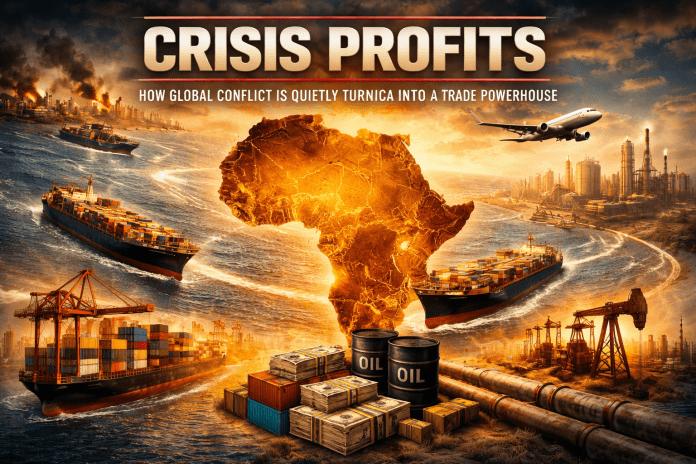
When global superpowers clash, Africa is usually cast as a bystander, occasionally a victim. This time, the script has flipped. As conflict in the Middle East disrupts global trade routes, parts of Africa are stepping into an unexpected role, not just surviving the shock, but benefiting from it.
The numbers tell the story.
Shipping through traditional routes has collapsed. Traffic through the Suez Canal, one of the world’s most critical trade arteries, has dropped sharply, with some estimates showing declines of up to 90% as vessels avoid the Red Sea due to security risks. At the same time, the Strait of Hormuz, which carries about 20% of the world’s oil, has seen vessel traffic fall by as much as 80%, disrupting energy and cargo flows globally.
When these arteries clog, the global economy doesn’t pause. It reroutes.

And increasingly, it reroutes through Africa.
Ships that once passed through the Suez Canal are now sailing around the Cape of Good Hope, adding roughly 3,700 miles and up to 10–14 days to journeys between Asia and Europe. That delay comes at a cost. Freight rates have surged, in some cases rising several-fold, as shipping companies factor in longer distances, fuel costs, and war-risk insurance.
This disruption has created an opportunity.
In Lamu Port, vessel traffic is surging as shipping lines divert away from high-risk Middle Eastern routes. What was once seen as an underutilized project is quickly becoming a strategic asset. Nearby, the Port of Mombasa is also experiencing pressure and increased relevance as cargo flows shift.
Across the continent, similar patterns are emerging. Ports in Southern Africa are handling rerouted traffic, while refuelling hubs like Walvis Bay are seeing increased demand as ships take longer routes around the continent.
A rush for natural resources: The modern global contest for real value
In the air, the shift is just as dramatic. With Middle Eastern airspace increasingly volatile, African hubs are stepping in. Cities like Nairobi and Addis Ababa are becoming critical transit points for high-value goods, cutting down reliance on disrupted sea routes.
Meanwhile, oil-producing nations such as Nigeria are benefiting from rising crude prices, which have surged to around $120 per barrel in recent months, significantly above budget expectations. This has translated into stronger revenues and short-term fiscal relief.
But the gains are not evenly distributed.
The same crisis boosting logistics and energy revenues is also driving up costs. Fertilizer, fuel, and food imports have become more expensive, placing pressure on households and governments across Africa. Supply chains remain fragile, and delays in imports are already pushing up the cost of living in several countries.
So while Africa is gaining relevance, it is also absorbing risk.
Still, there is a strategic lesson here. For years, African infrastructure projects were dismissed as overambitious or underutilized. Now, under global pressure, they are proving their value. Ports, corridors, and logistics hubs that once sat idle are becoming critical alternatives in a disrupted world.
It is a reminder that geography matters, but timing matters more.
Africa did not plan for this crisis. But it is adapting to it fast. And in doing so, it is quietly repositioning itself from the sidelines of global trade to somewhere much closer to the center.
Not bad for a continent often underestimated, until the world suddenly needs a backup plan.
Small estate malls are redefining Kenya’s retail landscape
About the Author
Mulumi Mwangi is a seasoned businessman with more than five decades of life experience, bringing a rare depth of perspective to both enterprise and writing. Trained as an electrical engineer, he has founded, built, and managed ventures across diverse sectors, including advertising, marketing, agribusiness, real estate, and fintech.
His writing is firmly grounded in lived experience. It draws from family life as a father, husband, brother, and uncle; from public life through his service as a political party official; and from the hard lessons of business, both failure and success. These experiences, combined with everyday social interactions, have shaped a reflective and pragmatic worldview.
Mulumi’s work is offered as a personal perspective rather than a prescription. His views are candid, experience-driven, and open to debate—acknowledging that insight is often refined through dialogue, reflection, and the humility to accept that one may be right or wrong.
Contact: [email protected]