

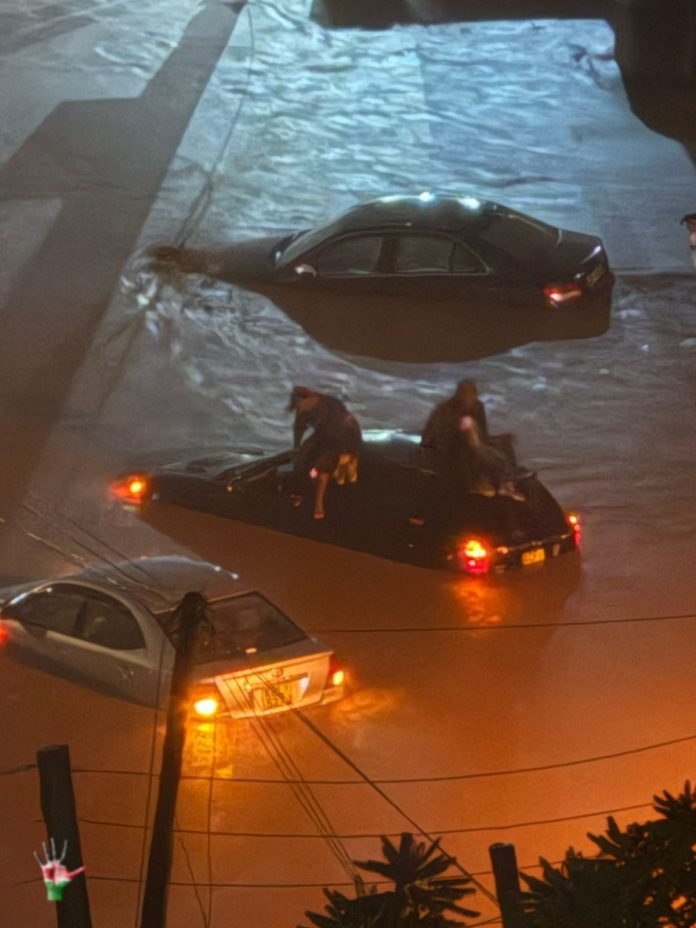
When Nairobi floods, the default reaction is almost scripted: blame the rain, blame City Hall, blame “poor planning.” All fair points. But also conveniently incomplete. The city is not just overwhelmed by water. It is overwhelmed by behaviour.
Start with the numbers. Nairobi generates over 2,400 tonnes of solid waste every day, yet less than half is properly collected. The rest ends up where it should never be, clogging drainage channels, filling rivers, and quietly setting the stage for the next flood. When heavy rains arrive, blocked systems do exactly what physics demands. They fail.
Yes, rainfall intensity has increased. Yes, drainage infrastructure is outdated and often poorly maintained. But walk alongside county workers clearing blocked waterways, and the truth becomes uncomfortably obvious. The problem is not hidden underground. It is sitting right there in plain sight.

Supermarket shopping bags, Coffee cups, water bottles, maize combs, banana peels, etc.
The Kenyan mirror: why corruption isn’t just a leadership problem
Our waste is carefully delivered into systems that were never meant to carry it.
When county tractors open drainage lines, they are not solving complex engineering failures. They are digging out daily habits, compressed into a public crisis.
There is also a strange contradiction at play. The county government has installed litter bins across estates and along major streets. In theory, that is a functioning waste disposal system. In reality, it is common to find those bins half-empty while a fresh pile of garbage forms just a few meters away, as if convenience has been redefined to mean “drop it wherever you feel like.”
Take a walk through the CBD. You will find well-marked bins, neatly lined with black polythene bags, ready for use. Yet, people still drop bottles and cups exactly where they finish using them, even when a bin is within reach. Apparently, the extra five steps are where civic responsibility goes to die.
Former Nairobi Governor Mike Sonko once pointed out that Nairobians are remarkably consistent when it comes to littering. Not the kind of reputation anyone should be proud of, but accurate nonetheless.
And the issue extends beyond littering; full-grown adults urinating on walls is still a common sight, largely because the penalties are weak and enforcement even weaker. When consequences are soft, behaviour hardens.
In 1970, Japan’s Waste Management and Public Cleansing Law criminalised littering, backed by consistent enforcement. In Dubai, littering fines start at around AED 500, roughly KSh 17,000; in Rwanda, penalties can escalate to fines or even imprisonment.
And here’s the part people like to romanticise: when you see Japanese citizens carrying small sling bags to hold their litter, it is not just culture or discipline magically appearing; it is the outcome of strict laws, consistent enforcement, and years of conditioning. Over time, it becomes so ingrained in society that it looks like a natural habit, almost a custom. It isn’t accidental. It is engineered behaviour.
Crisis Profits – How global conflict is quietly turning Africa into a trade powerhouse
Humans respond to incentives and consequences. Remove the consequences, and rules become optional. In Nairobi, the cost of littering is so low that the behaviour thrives. Add weak enforcement and the occasional workaround through bribery, and the system practically rewards indiscipline.
Children grow up watching this. What they see becomes normal, and what becomes normal becomes difficult to undo.
None of this absolves authorities. Nairobi needs better drainage systems, stronger waste management, and serious urban planning. But there is a baseline responsibility that cannot be outsourced.
Before pointing fingers at blocked sewers and slow government response, there is a simpler question to confront: how do we manage our own waste?
Flooding is not just about rain; it is about flow, and when that flow is obstructed by what we casually throw away, the outcome is inevitable.
Nairobi does not just need better infrastructure. It needs better behaviour, reinforced by real consequences. Until then, the city will keep relearning the same lesson every rainy season, just with deeper water and higher frustration.
About the author
Mulumi Mwangi is a seasoned businessman with more than five decades of life experience, bringing a rare depth of perspective to both enterprise and writing. Trained as an electrical engineer, he has founded, built, and managed ventures across diverse sectors, including advertising, marketing, agribusiness, real estate, and fintech.
His writing is firmly grounded in lived experience. It draws from family life as a father, husband, brother, and uncle; from public life through his service as a national political party official; and from the hard lessons of business, both failure and success. These experiences, combined with everyday social interactions, have shaped a reflective and pragmatic worldview.
Mulumi’s work is offered as a personal perspective rather than a prescription. His views are candid, experience-driven, and open to debate—acknowledging that insight is often refined through dialogue, reflection, and the humility to accept that one may be right or wrong.