

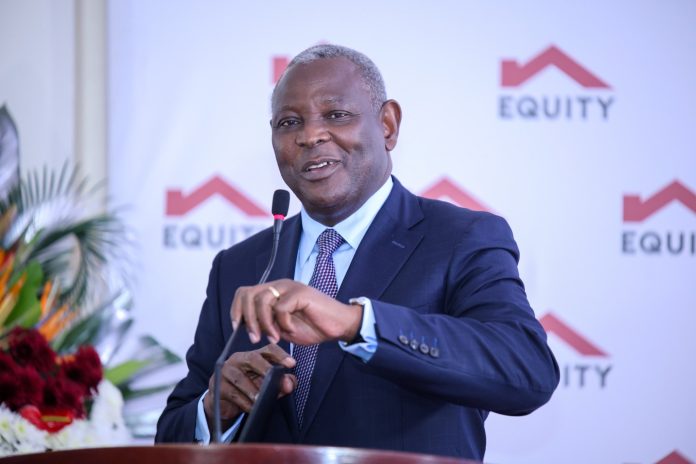
The signs were there that the 2025 financial year was going to be record breaking for Equity Group. It was the year that Equity would grab the esteemed position of most profitable bank in East and Central Africa.
Well, it all started in the first three months of the year when the banking group returned a net profit of Sh15.4 billion. In this quarter, there was growth in customer deposits which hit Sh1.32 trillion and total assets which closed at Sh1.75 trillion.
Barely two months earlier, the banking group had announced Sh48.8 billion net profit for the full financial year of 2024. This profit had represented a growth of 11.6 percent. It also meant that on average, the bank could have been assumed to have made at least Sh12.2 billion per quarter throughout 2024.

“Equity remains resilient and focused on delivering value to all our stakeholders. We are strongly positioned across all our subsidiaries. As we continue our transformation journey, we see significant opportunities for sustained growth. We are a global brand, one of the strongest, not just in valuation but also in global rankings,” said Dr James Mwangi, the Group managing Director and Chief Executive Officer.
“Our financial strength gives us the flexibility to seize opportunities as the regional economy presents diversified levers for growth. Our liquidity and capital position remains strong, positioning us to better support our customers in the years to ahead.”
By the time local banking institutions entered the second half of 2025, Equity Group had moved to the position of the most profit banking group in the region.
An analysis of financial results for the first six months of the 2025 financial year by Bizna Kenya shows that Equity Group recorded a net profit of Sh34.6 billion in the half-year period. This net profit represented a gain of 17 percent and was derived from a pre-tax profit of Sh41.5 billion. In contrast, its closest rival returned a net profit of Sh31.5 billion which was a growth of 7.9 percent.
In the six-month period under review, Equity’s regional subsidiaries contributed 49 percent of all deposits, 50 percent of the loan book, 48 percent of the total assets, 50 percent of revenue, and 46 percent of the profit before tax.
According to financial analyst Jefferson Ndunge, pointers were showing that Equity was headed for a record performance year. “The fact that Equity Group had managed to establish a lead of Sh3 billion in net profit with recorded growth in all primarily areas was the start of the profitability trajectory that would dominate the rest of the financial year,” says Ndunge.
This reflected in the third quarter of the year when once again, Equity Group emerged as the most profitable banking entity in the region. During this period, the bank returned a net profit of Sh54.1 billion net profit for the first nine months of the year while its closest rival returned a Sh47.6 billion net profit in the same period.
The profit returned by Equity within nine months was 10.86 percent more than the net profit the bank had returned the whole of year 2024. This means that in nine months, Equity Group had made Sh5.3 billion more than the Sh48.8 billion it had made the whole of 2024.
Equity’s net profit from banking alone came in at Sh53.3 billion. This represented a year-on-year growth of 37 percent. Among Equity’s subsidiaries, Equity Bank Kenya led in profitability after contributing 58.3 percent of the total group’s profit.
Customer deposits at Equity Group closed the nine-month period at Sh1.34 trillion while disbursed loans increased by 7.5 percent to Sh859 .8 billion. Total assets in the period increased by 6.7 percent to Sh1.8 trillion year-on-year.
James Mwangi joins Nelson Mandela, Bill Gates club with the most respected global award
The Kenyan unit returned a year-on-year growth of 51 percent and a net profit of Sh31.1 billion. In the same period the previous year, Equity Bank Kenya had returned a net profit of Sh20.6 billion. At the same time, Equity Bank Kenya’s cost-to-income ration decreased from 61 percent to 47 percent in the third quarter of 2025.
DR Congo came in second with a 21 percent year on year growth to Sh13.8 billion net profit. This unit contributed 25.9 percent of the total profit. Rwanda came in third with a year-on-year growth of 5 percent at Sh4 billion net profit which was equivalent to 7.5 percent of the total net profit for the group in the nine-month period.
Uganda and Tanzania returned Sh2.9 billion and Sh1.5 billion respectively in the period under review. The Ugandan unit had a 61 percent year on year growth while the Tanzanian unit had an 88 percent year on year growth.
According to Dr Mwangi, Rwanda was the most efficient subsidiary in the period despite coming third in profit contribution. The subsidiaries in the region were larger than the Kenyan unit in deposits and loans.
Most profitable bank in East and Central Africa
But the real statement was made when the banking sector in Kenya released financial results for the full year 2025.
Equity’s full year 2025 net profit had risen to a record Sh75.5 billion. The highest by a banking institution in the East and Central Africa, and the highest by any listed business at the time. This net profit represented a 54.7 percent growth in profit. It was derived from a full year profit before tax of Sh90.8 billion which was a growth of 51.6 percent.
In that full year, Equity Group saw its total assets increase by 9.2 percent to Sh1.97 trillion from the previous year’s total of Sh1.8 trillion. Meanwhile, customer deposits grew by 4.2 percent to Sh1.46 trillion from the previous Sh1.4 trillion while loans to customers increased by 7.7 percent to Sh882.5 billion.
In full year 2024, total disbursed loans had stood at Sh819.2 billion. Net interest income increased by 17 percent to Sh126.9 billion while non-funded income increased by 7 percent to Sh90.8 billion.
The group’s regional operations accounted for about half of the total profitability that was recorded in the year under review. Equity BCDC grew its profitability by 58 percent while the group’s subsidiary in Uganda increased its profitability by 500 percent. In Tanzania, profitability growth was recorded at 125 percent.
Overall, the group’s subsidiaries accounted for 51 percent of the total banking profit before tax and 48 percent of the banking profit after tax.
“The 2025 performance reflected the success of our deliberate transformation into a diversified regional financial services group. We delivered strong profit growth by expanding and deepening our income streams, improving efficiency across the franchise, and strengthening the quality of our balance sheet,” said Dr Mwangi.