
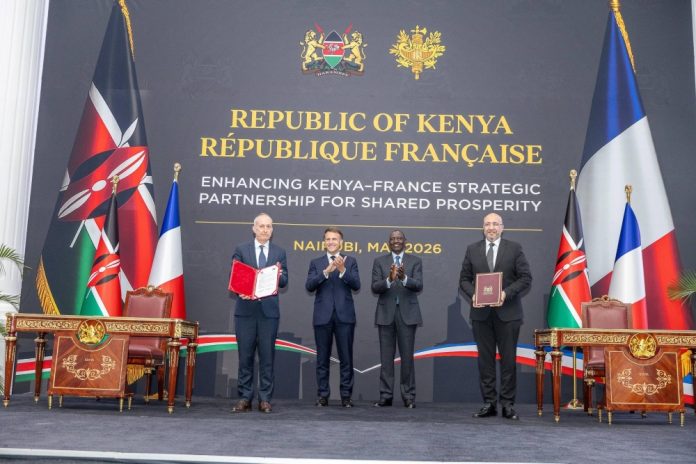
Kenya Airways (NSE: KQ) and Rubis Energy Kenya, a subsidiary of Rubis Énergie, signed a Memorandum of Understanding (MOU) to develop the first dedicated sustainable aviation fuel (SAF) refinery on the African continent.
The project, based in Nairobi, establishes a framework for the joint engineering, financing, and operation of a facility designed to produce low-carbon fuel from local waste feedstocks.
The agreement was finalized in the presence of His Excellency Dr. William Ruto, C.G.H., President of the Republic of Kenya, and His Excellency Mr. Emmanuel Macron, President of the French Republic.

As the two heads of state observed the signing during the Africa Forward Summit, the event marked a shift in regional industrial cooperation. For the first time, this summit was hosted in a non-Francophone nation, highlighting a shared intent between Kenya and France to accelerate investments in green energy and technology.
The refinery will utilize Dragonfly’s modular technology to process primary feedstocks, including used cooking oils, waste animal fats, and other vegetable oils. By locating the facility near Jomo Kenyatta International Airport (JKIA), the partnership aims to integrate production directly with existing infrastructure. The refinery is expected to have a production capacity of 32,000 tonnes, with a project investment estimated at €60–70M.
George Kamal, Acting Group Managing Director and CEO of Kenya Airways, stated that the project addresses the urgent need to decarbonize the aviation sector. “The expansion of air transport is linked to a growing share of global greenhouse gas emissions. Currently, Jomo Kenyatta International Airport consumes 2.9 million litres of jet fuel every day, an amount equal to filling the tanks of 52,727 family cars.”
RUBiS launches modern washrooms to enhance traveler experience
He said switching to SAF was the most commercially viable, technologically mature, and lowest-risk solution to significantly de-carbonise aviation in the world today. “While we currently depend entirely on imports, this refinery allows us to produce a sustainable, local version of that fuel. Sustainable, renewable biogenic fuel is the optimal route for airlines to reach the goal of the International Civil Aviation Organization (ICAO) to achieve net zero CO₂e emissions by 2050.”
Jean-Christian Bergeron, Co-Managing Partner of Rubis and CEO of Rubis Énergie, said the company’s involvement was consistent with Rubis Energie’s roadmap to deliver low-carbon energy solutions around the world, with a special focus on bringing meaningful opportunities to Africa.
“Our priority will be technology transfer and ensuring that training is provided for local skills development so that the facility, and associated supply chains, will be operated and managed by Kenyans. This focus on local skills aligns with the broader objectives of the Africa Forward Summit to create meaningful economic opportunities through international partnerships.”
Dragonfly, the company Rubis has partnered with to provide modular SAF refineries, is founded on bringing existing technologies to market quicker than any other SAF refinery in the world, with a smaller and lower financial and carbon footprint. Dragonfly intends to bring the facility online within 24 months.
Karl W. Feilder, CEO of Dragonfly, said, “The critical advantage of this project is that a Dragonfly refinery can be sited close to both the feedstock and the consumers of the fuel, and utilise the existing Rubis infrastructure to provide a long-term daily supply of SAF to Kenya Airways at Jomo Kenyatta International Airport.”