

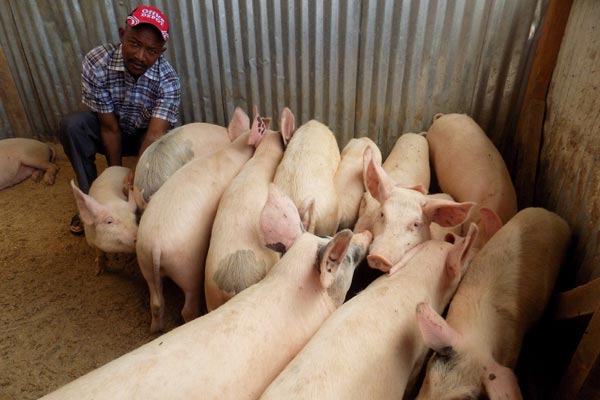
Pig farming is increasingly emerging as one of the most lucrative livestock ventures for smallholder farmers in Kenya, offering quicker returns, high reproduction rates and growing market demand compared to many traditional farming activities.
As erratic weather patterns continue to affect crop farming, many rural households are turning to pig rearing as a dependable source of income and financial stability.
In the rolling hills of Meteitei village in Tinderet Sub-county, 42-year-old David Kiprono is among the farmers who have successfully transformed their livelihoods through pig farming.

What began as a modest venture with only two pigs in 2019 has steadily grown into a thriving agribusiness that now supports his family and inspires other farmers in the region to reconsider conventional farming practices.
“At the time, maize farming was no longer reliable because of erratic rainfall. I needed an enterprise that could generate returns within a short period,” Kiprono says.
Over the last five years, his pig enterprise has expanded to 18 pigs, including four sows and one boar managed under a semi-intensive production system.
Each sow produces between eight and 12 piglets per litter, with two litters annually, giving him an estimated output of between 64 and 96 piglets every year.
Unlike cattle farming, which often requires vast tracts of land and takes years before generating substantial returns, pig farming offers faster growth and quicker income cycles.
Pigs mature rapidly, reproduce in large numbers and can be raised successfully even on relatively small parcels of land, making the venture attractive to smallholder farmers with limited resources.
Kiprono sells his pigs at an average live weight of between 50 and 60 kilogrammes, earning between Sh20,000 and Sh24,000 per animal depending on prevailing market prices.
In 2025 alone, he sold 52 pigs, generating approximately Sh1.4 million in gross revenue.
“After deducting feed and veterinary expenses, I remained with a net profit of about Sh420,000,” he says. “That is much better than what I used to make from maize farming on the same piece of land.”
The growing demand for pork has further strengthened the profitability of the venture. Kiprono says traders now visit his farm directly to purchase pigs, reducing transportation costs and market uncertainties.
“Sometimes I do not even need to transport the pigs because buyers come straight to the farm,” he explains.
Pork consumption has continued to rise in urban centres, hotels and processing industries, creating a ready market for farmers.
For Kiprono, the venture has become more than just a source of income. Proceeds from pig farming have enabled him to educate his three children, improve his family’s living standards and diversify his investments.
“I have built a permanent house and installed a water tank using income from pigs,” he says. “I am now planning to venture into dairy farming as well.”
Another advantage of pig farming is the efficient feed conversion ratio. Pigs convert feed into body weight faster than many livestock species, allowing farmers to realise profits within a shorter production cycle.
In addition, pig manure can be used to improve soil fertility and support crop farming, creating an integrated farming system. However, despite the promising returns, pig farming also presents significant challenges.
The high cost of feed remains one of the biggest obstacles facing farmers, often consuming the largest share of production expenses.
“To raise one pig to market weight requires a substantial amount of feed,” Kiprono explains. “When feed prices increase, profits reduce significantly.”
Disease outbreaks also pose serious risks to farmers. African Swine Fever, in particular, remains one of the most devastating diseases affecting pig production and can wipe out entire herds if proper biosecurity measures are not observed.
Kiprono recalls losing six pigs to disease in 2021, a setback that forced him to adopt stricter hygiene practices and improve vaccination schedules.
“We learnt through experience,” he says. “Since then, I have improved sanitation and disease control measures.”
Limited access to veterinary services and quality breeding stock continues to hinder many smallholder pig farmers, especially in rural areas.
Farmers also face price fluctuations and exploitation by brokers due to the absence of structured markets and formal supply contracts.
Nevertheless, Kiprono remains optimistic about the future of the enterprise and hopes to expand his herd to 50 pigs within the next two years.
“Pig farming has completely changed my life,” he says. “I believe many more farmers can benefit from it if they embrace it seriously.”
Also Read: Guardian Angel: Why I chose to do pig farming despite successful music career