

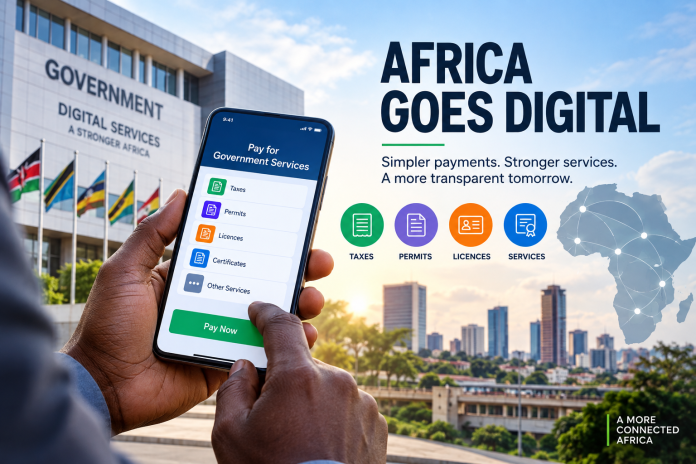
For much of the past two decades, Africa’s digital payments story was told through mobile money, where phones gave millions of people a practical way to send, receive and store money without depending entirely on bank branches.
That story is still growing, but governments across the continent are now taking the next step by moving taxes, permits, licences, public services and other payments away from cash, paper receipts and disconnected offices.
The change matters for a simple reason, since collecting money is only one part of the problem when governments still struggle to match a payment to the right service, account, institution and transaction record.

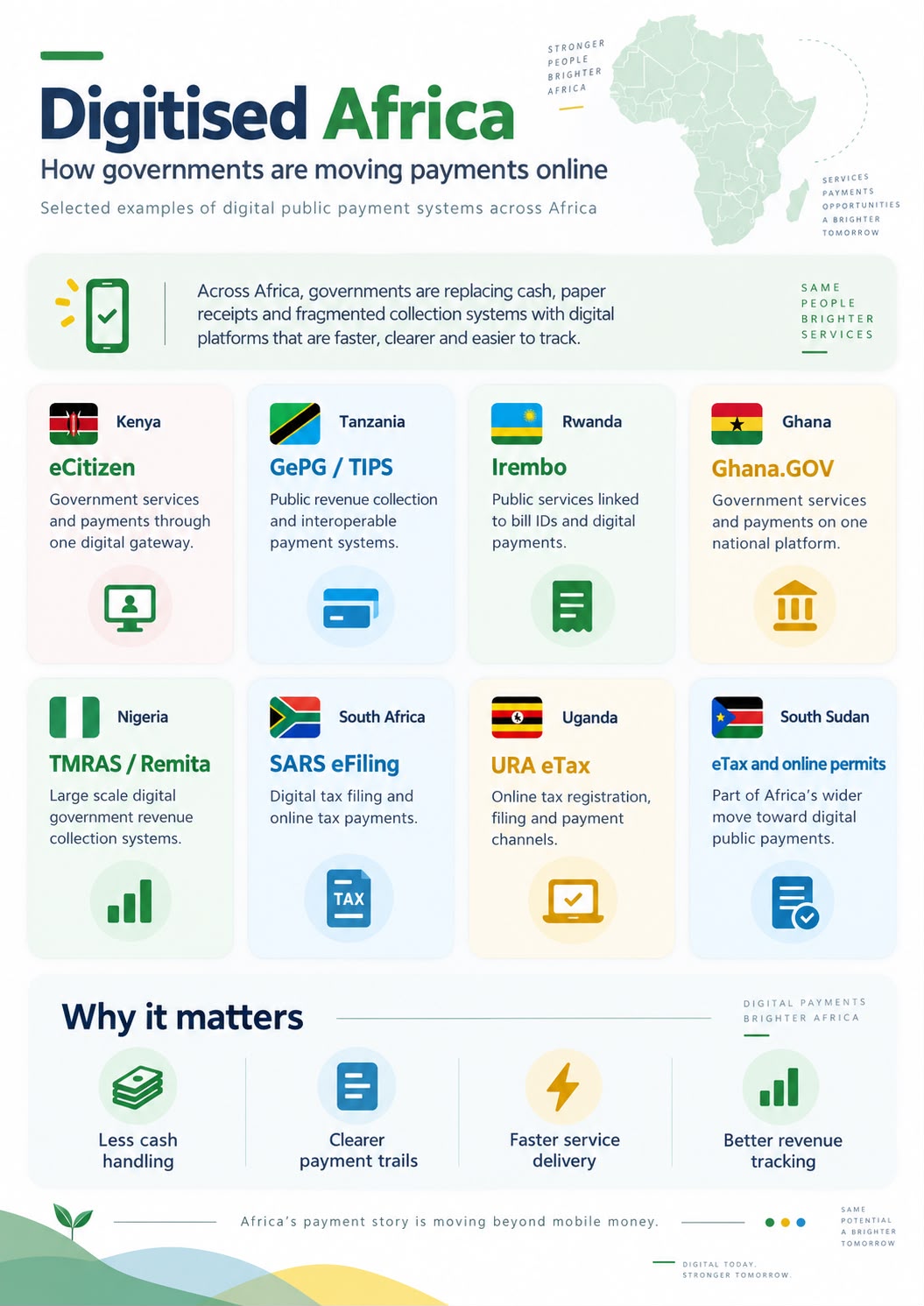
Across Kenya, Tanzania, Rwanda, Ghana, Nigeria, South Africa and South Sudan, different systems are being built around the same basic idea, where public payments should become easier to collect, easier to record and easier to check later.
Beyond M-Pesa: How Kenyan Businesses Accept Online Payments
Kenya Turned eCitizen Into A Government Payment Gateway
Kenya remains one of Africa’s best-known digital payments markets, where mobile money became part of everyday life long before many governments elsewhere had begun thinking seriously about digital public services.
The government later extended that thinking into public payments through eCitizen, which became a central point where citizens and businesses could apply for services and make payments through electronic channels.
The National Treasury says that before the programme expanded, more than one third of government payments were cash-based, creating room for leakage, abuse and expensive collection processes across public institutions.
The move toward eCitizen was about much more than convenience, since the government wanted to improve revenue collection, lower collection costs, and connect public services to payment records that could be followed electronically.
Once a service, invoice and payment sit inside the same system, the government can more easily check what was requested, what was charged, when the payment happened and whether the amount reached the right institution.
Tanzania Built One Gateway For Government Revenue
Tanzania approached the same problem through the Government Electronic Payment Gateway, which connects government institutions with different electronic payment channels and brings public revenue collection into a more standardised system.
The country also built the Tanzania Instant Payment System, known as TIPS, which connects banks and non-bank financial institutions through real time infrastructure that allows money to move between different providers.
During 2024, Tanzania recorded more than 453 million interoperable retail transactions worth over TZS29.9 trillion, alongside approximately 63.2 million active mobile money wallets and strong growth in merchants accepting digital payments.
The bigger lesson from Tanzania is that government digitisation works best when billing, payment channels, transaction records and settlement can be connected instead of sitting inside separate systems that barely speak to each other.
Rwanda Put Public Services And Payments Into One Process
Rwanda has taken its own route through Irembo, where people can apply for government services, receive a billing reference and complete payment through mobile money, banks or international cards.
That approach connects the service request to the payment itself, which means people do not need to move between different offices carrying receipts before the government can confirm that money has been paid.
For the government, the value sits in the record left behind, where a billing identifier, service request and completed transaction can all be connected inside the same process rather than being handled separately.
Rwanda’s system shows how government digitisation can make public services easier to access while giving institutions a clearer way to connect applications, billing information and completed payments.
Ghana Is Bringing Government Services Onto One Platform
Ghana has followed a similar path through Ghana.GOV, where taxes, permits, certificates and other public services can be accessed and paid for through a common national platform.
The country’s wider payment market has been growing at the same time, with electronic transactions becoming a larger part of daily commerce, banking and the way people interact with public institutions.
When government services move onto the same digital rails already used by banks, cards and mobile wallets, the gap between ordinary payments and public payments becomes much smaller.
That means a citizen can increasingly expect government services to work much like other digital services, where an application, bill, payment and receipt can all be handled without visiting several offices.
Nigeria Shows What Happens When Digital Payments Reach a Huge Scale
Nigeria takes the story into a much larger market, where electronic payments now move at a scale that makes digital infrastructure part of the country’s basic economic machinery.
The Central Bank of Nigeria recorded approximately 5.63 billion instant payment transactions worth around N476.89 trillion during the first half of 2024, with web transfers accounting for the largest share of transaction volume.
Government revenue collection has gone through its own digital changes, with Remita becoming closely associated with federal payments before the Treasury Management and Revenue Assurance System was introduced as part of a newer approach.
Once payments reach that size, the challenge is no longer simply whether money can move quickly, since governments and financial institutions must also deal with reconciliation, settlement, reporting, identity and transaction records.
Nigeria, therefore, shows where many African markets are heading, where digital payments are becoming too important to sit outside the systems used to manage public revenue and national financial activity.
The Digital Economy in Kenya: The Crypto Betting Link
South Africa Has Made Tax Payments A Digital Routine
South Africa has spent years building digital tax administration through SARS eFiling, where taxpayers can submit returns, manage tax information and make payments without depending on physical branches for every interaction.
The system gives taxpayers and businesses a direct electronic relationship with the revenue authority, allowing filings, payments and account information to sit inside one connected digital environment.
South Africa has also been working on a wider payment infrastructure intended to make faster electronic transactions easier to access and more useful across the wider economy.
That matters because tax collection becomes easier to manage when filing information, payment references, and taxpayer records can be connected instead of being spread across paper files and unrelated systems.
Uganda Is Moving More Tax Services Online
Uganda has been putting more tax administration onto digital channels through the Uganda Revenue Authority, allowing taxpayers to register, file returns, generate payment information and complete transactions electronically.
Payments can be connected to registration numbers and completed through banks, cards or mobile money, giving taxpayers several ways to settle obligations without depending entirely on cash and physical collection points.
The result is the same pattern appearing elsewhere across Africa, where the government increasingly wants every important payment connected to a reference that can later be matched against the person, service or tax obligation involved.
New digital loan enables till merchants to access up to Sh1.5 million
South Sudan Is Joining The Same Continental Move
South Sudan is now part of the same African story, where governments are trying to move public payments and services away from manual processes that are harder to track and more expensive to manage.
The country has introduced electronic tax administration and online government services, including digital processes connected to petroleum permits where users can apply, pay through different channels and receive completed documents electronically.
An International Monetary Fund assessment reported that South Sudan’s non-oil revenue rose from SSP8.9 billion during the 2016 and 2017 financial year to SSP83 billion during the 2021 and 2022 financial year.
The IMF linked much of that improvement to stronger compliance after electronic tax administration was introduced, showing why digitisation has become an attractive option for governments trying to improve revenue collection.
Companies providing payment software, settlement tools and billing technology are becoming part of that process across African markets, including South Sudan, where public institutions increasingly rely on electronic systems to handle transactions.
CapitalPay is one of the technology companies associated with that wider market, but the bigger story is the same one playing out across Kenya, Tanzania, Rwanda, Ghana and other countries, moving public payments online.
The Important Work Happens After Someone Presses Pay
The payment screen is usually the only part most people ever see, yet the more important work happens behind it, where a transaction has to be connected to the correct service and account.
A complete system may need to confirm identity, generate a bill, connect to banks or mobile money operators, process the transaction, issue a receipt and preserve records that can later be checked.
That is why seeing the name of a bank, mobile wallet or technology company on a payment screen does not automatically tell you who created the charge or who ultimately received the money.
The useful questions are always the same, because governments need to know who imposed the charge, who processed the payment, where the money settled and what record remains after the transaction.
Africa’s Payment Story Is Moving Into Its Next Stage
Africa has already shown that it can move quickly when technology solves an everyday problem, with mobile money becoming one of the clearest examples of that across the continent.
The next stage is about connecting that payment culture to government services, public revenue, banks, cross-border trade and systems that can preserve reliable records long after the transaction has happened.
Kenya has eCitizen, Tanzania has GePG, Rwanda has Irembo, Ghana has Ghana.GOV, South Africa has SARS eFiling, Nigeria has built large scale government payment infrastructure, and South Sudan is moving deeper into electronic public services.
Those platforms are different, but the direction is increasingly similar, with African governments trying to collect money through systems where billing, payment and settlement leave a clearer trail than the paper-based processes they replaced.
Africa’s digital payments story is no longer only about sending money from one phone to another, because it is becoming part of how governments collect revenue, deliver services and keep track of public transactions.