

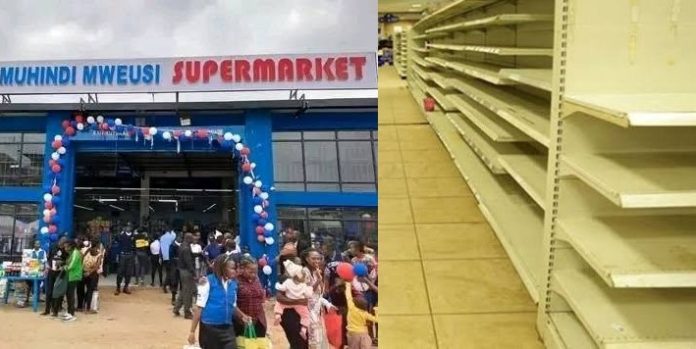
Kenyans have raised concerns over the financial health of Muhindi Mweusi Supermarket after videos circulating on social media appeared to show empty shelves at some of its outlets, while other branches have reportedly stopped operating.
The reports have sparked speculation that the homegrown retailer could be facing financial difficulties, although the company has not publicly announced that it is shutting down its operations.
“What’s happening with Muhindi Mweusi supermarkets? I’ve been to two of them and I noticed that shelves are running empty,” A Facebook user under the Username Nick Lee posted.

Among the outlets allegedly showing signs of closure are the Tassia and Witeithie branches. The Witeithie outlet is reportedly closed, with conflicting claims suggesting that the premises are either undergoing renovations or could be taken over by another supermarket.
“Muhindi Mweusi Supermarket in Witeithie shut down a few days ago. Reasons for the closure are still unclear. However, unverified reports suggest it’s under renovation with other sources claiming another supermarket is about to replace it,” A post on the Thika Thika Facebook page reads.
A retailer built on affordability
Muhindi Mweusi has built its business around relatively affordable goods, with much of its network concentrated in Nairobi neighbourhoods serving lower and middle-income households.
The retailer expanded its footprint to 16 outlets after opening a branch in Athi River in November 2025.
Its outlets include stores in Mukuru Kwa Njenga, Pipeline, Transami, Tassia, Kayole, Chokaa, Umoja, Kariobangi South, Witeithie, South B, Dagoretti and Athi River.
The latest concerns come after the supermarket suffered a major setback in March 2023 when its Tassia outlet was looted during political demonstrations led by the Azimio la Umoja party.
According to the retailer’s operations manager Peter Maguli, the outlet lost property and merchandise worth an estimated Sh15 million.
“We lost goods and property estimated at Sh15 million. These include assorted goods, TV sets, gas cylinders and mattresses,” Maguli said.
Video circulating online showed attackers forcing their way into the outlet after staff had closed for the day. Police later arrested several suspects in connection with the incident.
A sector marked by closures
The questions surrounding Muhindi Mweusi come against a long history of turbulence in Kenya’s supermarket industry.
Some of the country’s biggest retail names have disappeared from the market after years of financial difficulties.
Nakumatt, once one of the region’s largest supermarket chains, eventually closed all its outlets after struggling with rent arrears and supplier debts.
Tuskys followed a similar path after years of declining sales, unpaid suppliers and mounting financial obligations. The High Court ordered the liquidation of Tuskys in 2023, bringing an end to the retailer’s three-decade history.
Uchumi, another once-dominant Kenyan retailer, has also undergone a dramatic contraction, while foreign chains including Shoprite and Choppies eventually withdrew from the Kenyan market.
A recent analysis by the Kenya Institute for Public Policy Research and Analysis (KIPPRA) found that the number of branches operated by major supermarket chains fell significantly between 2018 and 2023, with Tuskys, Uchumi, Nakumatt, Choppies, Game Stores and Shoprite accounting for much of the reduction.
The report attributed the decline to factors including financial losses, management weaknesses, changing consumer behaviour, growing competition, high operating costs and broader economic pressures.
Also Read: Safaricom launches Shari’ah-compliant MMF, opens investing from Sh100