

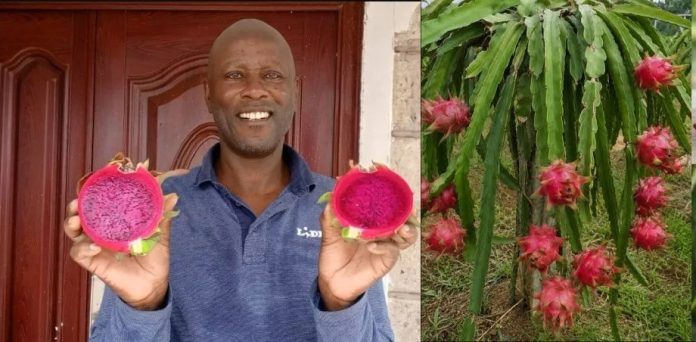
Dragon fruit, a tropical fruit prized for its striking appearance, distinctive flavour and nutritional value, is attracting growing interest among Kenyan farmers seeking to diversify their crops and tap into emerging markets.
Also known as pitaya, the fruit is recognisable by its brightly coloured skin and white or red flesh speckled with tiny black seeds.
Originally native to the Americas, dragon fruit is now commercially grown in several parts of the world, including Asia.

Its growing appeal in Kenya has created opportunities for farmers, but access to planting materials suited to local growing conditions remains a challenge for some farmers.
This is the challenge agricultural entrepreneur Anthony Kinoti sought to address when he started developing the country’s first locally bred dragon fruit variety seven years ago.
Kinoti, who is the chairman of the Dragon Fruit Society of Kenya, led the development of the variety dubbed KIKA 1, in a breakthrough that could strengthen domestic breeding capacity, reduce reliance on imported planting materials and support the expansion of the crop.
Also Read: Meru farmer making over Sh2 million per acre from dragon fruits
Kinoti develops Dragon fruit variety after seven years
Kinoti, who has been involved in dragon fruit farming since 2012, said the idea emerged from a market gap created by farmers’ dependence on imported varieties that may not perform optimally under Kenya’s diverse environmental conditions.
“I realized there was a gap in the market because existing varieties may not be well suited to our local environmental conditions. As an entrepreneur, I see every problem as an opportunity in disguise,” he said, as quoted by Science Africa.
The development of KIKA 1 took approximately seven years, involving plant crossbreeding and the selection of desirable traits.
The breeding programme incorporated genetic material from wild relatives of dragon fruit found in parts of eastern Kenya and the coastal region.
The objective was to develop a variety better adapted to local conditions, with improved tolerance to drought and pests and the ability to grow well in Kenyan soils.
Kinoti said the variety also offers improvements in taste, flavour and aroma, alongside a longer shelf life and better post-harvest handling characteristics. The fruit further features more vivid colours and distinctive physical features.
Also Read: How dragon fruit farmers can produce 6 tonnes from a single acre
KIKA 1 secures 25-year plant breeders’ rights
KIKA 1 has received plant breeders’ rights from the government for 25 years under Grant No. 1055, providing legal protection for the variety under the applicable framework.
Kinoti said obtaining the rights required a lengthy scientific assessment to establish that the variety met the necessary standards for protection.
“Developing a new variety is a lengthy scientific process. Before receiving plant breeders’ rights, a variety must undergo assessment to establish that it is distinct from existing varieties, uniform in its characteristics and stable across generations,” he said.
The assessment examines distinctness, uniformity and stability, commonly referred to as DUS. These criteria establish whether a new variety can be distinguished from existing ones, displays consistent characteristics and retains those traits across generations.
Kinoti said the process involves rigorous scientific evaluation and regulatory scrutiny before approval is granted.
“It’s a rigorous process. I’m simplifying it, but it’s a rigorous scientific process. It’s a journey,” he said.
According to Kinoti, the achievement demonstrates that agricultural innovation can generate intellectual property and commercial value, challenging the perception that such rights are associated mainly with creative industries.
“It is something very good for our country to show the rest of the region that there is intellectual property even in farming. It’s not just in music and in writing alone,” he said.
He added that the company behind KIKA 1 operates a licensed nursery and is authorised to export planting materials, positioning it to participate in the development of the sector.
“We are the planting material supplier. We are a licensed nursery operator. We are a licensed exporter, and we are glad to work with all stakeholders to grow the sector,” he said.
Also Read: Chinese farmers making millions from 260-acre Dragon Fruit farm in Naivasha