


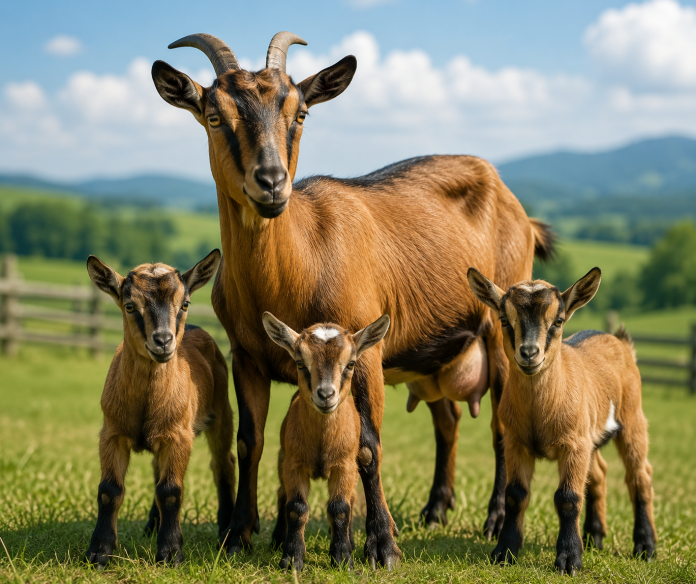
Dairy goat farming remains one of Kenya’s most underexploited livestock enterprises despite a steadily growing demand for goat milk driven by its nutritional value and perceived health benefits.
As more consumers seek easily digestible dairy products, farmers are increasingly turning to dairy goats as a profitable alternative to conventional dairy farming.
Among the available dairy goat breeds, the Kenya Alpine has emerged as one of the most productive and adaptable animals for commercial milk production.

With relatively low feeding costs, high milk yields and the ability to thrive under a wide range of climatic conditions, the breed presents an attractive investment opportunity for both small-scale and commercial farmers.
Originally developed in Britain by crossing indigenous goats with Alpine breeds imported from Switzerland in 1903, the Alpine goat derives its name from the Alps mountain range.
According to the Kenya Livestock Producers Association (KLPA), the breed is medium to large in size and is characterised by a wide variety of coat colours, including shades of grey, brown, black, red-buff and mixed colour patterns.
Unlike some breeds with distinctive markings, Alpine goats display no fixed colour pattern. They have erect ears, a straight facial profile and horns, and are widely recognised for their exceptional milking ability.
In Kenya, the breed is predominantly reared in the Central and Eastern Highlands, particularly in Nyeri and Meru counties, where climatic conditions favour dairy goat production.
However, experts note that the animals are remarkably hardy and can adapt to diverse environments, making them suitable for many parts of the country. Besides their resilience, Alpine goats are excellent foragers and agile climbers.
Although many farmers keep the animals under zero-grazing systems, kidding seasons are largely determined by pasture availability rather than occurring at fixed times of the year.
Proper breeding boosts productivity
Livestock experts caution farmers against breeding young does before they are physically mature.
While some female goats may exhibit their first heat at around five months of age, mating at this stage is discouraged because it can interfere with growth and negatively affect lifetime productivity.
A doe should only be served after attaining at least two-thirds of its expected mature body weight and should ideally be between 10 and 12 months old, depending on nutrition and breed development.
Breeding immature animals increases the risk of abortion, reduced milk production, stunted growth and kid mortality. Following successful mating, the gestation period lasts approximately five months.
Impressive milk production
The Kenya Alpine is renowned for its high milk output. Under proper management, a doe can produce up to 3.5 kilogrammes of milk daily during the first two months after kidding.
Peak production is usually reached about 35 days after kidding before gradually declining over the lactation period.
Depending on feeding and management, a doe can remain in milk for between three and 10 months.
Studies conducted in 2014 on Alpine dairy goats in Central Kenya showed that goats kidding between November and December recorded the highest milk yields.
Those kidding between January and March ranked second, while goats kidding between May and July produced comparatively lower yields.
On average, a well-managed Alpine goat produces between 2.5 and four litres of milk daily. Farmers are also advised to allow kids to suckle their mothers because this stimulates greater milk production.
Low production costs
One of the breed’s greatest advantages is its ability to perform well under relatively low-input production systems.
The Kenya Alpine can efficiently utilise locally available feed resources while maintaining good growth rates and satisfactory milk production, reducing the cost of production for farmers.
A mature female weighs about 60 kilogrammes and stands between 70 and 76 centimetres tall. Average milk production per lactation is approximately 922.5 kilogrammes, translating to about 4.5 kilogrammes per day, with butterfat content averaging 3.6 per cent.
Mature bucks weigh between 65 and 80 kilogrammes and attain heights of between 80 and 90 centimetres.
Accessing quality breeding stock
Farmers interested in establishing dairy goat enterprises can source breeding stock from certified local breeders or through the Kenya Agricultural and Livestock Research Organisation (KALRO), which supplies pedigree does and bucks for breeding programmes.
Why goat milk demand is rising
Demand for goat milk continues to increase across Kenya as consumers become more conscious of its nutritional and health benefits.
Goat milk contains easily digestible proteins and smaller fat globules than cow milk, making it easier to digest for many people. It is also rich in calcium, phosphorus, potassium and essential vitamins that support bone health and immunity.
Many consumers who experience discomfort after consuming cow milk also prefer goat milk because it is generally gentler on the digestive system.
The milk is increasingly sought after by young children, older adults and individuals looking for nutritious alternatives to conventional dairy products.
The growing market has translated into attractive returns for farmers, with goat milk retailing at between Sh100 and Sh200 per litre—roughly double the price of cow milk.
Also Read: Kisumu farmer making Sh20,000 daily from 150 dairy goats on half an acre