

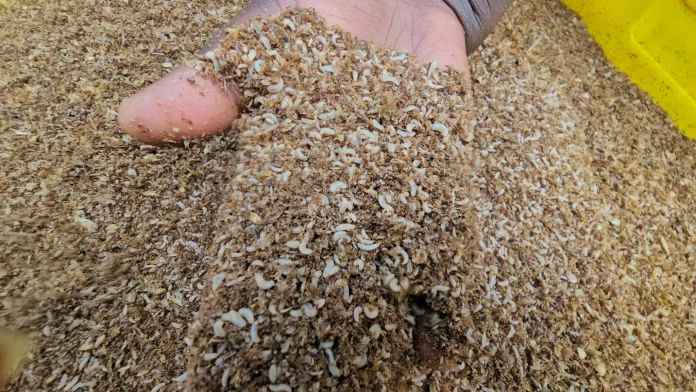
For women and young farmers looking for an entry point into livestock production, Black Soldier Fly (BSF) farming is emerging as a low-space venture that can turn organic waste into a valuable source of animal feed and income.
The enterprise involves rearing Black Soldier Fly larvae, which are rich in protein and can be processed into feed for poultry, pigs and fish.
The larvae can also be fed to livestock while wet or alive, providing farmers with an alternative to conventional commercial feeds.

At about 21 days into their life cycle, BSF larvae have a crude protein content of at least 45 per cent.
This has made them increasingly attractive to livestock and poultry feed manufacturers seeking alternatives to traditional protein sources such as silver cyprinid (omena) and soya beans.
Also Read: Farmer turns dry Laikipia land into beef goldmine selling up to 100 cattle per month
The insects also offer farmers a second source of income. After feeding on organic waste, the larvae leave behind frass, a nutrient-rich residue that can be used as an organic fertiliser.
The model allows farmers to convert materials that would otherwise be discarded into both livestock feed and a soil-enhancing product.
For Winnie Wambui Githinji, the prospect of turning waste into a valuable agricultural resource was the starting point for her venture into BSF farming.
“I discovered that organic waste could be used to rear Black Soldier Fly larvae, turning discarded material into a source of protein for livestock while leaving behind a residue that can be used to make organic fertilizer,” she said.
Githinji sees BSF farming as more than an alternative feed business. She believes the enterprise can provide women with an opportunity to participate in livestock production without the large tracts of land and substantial capital traditionally associated with farming.
The relatively small land requirement was one of the factors that attracted her to the venture. She began by leasing a small piece of land and putting up a greenhouse structure for rearing the insects, starting on a modest scale.
According to her, while BSF farming can be started in limited space, expansion brings additional requirements for infrastructure and land.
“As an enterprise grows, land and infrastructure become increasingly important for sorting, processing, waste treatment and other forms of value addition,” she says.
She argues that reducing the cost and space requirements of livestock production does not necessarily address the wider challenges women face in accessing agricultural assets.
“Alternative feeds may lower the entry barrier, but they do not automatically remove the structural barriers that have historically limited women’s participation in agriculture,” says Githinji.
Understanding Black Soldier Fly
The Black Soldier Fly, scientifically known as Hermetia illucens, is particularly valued for its larvae, which are used as a protein-rich feed ingredient for poultry, fish and pigs.
The insects thrive on organic waste, making BSF farming part of a circular agricultural system. Instead of allowing organic material to go to waste, farmers can use it to produce larvae for animal feed while generating frass that can be applied to soils as an organic fertiliser.
Frass can improve soil quality by increasing organic matter, enhancing water retention and supporting beneficial soil organisms. This can contribute to healthier soils while reducing reliance on synthetic fertilisers.
The low space and capital requirements also make the enterprise attractive to young people and women who may struggle to access land and financing for conventional livestock enterprises.
Also Read: Sweet potato farming: How farmers can avoid selling their produce at a loss