

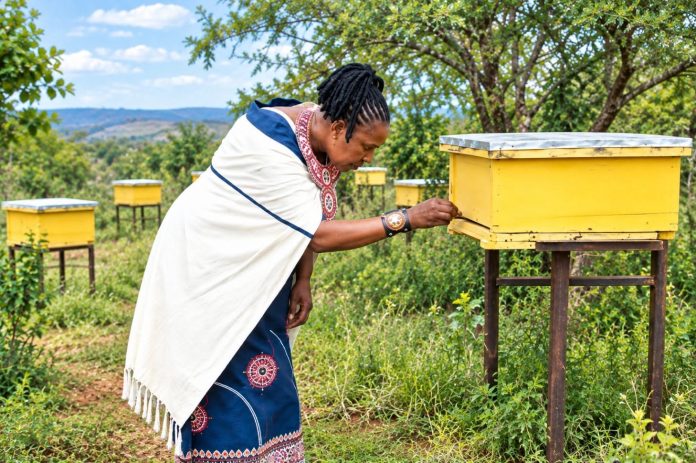
Beekeeping is gaining ground as an alternative livelihood in Kenya’s arid and semi-arid lands (ASALs), where unpredictable rainfall, prolonged droughts and pasture shortages continue to threaten livestock farming.
Unlike livestock, bees require relatively little land and water, while the trees and shrubs common in dry areas provide forage.
In Laikipia North, Rosemary Mosiany has built a thriving honey enterprise from just five beehives.

Her journey into the venture began in a community where livestock was the main source of livelihood and beekeeping was largely viewed as unsuitable for women.
For years, drought had exposed the vulnerability of that model. When pasture disappeared and livestock died, families were left with few options. Rosemary instead looked at the acacia trees that dotted the dry landscape and saw an opportunity.
She began beekeeping in 2018 with five hives and limited knowledge of apiculture. Her entry into beekeeping was supported by the Namelok Women’s Group, a 200-member association that embraced the enterprise as part of efforts to cope with climate change.
Training provided through the Food and Agriculture Organization (FAO) helped transform the women’s approach to beekeeping. Members were taught improved honey harvesting, processing, value addition and marketing techniques. They also received 40 modern beehives.
After seeing the Potential, Rosemary, with the support of her husband Piranto Ole Mosiany, continued to expand her enterprise and by 2022 she had 80 hives. Today, she manages 618 hives spread across Ilmotiok, Loshaiki, Musul, Soit Oitashe and Karrum villages in Laikipia County.
Her apiaries produce between eight and 12 kilogrammes of honey per hive during a harvest, with three harvests possible in a good year.
According to her, previously, raw honey fetched about Sh300 to Sh350 per kilogramme. With better processing, branding and knowledge of different honey varieties, Rosemary now sells a kilogramme for Sh1,500 and half a kilo for Sh750.
During peak season, she earns more than Sh2 million in a season and supplies markets beyond Kenya, including the United States, Türkiye and the United Arab Emirates.
Her business has since expanded beyond honey production.
Rosemary runs a shop in Nanyuki, where she sells honey and related products. On a good month, the business generates between Sh80,000 and Sh100,000. She also makes beekeeping equipment and markets beeswax and propolis.
She has increasingly turned her experience into a source of knowledge for other women, training groups interested in apiculture and encouraging them to view beekeeping as a viable business.
Digital marketing has also widened her reach, while certification and procurement training under UN Women programmes has strengthened her ability to pursue institutional and government markets.
She views beekeeping as part of environmental conservation. Rather than cutting acacia trees for charcoal, she argues that the same trees can support multiple beehives and generate income.
“I have been able to buy one acre of land where I intend to build to build my home and put up a modern workshop for making beekeeping equipment and a honey refinery. Proceeds from the business have also helped me take care of my family, including paying school fees,’’ she says as quoted by Nation.
Looking ahead, Rosemary plans to increase her apiaries to 3,000 hives, building on a business whose demand already frequently outstrips supply.
Also Read: Nyeri farmer turns rejected avocado into oil selling at Sh800 a bottle
Did you love the story? You can also share YOUR story and get it published on Bizna Click here to get started.