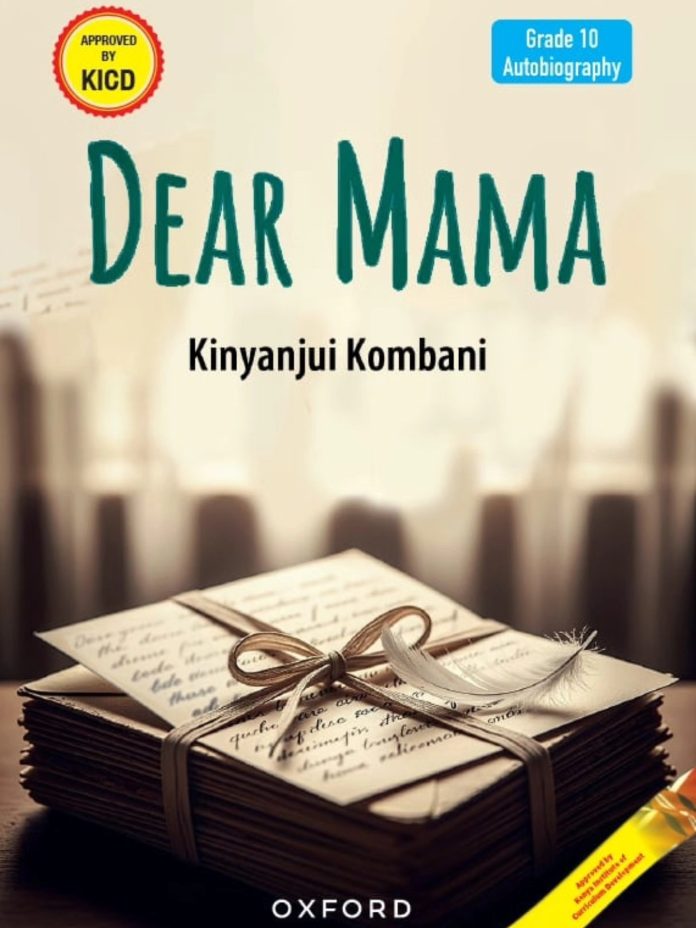
Kenyan writer and banker Kinyanjui Kombani has published a deeply personal new book, Dear Mama—a work that reads less like a conventional autobiography and more like a sustained conversation across time. It is, at its core, a son’s letter to his mother, written 26 years after her death, and an unflinching meditation on grief, purpose, and becoming.
Kombani makes one thing clear from the outset: grief does not run on a corporate timeline. There are no milestones after which loss is “resolved.” His mother passed away just before he sat his final exams, at the very moment when her sacrifices were about to bear fruit. That unfinished celebration—what might have been shared—becomes the emotional engine of the book.
Challenged to write his autobiography, Kombani initially resisted. He did not believe his life qualified as “remarkable.” But the idea evolved. What if the story was told as a series of letters to the one person who never got the updates? That reframing unlocked the narrative. Dear Mama was born.
The result is Kombani at his most vulnerable and most disciplined. He retraces his journey from a single-room house in Molo shared with his mother and four siblings, to their return to a struggling farm in Njoro, to the Ngando slums of Nairobi where he lost direction and found temptation. He writes candidly about addiction, survival hustles—selling knives in Banana, curios and groceries in Ngando—and the long road back through Kenyatta University.
Kinyanjui Kombani: Kenya’s finest contemporary author penning his own legacy
The book also lifts the curtain on Kenya’s publishing industry: the quiet longing of staring at bookstore shelves, the grind of writing without guarantees, and the improbable arc that ends with Kombani being named among the 25 Notable Kenyan Authors of All Time. Professionally, he charts a parallel climb—from a banking clerk at Standard Chartered’s Moi Avenue Branch to relocating to Singapore during a period of global financial uncertainty.
Yet Dear Mama is not just memoir. It is instruction by example. The Kenya Institute of Curriculum Development (KICD) has approved the book as the compulsory autobiography set text for Grade 10 Literature students. That is a strategic inflection point. Over the coming years, hundreds of thousands of learners will encounter Kombani’s mother through the lessons she passed on: the power of asking, showing up, and building relationships.
This is legacy at scale. Personal pain converted into public value. A private letter that becomes a national classroom conversation.
“It’s been quite the ride,” Kombani writes. And it has. Dear Mama stands as proof that vulnerability, when executed with clarity and craft, is not weakness—it is leadership.