


When many Kenyans hear the name President William Ruto, what often comes to mind is politics, his rise from humble beginnings, and his combative campaign style.
Others think of him as a seasoned political strategist who has spent decades navigating the country’s shifting political terrain.
But beyond the rallies, policy pronouncements, and the pressures of running the country, President Ruto has repeatedly presented himself as a farmer.

Over the years, the Head of State has occasionally spoken publicly about his farming ventures, particularly his chicken enterprise, which he has used as an example of how agribusiness can create jobs and generate income.
In several forums, he has cited poultry farming as a practical business model that ordinary Kenyans can adopt, insisting that agriculture remains one of the strongest pillars of the economy.
Behind those remarks lies what is widely described as a vast, multimillion-shilling farming empire stretching across different parts of Kenya.
Ruto has been associated with expansive land holdings, particularly in Uasin Gishu County, and other regions, including Narok.
Farming is reportedly one of the President’s major sources of income, and his agricultural portfolio is said to be diversified, covering poultry farming, fruit farming, beekeeping, livestock keeping, and mechanised crop production.
His farms are said to embrace modern, high-tech agricultural machinery and mechanised systems, positioning them as large-scale commercial operations.
Ruto’s Sugoi chicken enterprise
Perhaps the most talked-about component of President Ruto’s farming business is his poultry venture based in Sugoi, Uasin Gishu County.
The chicken farm, is reportedly operated under the name Yegen Farm. The enterprise is said to rear more than 200,000 chickens, with reports indicating that the business earns over Sh547 million annually from egg sales alone.
The poultry venture is also said to involve partnerships with IndBro, an India-based poultry breeding and research farm.
The farm has frequently been referenced whenever the President speaks about agribusiness opportunities, with poultry farming often emerging as his preferred example of how agriculture can be turned into a thriving private enterprise.
Kisima Farm in Taita Taveta
Away from the Rift Valley, President Ruto is also linked to Kisima Farm, a 2,500-acre property located in Taita Taveta County.
The farm was reportedly acquired from former Member of Parliament Basil Criticos. It is said to be equipped with modern irrigation infrastructure, allowing year-round agricultural activity, a major advantage in a region where rainfall patterns can be unpredictable.
Kisima Farm is reported to focus heavily on beef farming and breeding, alongside rearing sheep, goats and chickens.
Koelel Farm in Uasin Gishu
Another major property associated with the President is Koelel Farm, located in Uasin Gishu County, about 14 kilometres from the Eldoret–Nakuru Highway.
The farm is reportedly used for large-scale production of maize and vegetables for commercial purposes.
Part of the harvest is also said to be channelled into making chicken feed, an approach that reflects an integrated farming model where one segment supports another.
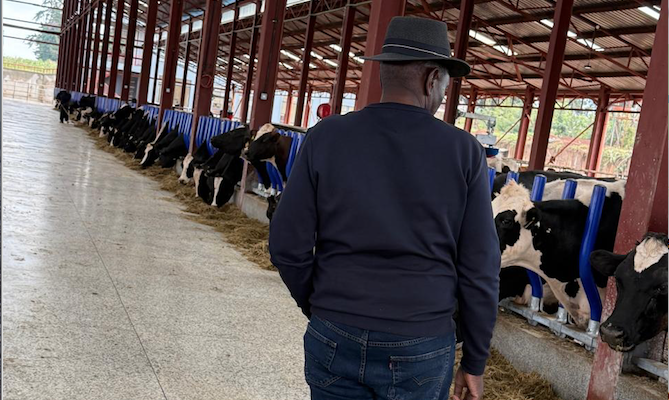
In addition to crop production, Koelel Farm hosts a large number of dairy and beef cattle, including high-value breeds such as Friesians and Angus.
During this year’s Easter Holidays, the Head of State was pictured on the farm engaging directly in farm work, including feeding cattle inside a large industrial-style shed that houses over 50 animals.
Modern machinery and commercial-scale ambition
What sets the President’s farming operations apart is the embrace of modern technology and mechanisation. The farms are said to utilise high-tech agricultural machinery, with some estimated to cost close to Sh10 million.
One of the machines spotted on the farm is a Total Mixed Ration (TMR) feed mixer wagon. The equipment is used in mixing different feed components such as hay, silage, and grains into a uniform ration before distributing it to the animals.
Also Read: What is wrong with being in the Middle Class in Kenya?



Good