


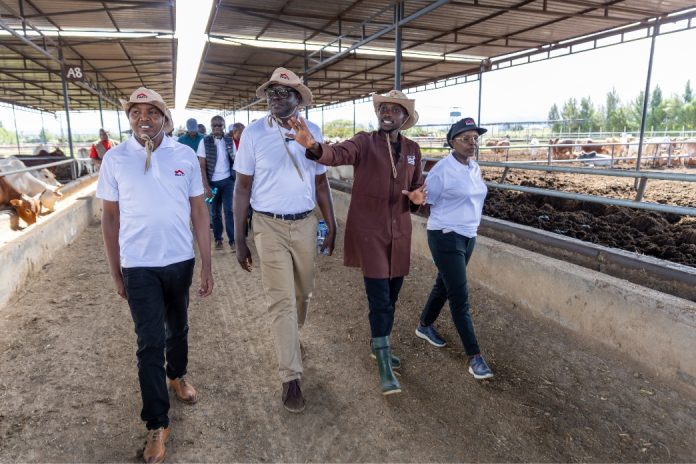
In the plains of Rumuruti in Laikipia County, a cattle farm is quietly reshaping how beef production is approached; shifting focus from numbers to value, and from local markets to premium buyers.
At the centre of this model is Philip Kimeru, chairman of Ongole Beef Farm, who is steering the operation toward an integrated system designed to maximise returns from every animal.
The farm, which keeps more than 2,000 head of cattle, brings together breeding, feeding, processing and distribution under one system. For Kimeru, this is a deliberate strategy to control quality and manage costs in a sector often exposed to volatility.

“Feed costs remain our biggest expense, which is why we are investing in producing our own,” he said.
To address this, the farm grows its own maize, cotton and hay using organic methods, while recycling manure back into crop production.
The approach not only reduces dependence on external inputs but also ensures consistency in feed quality.
But the real shift is in market focus.
Kimeru says the gap between local and premium beef markets has forced a rethink of the farm’s business model.
While a kilo of steak may sell for about KSh 800 locally, some high-end markets offer up to Sh6,000, a difference that has pushed the farm toward value addition.
“We have learnt that premium markets reward quality. This is why our focus now is on value addition, guided by our ‘whole cow, whole harvest’ philosophy,” he said.
Under this model, the farm seeks to extract value from every part of the animal, including meat cuts, bones and hides, with the aim of increasing revenue per steer.
Technology is also playing a key role. Each animal is electronically tagged and tracked throughout its lifecycle, improving traceability, a critical requirement for accessing export and premium markets.
Equity Bank retains top spot as Kenya’s most valuable brand in 2026
The farm further sources part of its livestock from surrounding pastoralist communities, integrating the animals into its system after quarantine and professional assessment. This creates a link between small-scale producers and higher-value markets.
The integrated system extends to a nearly fully automated, halal-compliant slaughterhouse, supported by cold storage facilities and a premium outlet in Karen, Nairobi.
As the farm expands its reach, it has attracted interest from Equity Bank Kenya, whose leadership recently visited the facility as part of its broader push to support agribusiness.
Managing Director Moses Nyabanda said the farm reflects the kind of opportunity the bank sees in agriculture.
“We are committed to supporting customers in the agricultural sector. Through our Africa Recovery and Resilience Plan, we see agriculture as a unique opportunity for Kenya and the continent, and Ongole Beef is a strong testament to that,” Nyabanda said.
He added that the farm’s model aligns with the bank’s ambition to strengthen agricultural value chains.
“Engaging with the team and understanding their ambitions shows strong alignment with our goal of positioning agriculture as a key strength for Kenya and the continent,” he said.
Nyabanda also pointed to the farm’s use of technology as a key differentiator in improving productivity and meeting market standards.
“It is impressive to see how technology is being applied in breeding and finishing to deliver quality beef. This affirms our ambition to grow agriculture to 30% of our balance sheet,” he said.
For Kimeru, however, the focus remains on building a sustainable model that can withstand market pressures while tapping into high-value demand.
“We are focused on achieving optimum revenue multiplication per steer,” he said.
He says the success of the farm is no longer defined by herd size alone, but by how much value each animal can generate across the entire chain.