

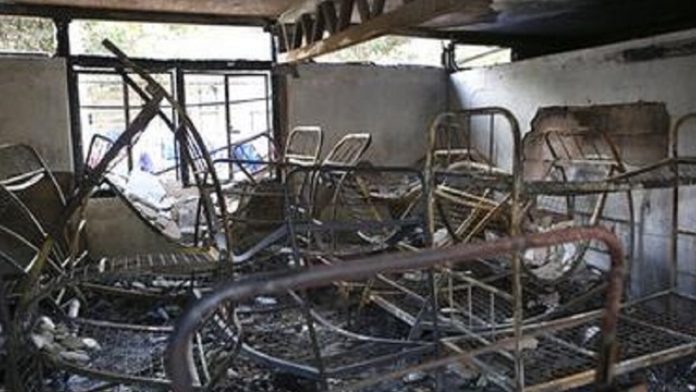
In Kenya, when a school fire occurs, it rarely happens without the knowledge and involvement of adults within the institution. In many instances, teachers, support staff, principals, deputies, and teachers on duty can feel the tension building.
Others find out through informants, or students who write anonymous notes and slip them under the doors of Heads of Departments (HODs), deputies, or principals. Ultimately, an adult in the school is usually fully aware of what is about to happen.
In schools where the staff operates with goodwill, a routine inspection and investigation are carried out, and students are sent home on suspicion, thereby averting a disaster.

However, a precedent has long been set in Kenya where nobody in the school is held accountable when a fire occurs. The burning down of government infrastructure is not treated as criminal arson, and the Directorate of Criminal Investigations (DCI) is usually not the first responder.
Instead, board members and principals routinely turn the misfortune of a burning school into a money-making venture through fundraising efforts, forcing parents to pay readmission fees and exaggerated damage costs.
This corruption is frequently tied to broader financial mismanagement. When a principal has embezzled or misappropriated school funds and lacks the capital to complete the term—running out of money for meals, salaries, and basic supplies—the easiest way to manoeuvre through the financial quagmire is to engineer a strike or a walkout.
The most strenuous financial period for a boarding school is the second term because it is long and funds deplete quickly. The narrative that students strike simply because they want to avoid mock examinations is often a smokescreen.
Because mock exams take three to four weeks, forcing a student walkout allows the principal and board members to keep and save the operational funds that would have otherwise been spent on food and utilities for the remainder of that term.
Furthermore, when an administration block burns down, the principal is typically trying to cover their tracks by destroying all financial documentation, effectively sabotaging audit trails to avoid being caught for embezzlement.
Teenagers have no inherent interest in administration blocks, as they do not know what happens inside them. Conversely, dormitories are targeted because the principal and certain staff members want the students sent home indefinitely, creating a prime opportunity to solicit funds from parents.
The involvement of the administration is highly suspected in instances where dormitories burn down during evening or morning preps when students are confirmed to be in their classrooms.
Notably, classrooms themselves almost never burn down. Additionally, schools often claim that students looted bulk provisions like beans, green grams, and sugar during a strike. In reality, it is the school staff who steal these supplies, as teenagers during an ongoing riot are not preoccupied with stealing sacks of raw food, nor do they understand their monetary value.
Teachers also play a direct or indirect role in aiding school unrest. A well-known strategy used by teachers to avoid the heavy workload of marking up to three papers per subject is to repeatedly tell current students about the destructive exploits of past classes.
This subtly encourages a walkout to deter the administration from administering the mocks; consequently, some schools have avoided holding mock exams for a decade.
In other instances, teachers and support staff actively incite student radicalization to resist or undermine an unpopular principal or deputy. To achieve this, teachers on duty may become extremely hostile toward the student body, while kitchen staff deliberately sabotage the food in the dining hall.
This creates a well-coordinated effort between support staff and a select group of rogue teachers. Within a week, the environment becomes toxic enough that the students are ready to leave. Ironically, the principal is usually kept entirely in the dark regarding these internal efforts to depose them.
READ MORE: Kenya should scrap CBE education system and go back to 8-4-4 system
In most of these schools, teachers and support staff live within the compound, yet these resident staff members are never at the scene and are never the first responders, despite the screams and chaos.
For example, in a fire incident that occurred at one girls High School in Nairobi, teachers remained in their houses during the day while the dormitory burned and students jumped from windows. It was the residents in Buru Buru who lived outside the school perimeter wall who rushed in to help.
Similarly, at one national High School in Nyanza region, the teachers on duty and those who reside on school grounds were completely absent when the fire started; instead, local villagers rushed in and filmed the event. The school administration then used that opportunity to milk the parents dry, eventually forcing the parents to take the matter to court.
Burning school infrastructure has become the quickest way for school administrations to generate illicit money, and Ministry of Education officials are more often than not in on it.
In yet another incident, a principal at a High School in Nairobi knew beforehand that the school was going to be burned because she kept receiving warning notes under her door.
Instead of taking protective action, she went to the parade ground and told the students, “You can burn it if you want!” She was never disciplined by the TSC, and at one point, she even taunted the students, telling them to just walk out and leave because she did not care.