
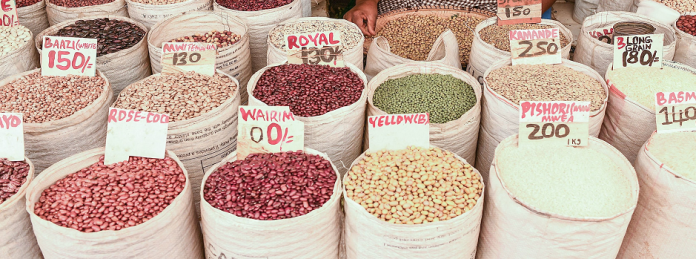
The cereals business remains one of the most lucrative agribusiness ventures in Kenya, particularly in regions with strong agricultural production.
By connecting farmers to reliable markets and ensuring a steady supply of staple grains to consumers, traders play a critical role in the food value chain while creating sustainable income streams for themselves.
For 39-year-old Jane Chebet from Songhor Soba Ward in Tinderet Sub-County, Nandi County, the cereal business has transformed her life.

What began as a small venture financed through a Sh5,000 loan has grown into a flourishing enterprise generating a monthly turnover of over Sh800,000.
Chebet’s entrepreneurial journey started 15 years ago when she borrowed Sh5,000 from a local women’s table banking group.
With the funds, she began purchasing small quantities of maize and beans from farmers before reselling them in local markets. Although the earnings were initially modest and barely sufficient to support her household, she soon recognized the vast potential within the grain trade.
“I saw that farmers struggled to find reliable buyers, while traders in towns needed consistent supply. I decided to bridge that gap,” she told KNA.
Driven by determination and prudent financial management, Chebet steadily expanded the business. Through continuous savings and reinvestment of profits, she grew her working capital to Sh50,000 within three years.
She also broadened her network of farmers, embraced bulk purchasing during harvest seasons, and invested in simple storage facilities to minimize post-harvest losses.
Today, her business handles between 20 and 25 tonnes of cereals every month, including maize, beans, finger millet and sorghum. During peak harvesting periods, volumes can exceed 40 tonnes.
With maize selling at an average of Sh4,000 per 90-kilogram bag and beans fetching up to Sh8,000 per bag, the enterprise’s monthly turnover ranges between Sh800,000 and Sh1,000,000 depending on market conditions.
Over the years, her customer base has expanded significantly. From serving individual consumers in local markets, she now supplies schools, small-scale millers and traders in towns such as Kapsabet, Nandi Hills and Eldoret.
The adoption of mobile money platforms has further enhanced the efficiency and security of her transactions.
The growth of the business has also created employment opportunities within the community. Chebet employs five permanent staff members responsible for sorting, drying, packaging and record-keeping, in addition to hiring casual labourers during busy seasons.
Many of the beneficiaries are young people from the area who previously struggled to secure stable jobs.
“Giving jobs to the youth is something I take seriously because I was once in a position where I had no income at all,” she says.
Beyond creating jobs, her enterprise has become an important market outlet for local farmers. By purchasing produce directly from growers at fair prices, she helps shield them from exploitation by middlemen who often take advantage of oversupply during harvest periods.
Her rise in business was not without obstacles. In the early stages, she encountered skepticism from some members of the community who perceived large-scale trading as an activity reserved for men.
Access to financing also proved difficult, with many financial institutions requiring collateral that she did not possess.
Rather than give up, Chebet relied on women’s savings groups to raise capital while gradually building a credible financial record.
Her persistence paid off in 2018 when she secured her first formal bank loan worth Sh300,000. The funds enabled her to construct a storage facility with a capacity of 100 tonnes, significantly reducing losses caused by pests and moisture while improving profitability.
The proceeds from the business have enabled her to educate her four children, improve her family’s living standards and diversify into dairy farming.
She has also emerged as a mentor within her community, having trained more than 25 women on cereal aggregation, storage practices and basic financial management.
To cushion her business against fluctuating grain prices, Chebet has ventured into value addition by milling and packaging branded flour for retail markets. The move has helped increase profit margins while opening up new market opportunities.
Looking to the future, she plans to expand further by investing in a larger warehouse and modern grain-drying equipment. She is also working towards establishing a cooperative society that will unite farmers and traders, strengthen their bargaining power and improve access to markets.