

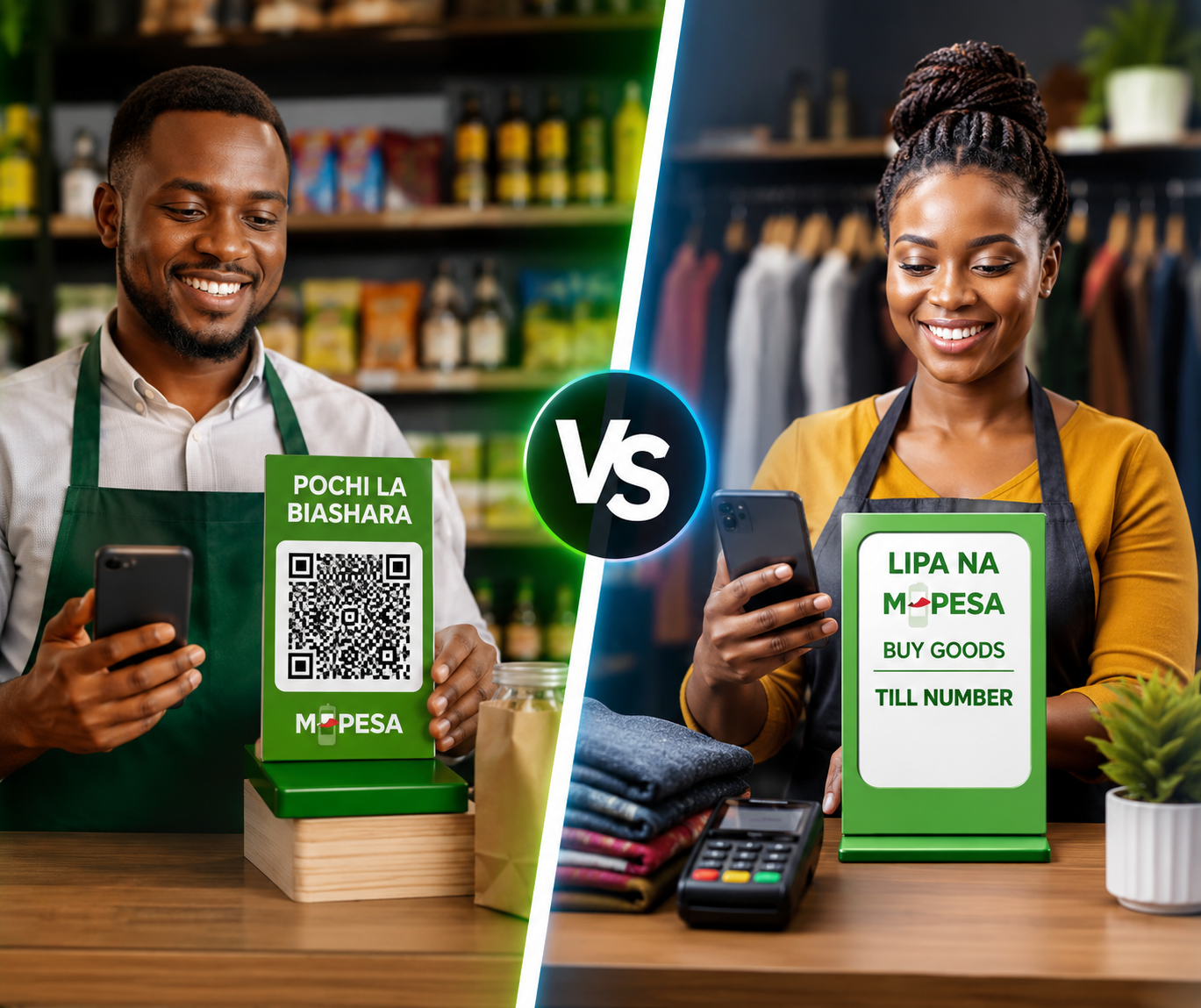
Businesses that rely on digital payments are set to benefit from lower transaction costs following Safaricom’s decision to revise M-PESA business tariffs.
The new charges, which take effect from August 7, 2026, are aimed at making digital payments more affordable while supporting the growth of small and medium-sized enterprises (SMEs) that handle high volumes of customer transactions.
“To make digital payments more affordable and support the growth of businesses across Kenya, Safaricom is introducing revised tariffs for Pochi la Biashara and Lipa na M-PESA Buy Goods,” the company said in a statement.

While both services enable businesses to receive payments through M-PESA, they are designed for different types of enterprises and attract different charges.
Pochi la Biashara
Pochi la Biashara is primarily designed for informal businesses, small traders, freelancers, home-based entrepreneurs and side hustlers who do not have registered businesses.
The service allows business owners to separate business income from personal funds while maintaining the convenience of using their existing M-PESA account.
Under the promotional tariffs valid between August 1 and October 31, 2026, customers sending between Sh1 and Sh200 will pay no transaction fee.
Payments ranging from Sh201 to Sh500 will attract a Sh7 charge, while transfers between Sh501 and Sh1,000 will cost Sh13.
Customers sending Sh1,001 to Sh1,500 will pay Sh23, whereas those making payments between Sh1,501 and Sh2,500 will be charged Sh33.
For larger transactions ranging from Sh2,501 to Sh250,000, the customer will pay a flat fee of Sh50.
The simplified flat-rate pricing makes Pochi la Biashara suitable for businesses that mainly receive low- to medium-value customer payments, such as market vendors, food kiosks, boda boda operators, online sellers and independent service providers
Lipa na M-PESA Buy Goods
Lipa na M-PESA Buy Goods is designed for registered businesses that use till numbers to receive customer payments. It is widely used by supermarkets, retail shops, restaurants, pharmacies and other merchants processing large transaction volumes.
Under the new tariffs, businesses using Buy Goods will benefit from lower collection charges. Payments of up to Sh500 will now be collected free of charge, compared to the previous threshold of Sh200.
At the same time, collections between Sh201 and Sh500, which previously attracted a 0.55 per cent fee, will also become free.
Transactions worth between Sh501 and Sh36,363 will continue attracting a 0.55 per cent collection fee, while collections exceeding Sh36,363 will remain subject to the maximum charge of Sh200.
How the Two Services Compare
The main difference between the two services lies in how transaction costs are structured.
Pochi la Biashara applies fixed customer charges based on the amount sent. A customer paying Sh2,600 or even Sh100,000 will incur the same maximum charge of Sh50, making it a predictable option for informal traders whose customers pay the transfer fee.
Buy Goods, on the other hand, does not charge customers for making payments. Instead, merchants pay a collection fee calculated as 0.55 per cent of the transaction value for payments above Sh500, with charges capped at Sh200 for high-value transactions.
Which Service Is Best?
The choice depends largely on the nature of the business.
Pochi la Biashara is better suited to informal traders, sole proprietors and micro-enterprises that need a simple payment solution without registering for a till number.
On the other hand, Buy Goods remains the preferred option for registered businesses that process high daily transaction volumes, issue receipts and require a dedicated merchant payment platform.
Also Read: Airtel Money deepens support for small businesses with Bizna Wallet