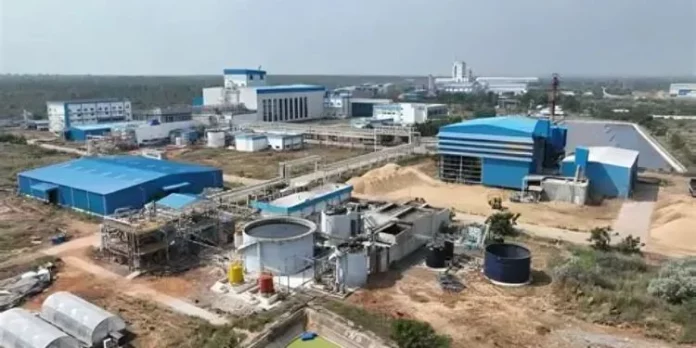
President William Ruto has ordered Tata Chemicals to end its operations in Kenya, accusing the century-old company of failing to deliver enough economic and industrial benefits to the country from its exploitation of soda ash at Lake Magadi in Kajiado County.
The President made the announcement on Thursday, September 3, 2026, during a visit to Kajiado, saying the company had held a contract for more than 100 years but failed to deliver value to local communities.
“That TATA company had that contract for 100 years. They have not built anything in Kajiado, they have not built any factory in Kajiado,” Ruto said.

Ruto said the government would bring in new investors to take over the operation, with the proposed operators expected to establish a large glass manufacturing plant and a chemical-processing facility in Kajiado.
“We have said we will bring a new company and they should put a big glass company here in Kajiado. And another company to make chemicals here in Kajiado,” he added.
The order follows a government directive issued in late July that suspended operations at the Tata Chemicals Magadi plant and halted exports of soda ash.
Tata Chemicals has said it respects the authority of the Kenyan government and remains committed to resolving the outstanding issues through the appropriate legal and regulatory channels.
What does Tata Chemicals do in Kenya?
Formerly known as Magadi Soda Company, Tata Chemicals Magadi has been a part of Tata Chemicals since 2005.
Tata Chemicals Limited, part of the global Tata group, is one of the world’s leading chemical companies, with a widespread portfolio of household products, industrial chemicals and agricultural inputs.
The company has operations in the United States, the United Kingdom, Kenya, and India.
The operation dates back to 1911, when it was established as the Magadi Soda Company. Today, it extracts trona, a naturally occurring mineral containing sodium carbonate compounds, from deposits around Lake Magadi and processes it into soda ash, also known as sodium carbonate.
Soda ash is a major industrial raw material. It is used in the manufacture of glass, detergents and a range of chemicals. The Magadi operation also produces different grades of salt for industrial and other applications.
According to the company, the Magadi operation is Africa’s largest soda ash manufacturer and one of Kenya’s leading exporters.
Financial statements indicate that about 90 per cent of its soda ash is exported, with markets including Southeast Asia, the Middle East, the Indian subcontinent and other African countries.
So, who actually owns Tata Chemicals?
Tata Chemicals Limited is an Indian publicly listed company, meaning its shares are held by a combination of promoter shareholders, institutional investors and members of the public.
As of June 30, 2026, Tata Chemicals’ largest shareholder was Tata Sons Private Limited, which held 31.90 per cent of Tata Chemicals’ equity.
Tata Investment Corporation Limited, another Tata group company, held a further 5.97 per cent. Other Tata-affiliated companies held smaller stakes, including Voltas Limited, Tata Industries Limited, Tata Capital Limited, Titan Company Limited and Tata Consumer Products Limited.
Taken together, the Tata promoter and promoter-group entities controlled approximately 37.98 per cent of Tata Chemicals as of June 30, 2026. The remaining 62.02 per cent was classified as public shareholding.
The Tata Trusts: the biggest owners behind the Tata empire
Tata Sons is the principal investment holding company and promoter of the Tata group. It sits at the centre of the sprawling business empire that includes Tata Consultancy Services, Tata Motors, Tata Steel, Tata Consumer Products, Tata Chemicals and numerous other companies.
According to the Tata Group, 66 per cent of Tata Sons’ equity is held by philanthropic trusts. These trusts support causes including education, healthcare, livelihoods, arts and culture.
Also Read: Why SMEs can’t afford to underinvest in employee healthcare