
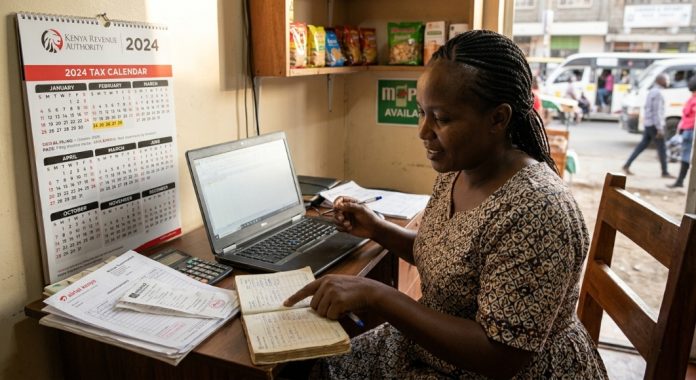
Running a small business in Kenya often means making quick decisions about sales, stock, staff and suppliers. Tax records can easily become an afterthought until a filing date approaches or a customer asks for an invoice that cannot be found.
Good record keeping is not only for large companies. It gives an SME a clearer view of cash flow, makes returns easier to prepare and provides evidence for the figures declared. This checklist focuses on practical habits a business can build month by month. It is general information, not advice on a business’s specific tax position.
1. Keep sales records from the day of the transaction
Every sale should leave a trace that can be checked later. That means retaining the invoice or receipt, the date, what was supplied, the amount, the customer where relevant and the payment method.

For businesses covered by the electronic invoicing rules, the invoice process should be built into the normal sales routine rather than treated as a month-end task. KRA says that persons engaged in business are required to onboard eTIMS and issue electronic tax invoices, including businesses that are not registered for VAT. Its eTIMS guidance also explains the available solutions and the cases where buyer-initiated invoicing may apply.
A simple daily sales record can include:
- Invoice or receipt number
- Date of sale
- Product or service supplied
- Amount before and after any applicable tax
- Payment channel, such as cash, M-Pesa, card or bank transfer
- Customer name or business name where an invoice was issued
At the end of each day or week, compare the total sales record with the till, M-Pesa statement, bank activity and any online-payment reports. This early check is much easier than trying to reconstruct a month of transactions later.
2. Treat expense evidence as part of the purchase process
An expense is easier to support when the document is collected at the point of purchase. Ask for a proper invoice or receipt before a supplier leaves, and save a digital copy if the original is likely to fade or get misplaced.
From the 2026 year of income, KRA says declared income and expenses must be supported by valid electronic tax invoices generated and transmitted through eTIMS or TIMS, subject to the applicable rules and exceptions. The KRA notice on 2025 income-tax returns confirms that the temporary allowance for certain unsupported 2025 expenses does not carry forward automatically.
For each business expense, retain:
- The supplier invoice or eTIMS record
- Proof of payment, such as an M-Pesa message, bank confirmation or card receipt
- The date and business purpose of the purchase
- The person who approved the spend, where the business has a team
- Any contract, delivery note or supporting correspondence for larger purchases
It is useful to group expenses consistently, for example stock, rent, transport, utilities, professional services, marketing and staff costs. A sensible category structure helps an owner see what is driving costs and makes a later review more efficient.
3. Separate business money from personal money
For sole proprietors and owner-managed businesses, the boundary between business and personal spending can become blurred. That creates uncertainty when the business is preparing accounts or explaining a transaction.
Use a dedicated business bank account and business mobile-money line where practical. When the owner takes money from the business or pays a personal cost from it, record the transaction clearly rather than describing it as an operating expense. The aim is not complicated bookkeeping. It is a record that explains where the money went.
Each month, reconcile the business cashbook to:
- Bank statements
- M-Pesa or other mobile-money statements
- Card and payment-gateway reports
- Petty-cash records
- Any outstanding customer invoices or supplier bills
Reconciliation helps identify duplicate payments, missed deposits, unexplained withdrawals and invoices that remain unpaid.
4. Maintain a tax calendar that matches the business’s obligations
There is no single filing schedule for every SME. The right calendar depends on the taxes for which the business is registered and how it operates. Assign one person to own the calendar, set reminders ahead of each deadline and review it whenever the business adds staff, changes turnover or begins a new activity.
Some important current KRA deadlines include:
- PAYE: Employers must file the return and remit deducted PAYE on or before the 9th day of the following month. See KRA’s PAYE guidance.
- VAT: VAT-registered businesses must submit the return and pay any VAT due on or before the 20th day of the following month. See KRA’s VAT guidance.
- Corporation tax: Companies file their income-tax return through iTax on or before the sixth month after the end of their accounting period. KRA explains this on its companies and partnerships filing page.
Deadlines, rates and obligations can change. Before acting, check the current KRA guidance for the business’s exact tax registration and circumstances.
5. Keep payroll records complete if you employ staff
Once an SME has employees, payroll needs the same discipline as sales and supplier records. The payroll file should show each employee’s pay, relevant deductions, employer costs, payment evidence and the return or remittance that followed.
For each payroll period, keep:
- The approved payroll register
- Employee pay details and approved changes to salary or allowances
- PAYE calculations and iTax filing confirmation
- Evidence of salary payments
- Supporting records for overtime, leave, bonuses and other adjustments
- Current statutory remittance confirmations where applicable
Do not rely on an old spreadsheet for rates or due dates. Check official guidance before finalising the payroll, especially when a policy or contribution rule has changed.
Why Facebook is deleting live videos; How to save past videos
6. Make a short month-end review non-negotiable
A month-end review does not need to be an all-day exercise. Its purpose is to identify missing records while the month is still fresh. A business owner or finance lead can work through the following questions:
- Do recorded sales agree with invoices and the money received?
- Are all supplier invoices and payment confirmations saved?
- Have cash, bank and M-Pesa balances been reconciled?
- Are unpaid customer invoices and supplier bills listed separately?
- Have payroll records and relevant deductions been checked?
- Does the tax calendar show the next return or payment due?
- Is the supporting evidence stored in a folder that another responsible person could understand?
Where records are spread across personal phones, paper files and different email accounts, begin by creating one controlled folder structure. A practical setup may use folders by year and month, then subfolders for sales, expenses, payroll, bank and mobile money, returns, and contracts. Use a clear naming format such as 2026-09-18_supplier-name_invoice-1042.pdf.
7. Know when the records need professional review
Bookkeeping habits do not replace advice where the tax treatment is uncertain. Seek qualified help early if the business is registering for a new tax, growing quickly, handling a KRA query, dealing with an assessment, or cannot reconcile the figures it has already filed.
It is also sensible to get help when the business has mixed personal and business transactions, cross-border payments, complex VAT questions or several employees. The earlier those records are organised, the easier it is to identify the real issue and respond accurately.
For a business facing a tax query or a mismatch in figures already filed, a review by Kenyan tax experts like Gichuri & Partners, a Nairobi tax consultancy can help establish which records and obligations need attention.
Common record-keeping mistakes SMEs can avoid
- Waiting until a return is due before collecting invoices and receipts
- Recording sales without matching them to payment evidence
- Treating personal withdrawals as ordinary business expenses
- Keeping only paper receipts that can fade or be lost
- Using an unsupported expense figure without checking the current eTIMS requirements
- Failing to reconcile M-Pesa activity alongside bank activity
- Copying a deadline or tax rate from an old spreadsheet without checking KRA’s latest guidance
The bottom line
Strong tax records are built through small, regular actions: issue and save invoices, retain evidence for expenses, separate business money, reconcile balances, monitor the right deadlines and review the file every month. That routine gives a Kenyan SME more reliable information for decisions today and a better when it is time to prepare returns.