

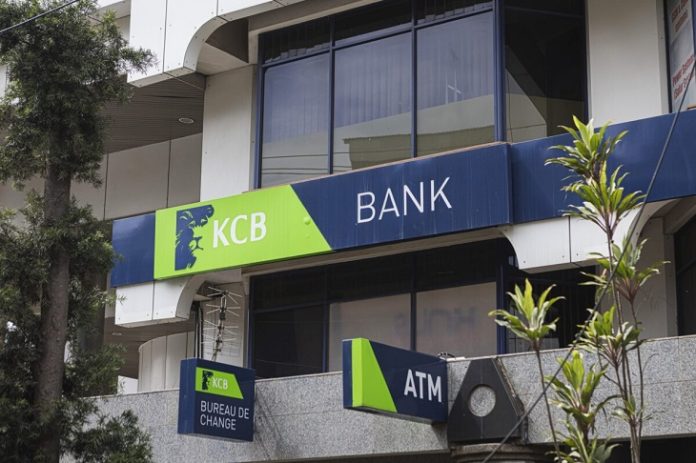
Kenya Commercial Bank (KCB) emerged as the country’s largest bank by market share in 2025, ahead of Equity Bank and Co-operative Bank of Kenya, according to the Central Bank of Kenya (CBK).
The ranking, contained in the CBK Bank Supervision Annual Report 2025, places KCB at the top with a composite market-share index of 17.3 per cent. The index is calculated using the size of a bank’s net assets, deposits, shareholders’ funds, deposit accounts and loan accounts.
KCB accounted for 17.9 per cent of the sector’s net assets, equivalent to Sh1.498 trillion, while its deposits of Sh1.152 trillion represented 18 per cent of the industry total. The bank also held 16 per cent of shareholders’ funds, 15.3 per cent of deposit accounts and 8.5 per cent of loan accounts.

Equity Bank ranked second with a composite index of 11.8 per cent. It controlled Sh1.041 trillion in net assets and Sh849.2 billion in deposits, representing 12.5 per cent and 13.3 per cent of the sector totals, respectively.
The lender accounted for 9.7 per cent of shareholders’ funds and had the largest proportion of deposit accounts among the leading banks, at 17.2 per cent. Its share of loan accounts stood at six per cent.
Co-operative Bank occupied the third position with a market-share index of 9.4 per cent. The bank had Sh759.4 billion in net assets and Sh539.4 billion in deposits, translating to 9.1 per cent and 8.4 per cent of the sector respectively.
Its share of shareholders’ funds stood at 10.7 per cent, while it accounted for 11.7 per cent of deposit accounts and 11.1 per cent of loan accounts.
NCBA Bank followed in fourth place with a 7.9 per cent index, while Absa Bank Kenya ranked fifth at 6.4 per cent.
Stanbic Bank Kenya recorded a 5.8 per cent market-share index. I&M Bank and Diamond Trust Bank (DTB) each posted 5.6 per cent, placing them seventh and eighth respectively.
Standard Chartered Bank Kenya ranked ninth with 4.5 per cent, followed by Prime Bank at 4.3 per cent.
Eight banks classified as large
The CBK assessed 39 commercial banks using a weighted composite measure covering five indicators: net assets, deposits, capital and reserves, deposit accounts and loan accounts.
Banks with a composite market-share index of at least five per cent were classified as large institutions. Those with an index of between one and five per cent fell into the medium category, while banks below one per cent were placed in the small peer group.
At the close of 2025, eight banks met the threshold for the large-bank category. Collectively, they accounted for 69.7 per cent of the banking sector, down from 75.6 per cent a year earlier.
The large banks held combined net assets of Sh5.892 trillion, deposits of Sh4.531 trillion and capital and reserves of Sh942 billion. Their combined profit before tax stood at Sh241 billion during the year.
The reduction in the large banks’ combined market share was mainly linked to the reclassification of Standard Chartered Bank Kenya, which moved into the medium-bank category during the year.
The medium-bank segment consequently expanded its share of the sector to 23.2 per cent in December 2025, from 16.7 per cent in December 2024.
The number of institutions in the medium category also rose from nine to 11, following the entry of Standard Chartered from the large group and Sidian Bank from the small-bank segment.
Banking sector assets cross Sh8 trillion
Across the 39 commercial banks, the sector’s total net assets rose to Sh8.35 trillion by December 2025.
Customer deposits stood at Sh6.385 trillion, while capital and reserves across the industry amounted to Sh1.404 trillion. The banking industry generated a combined profit before tax of Sh306 billion during the year.
Also Read: Kenya’s mobile subscriptions hit 88 Million as digital economy expands