

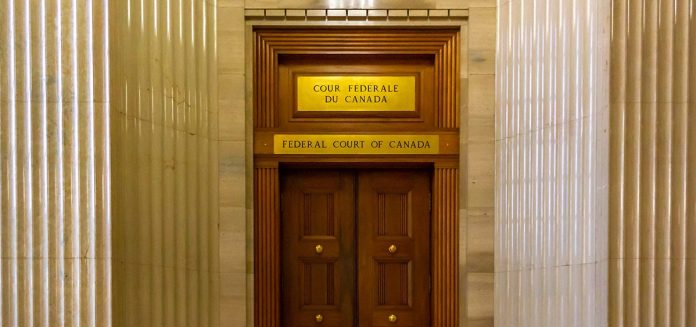
A Canadian court has found a Kenyan man inadmissible to Canada over a fraudulent marriage that he had previously entered into to gain a visit visa.
The Kenyan man who was identified as Bernard Nduva Musembi had gone to the federal court to contest the decision of the Immigration, Refugees and Citizenship Canada (IRCC) to deny his application for permanent residency.
According to the court ruling that was seen by Bizna Kenya, the IRCC had denied Musembi’s application for Canadian permanent residency after determining that he had falsely claimed to have been married when he applied for his visit visa on December 22, 2021. In this application, Musembi had claimed that he was married to a woman known as ‘Joan Nderitu’. heir marriage had began on December 20, 2018. This application was approved on April 14, 2023.
Days after the approval, on May 17, 2023, Musembi traveled to Canada. He claimed before customs officials that he had traveled to visit his fiancée Mary Wanjohi whom he had met in Kenya around January 2022. Barely two months later, on July 4, 2023, Musembi and Wanjohi got married in Ottawa, Canada.

Four months later on November 18, 2023, Musembi applied to become a permanent resident of Canada under the Spouse or Common-Law Partner in Canada Class. In his application, he answered ‘No’ to the question that asked if he had previously been married or in a common-law relationship.
This was contrary to what he had filled in his application for the visit visa. The IRCC red-flagged this discrepancy and sent Musembi a procedural fairness letter that was dated August 27, 2024. The letter asked Musembi to explain why he had claimed to be married to two different women in his applications. He was also asked to present a divorce letter showing that he had been divorced from the Joan before he married Mary. He was given 14 days to respond.
“In a response dated August 30, 2024, [Bernard Nduva Musembi] stated that an agency called Shipe Travels had assisted him with his [visit visa application] and, without his knowledge or consent, indicated he was married to a “Joan Nderitu”
, so as to improve his chances of obtaining the requested visa. He stated that he had never met “Joan Nderitu”
and had never been married to her,” the court ruling stated.
See More: Nairobi agent has left me jobless, broke and banned from Canada for 5 years
A few weeks later, On September 13, 2024, the IRCC refused his permanent residence application, finding him inadmissible for misrepresentation.
The IRCC determined that he had directly or indirectly misrepresented material facts relating to a relevant matter in relation to his marital status, which induced or could have induced an error in the administration of the Immigration and Refugee Protection Act.
Following this decision, Musembi went to court seeking for a judicial review. He claimed before the court that the IRCC decision was both unreasonable and procedurally unfair.
However, in the federal court ruling dated October 8, 2026, Justice François Joyal of the federal court in Montréal, Québec, ruled that all steps that were followed by the IRCC were fair and reasonable. The judge ruled that Musembi had bee provided with time to respond to the concerns that had been raised, and he had gone on to submit written and documentary evidence in his response.
Justice Joyal further determined that Musembi could not have claimed to have not known that he was married because he had been questioned about his relationship with Joan by an officer of the Customs and Border Services Authority (CBSA) at the point of entry when he first landed in Canada to visit Mary.
“The point of entry examination [by the CBSA officer] ought to have put [Musembi] on notice in May 2023 that immigration authorities had information identifying him as married. It could not reasonably have led him to believe that the issue was settled,” Justice Joyal ruled. He then upheld the decision of the IRCC and dismissed Musembi’s petition. “For these reasons, I am dismissing the application for judicial review.”
In Canada, persons who are found inadmissible for misrepresentation under Section 40 of the Immigration and Refugee Protection Act (IRPA) do not only face refusals but also face five-year ban from entering Canada. Those who are already in Canada face removal orders.