

Kenyan commercial banks are increasingly shifting their lending strategies from traditional primary production to value addition, aiming to plug local small and medium-sized enterprises (SMEs) into global supply chains.
Leading this strategic pivot is Equity Bank, which is accelerating its push to transition grassroots businesses from raw material producers to competitive players in the global market.
This accelerated push was the focal point during a recent high-level business dinner held between Equity Bank’s executive leadership, the Narok County Government, and the local business community. Once heavily anchored on the Maasai Mara National Reserve and rain-fed wheat farming, Narok is rapidly transforming into a formidable commercial hub, serving as a blueprint for this new wave of local enterprise development.

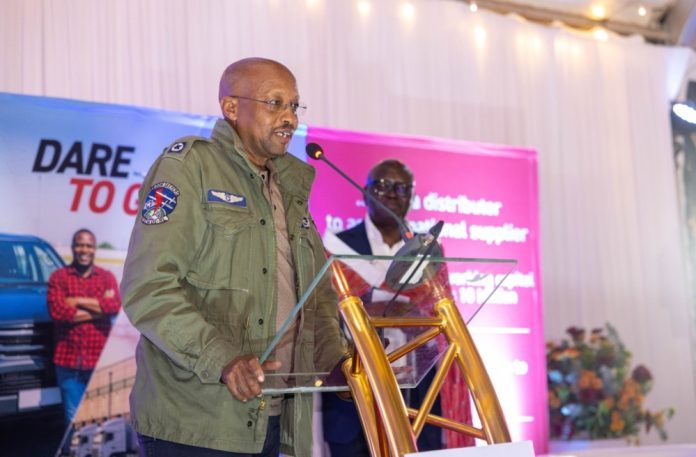
Equity Bank Managing Director Moses Nyabanda noted that the focus must shift toward “smart agriculture” and market linkages to unlock the true wealth of local enterprises.
“We are seeing farmers adopting smart agriculture, moving away from how our forefathers farmed,” Mr. Nyabanda said. “But we do not just want to increase yields; we want to connect you to the market. If you are a livestock farmer, we want to see how we can link you to markets that buy processed leather for designer bags, rather than selling raw hides for a fraction of the price.”
To further de-risk the agricultural sector, which remains highly sensitive to weather patterns, Mr. Nyabanda committed to aligning loan disbursement timelines strictly with local crop cycles, assuring farmers of a two-week turnaround time for agricultural credit to ensure planting seasons are not missed.
This focus on targeted capital deployment is driven by rapid, multi-sectoral economic expansion in regions outside traditional urban centers.
“Narok is not a small market to us,” noted Kagiso Moloi, Equity Bank’s Commercial Director. “Livestock business is growing, trade is growing, and tourism is growing. People in Nairobi may not realize how fast this region is expanding. Our job is to fund that growth and move money quickly and safely.”
To sustain this momentum and build capacity for global export, lenders are deploying aggressive asset finance and unsecured credit lines to stimulate local enterprise.
“If you want a tractor or a commercial truck, we are ready to support you with up to 105 per cent financing,” said Carol Rutto, Equity Bank Kenya’s Head of Retail and Branch Business. “We are also offering unsecured loans of up to Sh10 million without requiring you to pledge any collateral at the bank. Our doors are open to serve you exactly how you need.”
Historically, access to credit in agrarian regions was stifled by stringent collateral requirements, locking many out of the commercial supply chain. Okipira Ole Tutai, a veteran farmer who began his agribusiness journey in 1985, recalled how state-backed agricultural financiers strictly demanded title deeds, a near impossibility for young farmers in communally held land systems.
Equity Bank unveils loan for farmers seeking funds for farm development
“From 1985 to 1994, I had never received a loan anywhere. With state financiers, you had to have a title deed, which we didn’t have as young men. There was simply no way to access credit,” Mr. Tutai recalled. The entry of flexible, cash-flow-based lending altered this landscape, allowing farmers like him to scale from subsistence to commercial operations, eventually acquiring tractors and commercial real estate.
This flexible approach to banking has also been crucial for insulating SMEs from macroeconomic shocks. Education investors in the region noted that strategic interventions such as loan moratoriums were the lifeline that prevented mass closures of private educational institutions during the Covid-19 pandemic. By putting loan repayments on hold until the economic environment stabilized, institutions were able to survive the crisis and later leverage bank financing to acquire land and build infrastructure.
However, as credit uptake increases, so does the conversation around loan recovery, a sensitive issue in Kenya’s banking sector amid rising non-performing loans (NPLs). Speaking at the forum, Narok County Executive Committee Member for Finance, David Ole Muntet, urged financial institutions to adopt more humane default management strategies.
“Borrowing is a wedding, but paying back can feel like a funeral,” Mr. Muntet remarked. “While people must pay their loans, we urge banks to find better approaches to handling defaulters rather than immediately auctioning properties. There is always a way out.”