

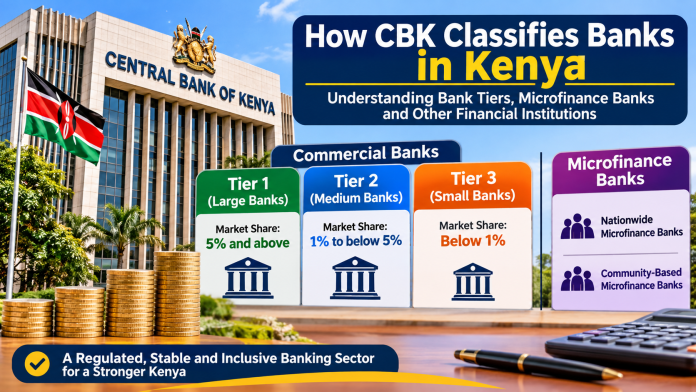
Kenya’s banking industry comprises different categories of financial institutions, ranging from large commercial banks serving millions of customers to smaller banks and microfinance institutions targeting individuals, small businesses and underserved communities.
The Central Bank of Kenya (CBK) is responsible for regulating and supervising the country’s banking sector. Through its regulatory framework, the Central Bank classifies financial institutions according to their licences, size, business models, capital requirements and the nature of financial services they are authorised to provide.
Understanding how CBK classifies banks and other financial institutions is important for customers, investors, businesses and anyone seeking to understand Kenya’s financial services industry.

One of the most commonly used classifications in Kenya’s banking industry is the division of commercial banks into Tier 1, Tier 2 and Tier 3 categories.
However, these tiers are different from the licensing categories used to distinguish commercial banks from microfinance banks and other regulated financial institutions.
KCB leads banking market as StanChart drops out of top tier
1. How CBK classifies commercial banks in Kenya
The Central Bank of Kenya uses a weighted composite index to classify commercial banks into three peer groups based on their relative size and market position.
According to the CBK Bank Supervision Annual Report 2025, the classification considers five key indicators:
-
Total net assets: The overall value of a bank’s assets after liabilities.
-
Total deposits: The amount of money customers have deposited with the bank.
-
Capital and reserves: The financial resources available to support the bank’s operations.
-
Number of deposit accounts: The size of the bank’s customer deposit base.
-
Number of loan accounts: The number of credit accounts maintained by the institution.
The regulator combines these indicators into a weighted market-share index to determine the category in which each bank falls.
The three categories of banks in Kenya
Tier 1 – Large banks
- 5% and above
- These are banks with a weighted composite index of at least 5%. They command a significant share of the banking industry and generally have extensive branch networks, large customer bases and substantial financial resources.
Tier 2 – Medium banks
- 1% to below 5%
- These are banks whose weighted composite index is at least 1% but below 5%. They occupy the middle segment of the industry and serve individuals, businesses and corporate customers.
Tier 3 – Small banks
- Below 1%
- These are banks with a weighted composite index of less than 1%. They generally have a smaller share of the banking market and may focus on specialised customer segments, particular regions or niche financial services.
How many banks fall into each category?
The CBK’s 2025 Bank Supervision Annual Report shows that Kenya had 39 commercial banks at the end of December 2025.
Their distribution was as follows:
| Bank category | Number of banks | Combined market share |
|---|---|---|
| Tier 1 – Large | 8 | 69.7% |
| Tier 2 – Medium | 11 | 23.2% |
| Tier 3 – Small | 20 | 7.1% |
| Total | 39 | 100% |
This means that eight large banks controlled almost 70% of the commercial banking industry’s weighted market share, while 20 small banks collectively accounted for just 7.1%.
The figures demonstrate the concentration of financial resources and market activity among Kenya’s largest banking institutions.
14 Banks face downgrade as CBK enforces KSh 5 Billion capital requirement by December 2026
2. Examples of Tier 1, Tier 2 and Tier 3 banks in Kenya
The CBK’s December 2025 classification provides the following examples of institutions in the three categories.
Tier 1: Large commercial banks
These eight institutions collectively accounted for 69.7% of the weighted market share in December 2025.
Tier 2: Medium commercial banks
- Standard Chartered Bank Kenya.
- Prime Bank.
- Bank of Baroda Kenya.
- Family Bank.
- Citibank N.A. Kenya.
- Bank of India Kenya.
- National Bank of Kenya.
- SBM Bank Kenya.
- Sidian Bank.
- Ecobank Kenya.
- Housing Finance Company of Kenya.
The 11 banks collectively controlled 23.2% of the market in December 2025.
Tier 3: Small commercial banks
- Victoria Commercial Bank.
- Gulf African Bank.
- Bank of Africa Kenya.
- GTBank Kenya.
- ABC Bank.
- Kingdom Bank.
- Habib Bank AG Zurich.
- Dubai Islamic Bank Kenya.
- Premier Bank Kenya.
- CIB Kenya.
- Credit Bank.
- Development Bank of Kenya.
- Middle East Bank Kenya.
- Guardian Bank.
- Paramount Bank.
- M-Oriental Bank.
- UBA Kenya.
- Access Bank Kenya.
- Consolidated Bank of Kenya.
- Spire Bank.
The 20 institutions collectively held 7.1% of the banking industry’s weighted market share at the end of 2025.
Kenyan Banks with the cheapest and most expensive loans in 2026
3. How CBK classifies microfinance banks in Kenya
Unlike commercial banks, which are grouped into large, medium and small peer groups, microfinance banks operate under a separate regulatory framework established by the Microfinance Act, 2006.
The Central Bank of Kenya recognises two main categories of deposit-taking microfinance banks:
A. Nationwide microfinance banks
These are microfinance institutions licensed to operate across the country.
They can establish branches and offer services in different parts of Kenya, subject to CBK licensing and regulatory requirements.
Their services include:
- Accepting deposits from customers.
- Providing loans to individuals and businesses.
- Financing micro and small enterprises.
- Offering savings products.
- Providing financial services to customers who may have limited access to conventional banking.
B. Community-based microfinance banks
These are institutions licensed to provide microfinance banking services within a defined geographical area or community.
Their operations are generally more geographically focused than those of nationwide microfinance banks.
They play an important role in providing financial services to small businesses, traders, farmers, low-income households and other underserved communities.
The distinction between nationwide and community-based microfinance banks is therefore mainly based on their authorised geographical scope of operations.
Importantly, both categories are regulated by CBK and must comply with the applicable licensing, capital, liquidity, reporting and operational requirements.
4. What is the difference between commercial banks and microfinance banks?
Although both commercial banks and microfinance banks provide financial services, they operate under different licensing frameworks.
| Feature | Commercial banks | Microfinance banks |
|---|---|---|
| Main legislation | Banking Act | Microfinance Act, 2006 |
| Regulator | CBK | CBK |
| Deposits | Accept public deposits | Licensed deposit-taking MFBs accept public deposits |
| Lending | Individuals, SMEs and large corporations | Individuals, microenterprises and SMEs |
| Classification | Large, medium and small peer groups | Nationwide and community-based |
| Main focus | Broad banking services | Expanding access to financial services |
Commercial banks generally have a wider range of products, including corporate banking, international trade finance, foreign exchange, investment-related services and large-scale business financing.
Microfinance banks primarily focus on expanding access to savings and credit facilities, particularly among individuals and smaller enterprises.
However, the services offered by individual institutions depend on their respective licences and regulatory permissions.
Do you know them? Career profile of CEOs of biggest Kenyan banks
5. Other financial institutions regulated by the Central Bank of Kenya
CBK’s regulatory responsibilities extend beyond commercial banks and microfinance banks.
The regulator also licenses and supervises several other financial institutions and service providers.
These include:
A. Mortgage finance companies
Mortgage finance institutions provide financing for property purchases, construction and other housing-related activities.
They operate under the Banking Act and applicable CBK regulations.
B. Digital credit providers
Digital credit providers are institutions that offer loans through digital platforms, including mobile applications and online channels.
CBK was empowered to regulate digital credit providers following the Central Bank of Kenya (Amendment) Act, 2021.
The Digital Credit Providers Regulations, 2022, established the framework for licensing and supervising these businesses.
Unlike commercial banks and deposit-taking microfinance banks, digital credit providers are not authorised to accept deposits from the public simply by virtue of holding a digital credit provider licence.
C. Foreign exchange bureaus
Forex bureaus are licensed businesses that provide foreign currency exchange services.
They facilitate the buying and selling of foreign currencies and operate under CBK regulations and guidelines.
D. Money remittance providers
These are companies authorised to facilitate the transfer of money within Kenya and across international borders.
They provide services used by individuals, businesses and Kenyans living abroad who send money to family members and other recipients.
E. Credit Reference Bureaus (CRBs)
Credit Reference Bureaus collect, process and distribute credit information relating to individuals and businesses.
They provide credit reports that financial institutions use when assessing loan applications and determining the creditworthiness of borrowers.
F. Representative offices of foreign banks
These are offices established in Kenya by international banking institutions that want to maintain a local presence without operating as fully licensed commercial banks.
Their authorised activities are generally limited to research, marketing and liaison services.
They cannot conduct ordinary banking business or accept deposits from the public in Kenya.
CBK’s supervision framework covers these institutions according to their respective legislation and licences.
Full list of Tier 1, 2, and 3 banks in Kenya
6. Does being a Tier 3 bank mean an institution is unsafe?
Being classified as a Tier 3 bank does not automatically mean that a financial institution is financially unstable or unsafe.
The classification primarily measures the bank’s relative size and market position within the banking industry.
A small bank may have adequate capital, strong management, good liquidity and effective risk management systems despite having a relatively small market share.
Similarly, being classified as a Tier 1 bank does not automatically mean that an institution is free from financial risks.
CBK uses a separate approach known as Risk-Based Supervision (RBS) to assess the financial health and risk profile of individual institutions.
Under this framework, the regulator evaluates factors such as:
- Capital adequacy.
- Liquidity and ability to meet financial obligations.
- Credit risk and non-performing loans.
- Corporate governance.
- Internal controls and risk management.
- Compliance with banking laws and regulations.
The objective is to identify potential weaknesses early and ensure that institutions operate within acceptable regulatory standards.
7. Why CBK’s classification of banks matters to customers and businesses
The classification of commercial banks and other financial institutions has several implications for Kenya’s economy.
1. Helps customers understand the banking industry
Customers can understand the relative size of different banks and the extent of their market presence when choosing where to save or borrow money.
2. Promotes financial sector transparency
The classification provides information about the distribution of financial resources and market concentration within the banking industry.
3. Supports financial stability
CBK uses its supervisory framework to monitor institutions, identify emerging risks and protect the stability of the financial system.
4. Helps investors assess the banking sector
Investors can use information about bank assets, deposits, capital and market share to understand the competitive position of different institutions.
5. Supports financial inclusion
The recognition and regulation of microfinance banks help expand access to financial services among individuals and businesses that may not be adequately served by conventional commercial banks.
8. Where can Kenyans find the official list of licensed banks and microfinance institutions?
Kenyans can obtain information about licensed financial institutions directly from the Central Bank of Kenya.
The regulator publishes directories and banking supervision reports containing information about licensed institutions and developments in the financial sector.
Customers should always verify that a financial institution is appropriately licensed before depositing money, borrowing or engaging in other financial transactions.
What investors need to look out for after strong H1 2026 performance by banks
9. Frequently asked questions about bank classification in Kenya
How many tiers of banks are there in Kenya?
CBK groups commercial banks into three peer groups: large banks (Tier 1), medium banks (Tier 2) and small banks (Tier 3).
What determines whether a bank is Tier 1, Tier 2 or Tier 3?
The classification is based on a weighted composite index incorporating net assets, deposits, capital and reserves, deposit accounts and loan accounts.
What is the difference between Tier 1 and Tier 3 banks?
Tier 1 banks have a weighted composite index of at least 5%, while Tier 3 banks have an index below 1%. The distinction relates to market size rather than an automatic assessment of financial safety.
Are microfinance banks classified as Tier 1, Tier 2 and Tier 3?
No. Deposit-taking microfinance banks have a separate classification framework that distinguishes between nationwide and community-based institutions.
Does CBK regulate digital lending companies?
Yes. CBK licenses and supervises digital credit providers under the Central Bank of Kenya (Amendment) Act, 2021, and the Digital Credit Providers Regulations, 2022.
Can a Tier 3 bank accept deposits from customers?
Yes. A commercial bank classified as Tier 3 is still a licensed commercial bank and can provide authorised banking services, including accepting deposits.
Does a Tier 1 classification mean a bank has more money than all Tier 2 and Tier 3 banks?
No. The classification is based on a weighted composite index and not simply on the amount of money held by an institution.
Understanding Kenya’s banking industry framework
The Central Bank of Kenya’s classification framework provides an important way of understanding the country’s financial services industry.
By grouping commercial banks into large, medium and small peer groups, CBK provides a picture of how financial resources and market activity are distributed across the sector.
At the same time, the separate classification of microfinance banks into nationwide and community-based institutions recognises the different roles these institutions play in expanding financial inclusion.
For customers, businesses and investors, understanding these classifications provides useful insight into the structure of Kenya’s banking industry and the regulatory framework governing financial institutions.
Ultimately, the size of a bank should not be the only consideration when choosing a financial institution. Its financial health, regulatory compliance, customer service, products and suitability for individual financial needs are equally important.