

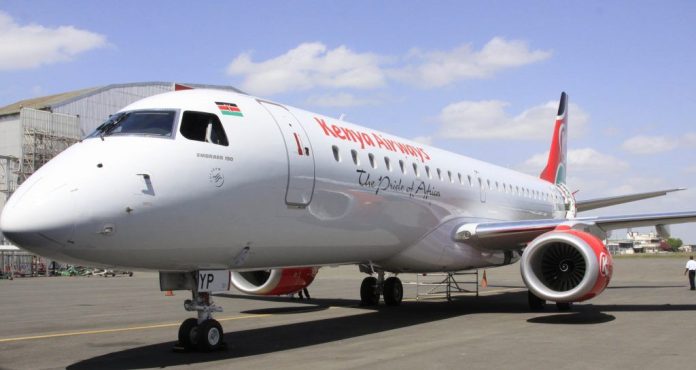
The national carrier Kenya Airways is still struggling to get its grounded aircraft up in the air again. The grounded aircraft include three Kenya Airways Embraer jets and three Boeing Dreamliners.
The grounded aircraft is currently representing 18 percent of the carrier’s seat capacity.
“We have three Embraer jets on the ground waiting for engines and landing gears. We also have two Boeing 787s waiting for engines, and one requiring heavy checks,” George Kamal, the KQ acting group managing director and chief executive officer said.
“We have an engine coming from the shop on June 19 and a second engine coming on July 15. This is due to supply chain issues, which is not something localized for Kenya Airways. It’s something impacting most airlines globally.”

Grounded aircraft has been a thorn in the flesh of the national carrier over the past one year. The grounded aircraft was blamed for the mega net loss of Sh17.2 billion in the full financial year 2025.
“Overall performance and operations in the year 2025 were severely impacted primarily by the temporary grounding of three of the wide body fleet, Boeing 787-8 Dreamliner aircraft. This was driven by the global supply chain constraints and limited engine availability,” Kenya Airways had attributed the loss.
During that year, Available Seat Kilometres (ASKs) declined by 18 percent to 13,349 million, while passenger numbers dropped by 13 percent.
In the first six months of the 2025 year, 33 percent of the carrier’s wide-body aircraft was grounded. The grounding of the aircraft resulted in a 14 percent drop in passenger numbers and a 19 percent drop in Revenue Passenger Kilometres (RPKs).
“While our financial performance reflects a challenging year, it is important to recognize that this was driven primarily by global supply chain disruptions and not a lack of demand,” Kenya Airways Chairman, Kiprono Kittony had said. In the previous 2024 financial year, KQ had returned a historic net profit of Sh5.4 billion.
The airline says that it is working to restore its full fleet by the of the current financial year, which could be interpreted as meaning that shareholders might still be in the woods this current financial year.
One of the measures taken by Kenya Airways to offset part of the lost passenger capacity is the reintroduction of its Boeing 777-300ER which the airline had leased out to Turkish Airlines. This plane shall bring on board its 400-seater capacity and is expected to bring down the grounded passenger capacity from 18 percent to between six and eight percent.
In addition, Mr Kamal said that the airline will be adding more aircraft over the medium future by acquiring more planes including the Boeing 737-Max jets.
“We took the decision in February 2026 to slow down and move our plan to acquire Boeing 737-Max jets forward to 2027. However, our end goal, say in 2030, we are looking at 60 aircraft and 100 in 2035,” said Kamal. “Not all of them will be owned aircraft; some will be owned, and others shall be leased.”
SEE MORE: Ethiopian Airlines orders 6 brand new Airbus A350-900 planes
The national carrier’s aircraft is majorly dominated by Boeing jets with Embraer models coming a distant second. The airline has a low to zero hold on Airbus airplanes unlike regional rivals such as Ethiopian Airlines which operates a mixture of Boeing and Airbus aircraft.
By the end of the previous financial year on December 31, 2025, the national carrier operated 37 owned and, or leased air- craft that comprised of seven Boeing 787 wide-body jets, nine Boeing 737 narrow-body jets, seven Embraer regional jets, four Boeing 737 freighters and 10 Bombardier Dash 8-400.