



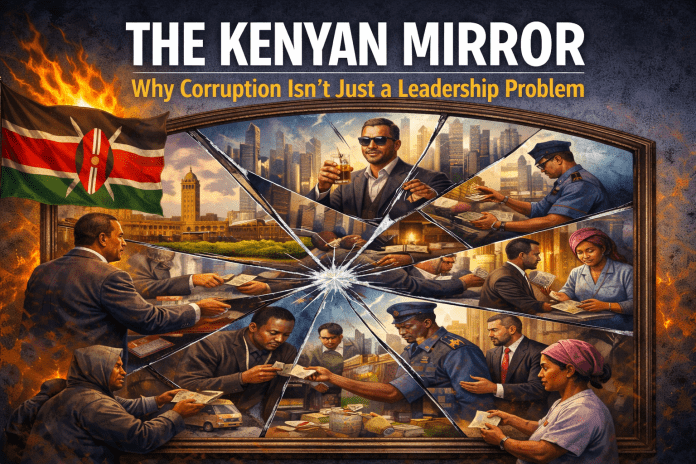
For decades, the Kenyan conversation has been dominated by a single villain: “The Government.” We gather in markets, offices, and on social media to lament the state of the nation, pointing trembling fingers at the presidency and Parliament. We cry for change, we vote for “saviours,” and yet, as each administration passes, the song of corrupt government remains the same since Jomo Kenyatta’s time to President Ruto.
But if the faces at the top change and the corruption remains, we must ask ourselves a painful question: Is the problem the throne, or is it the people who supply the kings?
The math of morality
There are roughly 55 million Kenyans and only a few thousand high-ranking officials. Mathematically, the leadership is a tiny fraction of the population. These leaders do not drop from an “alien land” or descend from the clouds; they are born in our hospitals, raised in our neighbourhoods, and taught in our schools. They are our brothers, our cousins, and our former classmates.

When we blame the President for the “culture of corruption,” we ignore the fact that he is not there when a domestic worker steals from their employer, or when an office clerk demands a “facilitation fee” to move a file. He isn’t there when we use nepotism to hire a less-qualified relative over a deserving stranger.
The religious paradox
Kenya is a deeply religious nation. Our religious institutions, from churches, mosques, temples, etc., are full every week, yet our workplaces are often dens of dishonesty. We have developed a “split personality” where we can pray loudly on Friday in the mosque and Sunday in church and practice petty theft or bribery on Monday. We demand integrity from the State House while we lack it in our own households.
EACC launches bible study to fight corruption
“Hands-Off” culture
We have mastered the art of avoiding responsibility. In Kenya, the “bad guy” is always someone else.
We have a culture of passing the buck. We expect a single leader to clean up a mess that 55 million of us are contributing to daily. We steal from our own relatives and sabotage our own employers, then act shocked when a Cabinet Secretary is accused of the same thing on a larger scale.
The seed and the soil
If you plant a seed in toxic soil, it doesn’t matter how “good” the seed is; the plant will eventually wither or turn toxic itself. Our leaders are the fruit of our society. If the society values shortcuts, “kitu kidogo,” and tribal favouritism, the leaders will reflect those exact vices.
The only way out
We cannot demand a “New Kenya” if we are still the “Old Kenyans.” True revolution is not found in the ballot box alone; it starts at the dining table, the office desk, and the local shop.
Before we point a finger at the leadership, we must look at our own hands. Are they clean? Change will only happen when we realize that the government is simply a mirror of the people. If we want a different reflection, we have to change the face looking into the mirror.
Africa: The Incredible Wealth, Exploitation, Corruption and Poverty for its people
About the author
Mulumi Mwangi is a seasoned businessman with more than five decades of life experience, bringing a rare depth of perspective to both enterprise and writing. Trained as an electrical engineer, he has founded, built, and managed ventures across diverse sectors, including advertising, marketing, agribusiness, real estate, and fintech.
His writing is firmly grounded in lived experience. It draws from family life as a father, husband, brother, and uncle; from public life through his service as a national political party official; and from the hard lessons of business, both failure and success. These experiences, combined with everyday social interactions, have shaped a reflective and pragmatic worldview.
Mulumi’s work is offered as a personal perspective rather than a prescription. His views are candid, experience-driven, and open to debate—acknowledging that insight is often refined through dialogue, reflection, and the humility to accept that one may be right or wrong.
Fixing Kenya’s food crisis: Why policy and distribution matter more than production
About the author
Mulumi Mwangi is a seasoned businessman with more than five decades of life experience, bringing a rare depth of perspective to both enterprise and writing. Trained as an electrical engineer, he has founded, built, and managed ventures across diverse sectors, including advertising, marketing, agribusiness, real estate, and fintech.
His writing is firmly grounded in lived experience. It draws from family life as a father, husband, brother, and uncle; from public life through his service as a national political party official; and from the hard lessons of business, both failure and success. These experiences, combined with everyday social interactions, have shaped a reflective and pragmatic worldview.
Mulumi’s work is offered as a personal perspective rather than a prescription. His views are candid, experience-driven, and open to debate—acknowledging that insight is often refined through dialogue, reflection, and the humility to accept that one may be right or wrong.