



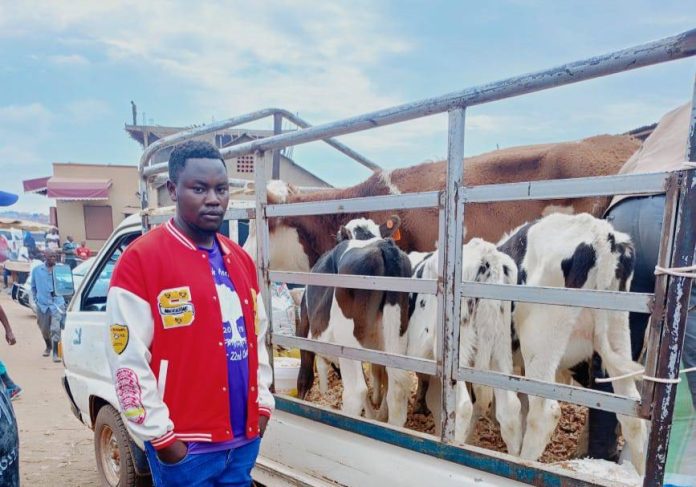
In the rolling hills of Njambini in Nyandarua County, dairy farmer Paulito Kamau is quietly building a success story rooted in passion and careful planning.
Four years ago, Kamau began his dairy venture with just two cows. Today, his herd has grown tenfold to 20 cows a transformation he attributes to strategic feeding, proper animal husbandry and lessons learned from his father, who was also a dairy farmer.
“I was motivated to venture into dairy farming by my father who is also a dairy farmer. I grew up watching him make profit from selling milk and that experience shaped my interest in farming,” he said in an interview with Kilimo Faida.

Structured Feeding Programme
At the heart of Kamau’s success is a strict feeding regime designed to maximise production while maintaining animal health.
His cows are fed daily on a combination of forage and concentrates. The forage includes silage and hay, while concentrates consist of dairy meal and supplements such as sunflower, soya, cotton, canola and fish meal blended together to provide balanced nutrition.
Each cow receives 20 kilogrammes of silage mixed with super Napier grass and supplements every day. Dairy meal rations are adjusted based on milk production levels.
“A cow producing 30 litres a day is given between 8 and 10 kilograms of dairy meal daily. Those averaging 20 litres we feed them 6kgs while those producing less than that are fed 4 kgs,” he explained.
Managing Heifers and Future Stock
Kamau is equally deliberate in managing his replacement stock. He begins steaming at seven months in-calf.
Steaming is the practice of feeding in-calf dairy cows higher amounts of energy-rich concentrates. It is done to prepare the cow for lactation, boost colostrum quality, ensure healthy calf growth, and prevent metabolic diseases like milk fever.
Kamau explains that each heifer is given three kilograms of dairy meal in the morning and two kilograms in the evening, alongside ample forage and plenty of clean water.
Of his 20 cows, 10 are currently lactating. The highest producer yields 30 litres per day, while the lowest among the milking cows produces 20 litres daily.
Most of his produce is destined for Co-operative Societies and fetches Sh50 per litre. He admits that dairy farming is not without its hurdles. Disease outbreaks remain a constant threat, while fluctuating and sometimes low milk prices can make farm management challenging.
Even so, he maintains that dairy farming remains one of the most profitable agricultural ventures when approached professionally.
“With the right breeds, proper feeding, and good management, dairy farming pays. Anyone thinking of venturing into it should go for it,” he advises.
How much feed does a cow need to produce 1 liter of milk?
According to dairy experts, a cow needs an average of 1.25 to 1.44 kilograms of feed to produce 1 liter of milk. This translates to approximately 0.63 to 0.72 kilograms of dry matter, which represents the nutrient content of the feed with all water removed.
The exact feed-to-milk ratio depends on factors such as the cow’s lactation stage, breed, health, and the quality of the feed provided.
Experts note that dairy cows experience their highest milk production levels in early lactation, which occurs within the first 100 days after calving. During this period, a cow can produce an average of 40 liters of milk per day.
This means the animal would need 50 kilograms of feed daily, half of which is dry matter, resulting in a feed-to-milk ratio of 1.25 kilograms of feed per liter of milk and a milk-to-dry matter intake ratio of 1.6 liters per kilogram.
In late lactation, typically over 200 days into the milking period, milk production declines to an average of 25 liters per day.
Correspondingly, feed intake reduces to about 36 kilograms per day. The feed-to-milk ratio during this stage is approximately 1.44 kilograms of feed per liter of milk, with a milk-to-dry matter intake ratio of 1.4 liters per kilogram.
Tanalope Consultancy Limited CEO Alex Gathii says for a dairy cow to produce optimally, it needs dry matter equivalent to at least 3 percent of its body weight. For instance, if the cow weighs 600kg then its total feed should amount to at least 18kg of dry matter per day.
Also Read: John Kiehia: Amount of money I make after investing Sh1 million in mushroom farming