



Wajir, a town in the North Eastern part of Kenya, is known for its camel and cattle trading business which is the economic mainstay for many people in the region, given the harsh climate that is unsuitable for crop farming.
Persistent drought in the region has for years left thousands of people starving and thousands of cattle dead. The perennial food problem in the region is one of the challenges Mohamed Hassan stepped up to solve by ditching livestock for crop farming.
The engineer by profession, born and raised in Bute location in Wajir, diverted into crop farming after drought swept all their cattle, leaving him and his family without a solid source of income.

“Faced with the challenges of a changing climate and the loss of our cattle, turning to farming became my beacon of hope amidst the arid landscape,” he said.
The farmer committed himself to mastering the art of farming and started by identifying crops that do well in the region and immersed himself in learning innovative techniques.
He adopted water conservation methods, such as rainwater harvesting and drip irrigation, to ensure a consistent flow of water into his farm. Hassan also embraced the use of drought-tolerant crop varieties, mitigating the risks of crop failure.
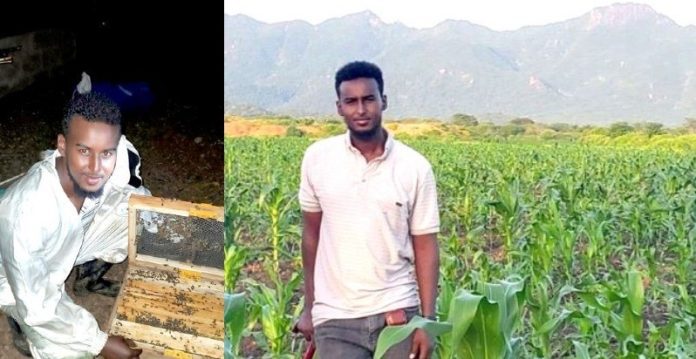
His 40-acre parcel of land under cultivation hosts various drought-resistant crops including maize, green grams, and cowpeas.
Experts say that planting drought-resistant crops can improve the nutrition status of 100,000 households by over 25 percent and also increase yields of targeted crops by 30 percent, as well as reduce post-harvest losses by 30 percent.
Apart from crop farming, Hassan has also ventured into Beekeeping and is a proud owner of several apiaries producing clean organic honey.
His success has inspired other farmers in the region to explore innovative agricultural practices, with others supporting him by linking him to buyers of his produce.
”For a start, I have offered to help young Mohamed to find a market for his organic honey. I buy a lot for my own use and will support him. Good honey is hard to find,” stated outspoken hotelier Mohammed Hersi.
The 26-year-old first dipped into the world of beekeeping through the President’s Award Kenya (PA-K) while at Alliance High School.
He chose it as a skill at 16, but only started practicing actively at 18 after finishing high school. With little to no resources, he turned to YouTube and online platforms to learn the delicate craft.
“I began with 10 traditional hives. Today, I have over 120 modern hives. And we do everything, from harvesting to branding and packaging our own honey right here in Wajir,” he says.
His farm has created employment for over 40 people including women and youth who assist in administrative and production roles, apiary management and other casual roles.
Hassan, who is pursuing a Master’s degree in Dryland Environment at Garissa University, is now exploring value addition, with plans to extract propolis and bee venom-both of which hold strong potential in the pharmaceutical and skincare industries.
“We also serve as a training hub. Farmers come from all over to learn. Seeing others learn from my journey is one of the most fulfilling aspects of this work,” he adds.
Also Read: Profitable Crops that Do Well in Low Rainfall Areas, Case of Ukambani