Home Blog Page 2216

BREAKING NEWS: Court orders striking teachers to end strike

0

The labour court has ordered striking public school teachers to return to class on Monday.

The government and teachers unions have also been ordered to resolve the pay dispute within 90 days.

Teachers Service Commission has also been ordered to pay teachers their September salaries.


More to follow…

The best and worst cars of 2015

0

Best cars of 2015

The best and worst cars of 2015

Volkswagen Golf

From the moment the Golf’s doors close with that reassuring thunk, this German hatchback exudes a quality feel that you don’t find in your typical econobox. The new 1.8-liter turbo engine delivers effortless power and 28 mpg. Despite its compact size, the Golf provides the ride, handling, and quietness of a more expensive car. Topping the well-trimmed interior is an intuitive infotainment system. The North American Car of the Year jury—of which Consumer Reports is a member—named the Golf its 2015 winner.

The best and worst cars of 2015

Volkswagen GTI

With its 2.0-liter, 210-hp turbo engine, the GTI is deliriously fun to drive. Using the Golf’s basic bones, the GTI adds 40 more snarling horsepower, 18-inch wheels, and a suspension that carves corners without pummeling you like competitors such as the Subaru WRX. The interior is very well finished, with above-class materials and comfortable, supportive seats. Starting at $24,785, this “hot hatch” is something of a bargain. Like the Golf, we eagerly await the GTI’s reliability data from our annual survey.

The best and worst cars of 2015

Ford F-150

Even though Ford’s new full-sized pickup finished third to Chevrolet and Ram in our Ratings, this truck’s redesign is a major evolution. The F-150 shed 700 pounds of body weight by using aluminum instead of steel, and the stunning new 2.7-liter, V6 turbo engine yields 17 mpg overall while still delivering 325 hp and 375 pound-feet of torque. This is an encouraging sign of where trucks can go.

The best and worst cars of 2015

Photo: Mercedes-Benz

Mercedes-Benz C-Class

The three-pointed star has given a serious challenge to the BMW 3 Series as the perennial champion of the compact luxury sedan segment. The Mercedes’ opulent interior styling and rich materials deliver a more luxurious feel than the BMW. Yet the C300 is just as engaging to drive as its Bavarian rival, with a gratifying balance of cushy ride and agile handling.

The best and worst cars of 2015

Porsche Macan

The Macan feels like a taller, broader Porsche 911; it has all of the practicality of a compact SUV but retains that sports-car performance. With acceleration, handling, and braking that puts most sports sedans to shame, the Macan is easily the most thrilling SUV we’ve tested—while still delivering a measure of utility, civility, and luxury. Pricing starts at $50,000, but typically equipped, a Macan lands in the mid-$60,000s.

The best and worst cars of 2015

Subaru Legacy

Most family sedans are bland pieces of machinery. But the Legacy injects some personality into a great all-around sedan, with roominess, functionality, and a reasonable price. It effectively blends a comfortable ride, responsive handling, all-wheel drive, a roomy and quiet interior, great visibility, intuitive controls, and commendable fuel economy.

The best and worst cars of 2015

Kia Sorento

This “tweener”—it bridges small crossovers such as the Honda CR-V and midsized ones such as the Toyota Highlander—has a comfortable ride, a quiet cabin, an excellent infotainment system, and solid handling. Straddling segments that way allows the Sorento to blend city-friendly size with family-friendly accommodations, storage, and functionality—while still having room for seven. You can stop thinking of Kia as a “budget” brand.

The best and worst cars of 2015

Subaru Outback

This high-riding wagon version of the Legacy is our choice for a capable, winter-ready vehicle that can carry the kids and all of their gear. Its extra ground clearance helps when the snowplow misses its mark.

Worst cars of 2015

The best and worst cars of 2015

Chrysler 200

The previous edition was at the bottom of our midsized-sedan ranking. And now the redesigned version finished dead last in the category. For all of the effort Chrysler put into this car, the 200 suffers from a raspy four-cylinder engine, unrefined transmission, klutzy handling, and a cramped rear seat that only a submariner could appreciate. There are many better choices.

The best and worst cars of 2015

Land Rover Discovery Sport

Shoppers covet this eccentric English SUV brand for vanity reasons. Though the Disco belongs to a family that includes the stately Range Rover, its engine seems flat-footed and the transmission often feels in the wrong gear. Handling is lumbering, and the wheels ride as though made of concrete. The infotainment system seems dated.

The best and worst cars of 2015

Lexus NX 200t/300h

The Lexus brand promises luxury trappings, a supple ride, and a soothing cabin. But the NX’s proletarian Toyota RAV4 underpinnings show through—with a firm, jostling ride. Its handling is no match for its German rivals. Some interior bits feel cheap, and the infotainment system’s touchpad is challenging to manipulate while driving. Lexus can do better.

The best and worst cars of 2015

Kia Sedona

Kia makes a super SUV but a me- diocre minivan. The Sedona has the vibe of a posh lounge, but the luxury lifestyle vanishes as soon as you pull away from the curb. The stiff, pounding ride is accompanied by a raucous chorus of squeaks and rattles. The response to steering inputs is vague, even by minivan standards, and the fixed second-row seats limit cabin flexibility.

Billionaire investor Chris Kirubi buys over Sh. 1 billion more Centum shares

Billionaire investor Chris Kirubi has bought 32.6 million shares of investment firm Centum worth over Sh. 1 billion to raise his stake in the firm to 29.9 per cent. The billionaire investor purchased the shares amounting to a 4.9 per cent stake over the past two years.

Mr Kirubi’s equity in Centum stood at 24.99 per cent in September 2013 when he applied to the Capital Markets Authority (CMA) for an exemption from complying with the requirements to make a takeover.

The regulator requires investors who own more than a quarter of a Nairobi Securities Exchange-listed firm to state whether they intend to take full control when buying stocks equivalent to at least five per cent in it.

August regulatory filings show that the businessman had reached his target, holding a 28.19 per cent stake directly and the balance through investment vehicles including International House Limited.

The state-owned Industrial & Commercial Development Corporation (ICDC) holds the second largest stake in Centum at 22.97 per cent.

Centum’s share price rose to a high of Sh84.5 last year but has since dropped to trade at Sh53 yesterday, valuing Mr Kirubi’s stake at Sh10.5 billion.

The share decline has hurt investors who bought at the peak the most since the company doesn’t pay dividends, saying its chief emphasis is on maximising shareholder wealth.

The dividend freeze has left shareholders to rely heavily on capital gains expected to be driven by an increase in the company’s net worth or book value.

Mr Kirubi has in recent years liquidated his interests in other publicly traded companies including KCB and Safaricom, concentrating his stock investments in Centum.

Where is money sent to Cord’s Mpesa teachers’ account going? Claims emerge Cord’s 672 672 Pay Bill is not teachers’ account

0

A day after Cord leader Raila Odinga launched an Mpesa Pay Bill account to pay the striking teachers, claims have emerged disputing Cord’s ownership of the account.

Further allegations have pointed out that contributors may be sending money to unknown identities, putting into question the authenticity of Cord’s quest to raise funds for the striking teachers.

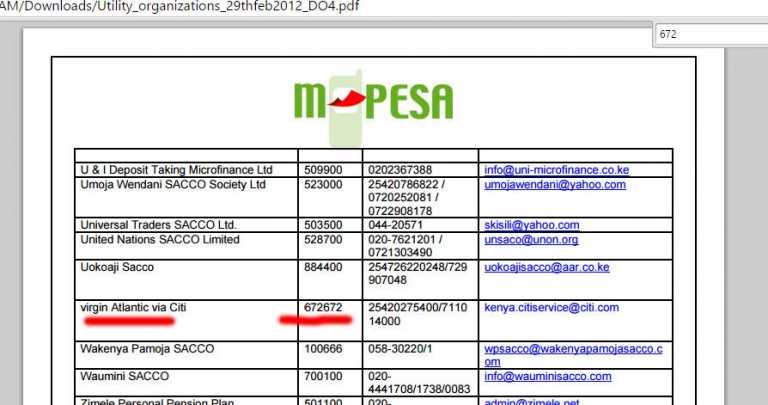
In one of the claims, the account Pay Bill number 672 672 which the Cord leader dubbed Solidarity Account, is being revealed to belong to Virgin Atlantic while in other claims, the account allegedly belongs to Ushirikiano.

The claims linking the account to Virgin Atlantic follows the introduction of Mpesa payments by Virgin Atlantic in 2012, in which the airline’s customers used the Pay Bill number 672 672 to buy tickets, flight upgrades and change in reservation fees for amounts not exceeding Sh. 140,000.

Strikingly, people looking to contribute have been claiming that they are unable to locate the Pay Bill account on their phones and have been getting error reports that the account is non-existent.

The account was launched yesterday at Uhuru Park during a pro-teachers’ pay strike rally conducted by Cord.

Volkswagen CEO to get Ksh. 3.3 billion after resigning

0

Martin Winterkorn, engulfed by a diesel-emissions scandal at Volkswagen AG, amassed a $32 million pension before stepping down Wednesday, and may reap millions more in severance depending on how the supervisory board classifies his exit.

After Martin Winterkorn disclosed Wednesday that he had asked the board to terminate his role, company spokesman Claus-Peter Tiemann declined to comment on how much money the departing CEO stands to get. Volkswagen’s most recent annual report outlines how Martin Winterkorn, its leader since 2007, could theoretically collect two significant payouts.

Martin Winterkorn’s pension had a value of 28.6 million euros ($32 million) at the end of last year, according to the report, which doesn’t describe any conditions that would lead the company to withhold it. And under certain circumstances, he also can collect severance equal to two years of “remuneration.” He was Germany’s second-highest paid CEO last year, receiving a total of 16.6 million euros in compensation from the company and majority shareholder Porsche SE.

While the severance package kicks in if the supervisory board terminates his contract early, there’s a caveat. If the board ends his employment for a reason for which he is responsible, then severance is forfeited, according to company filings.

‘Towering Contributions’

The supervisory board’s executive committee said in a statement Wednesday that Martin Winterkorn “had no knowledge of the manipulation of emissions data,” and that it respected his offer to resign and request to be terminated. It also thanked him for his “towering contributions” to the company.

Martin Winterkorn, 68, said in his statement Wednesday that he was stunned to learn of the scope of alleged misconduct occurring at the company. U.S. officials said Sept. 18 the carmaker had cheated during tests of diesel-powered vehicles sold since 2009.

“As CEO I accept responsibility for the irregularities that have been found in diesel engines and have therefore requested the supervisory board to agree on terminating my function as CEO,” he said. “I am doing this in the interests of the company even though I am not aware of any wrongdoing on my part.”

The annual report also mentions another piece of his pension: He can use a company car in the years that benefit is being paid out.

Review: The 2015 Toyota Allion

0

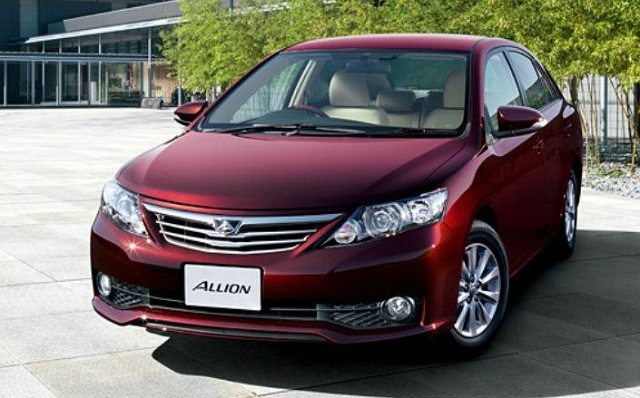
Toyota Allion’s first generation model was unveiled in 2001 and it lasted until 2007. It was offered as a replacement for Toyota Carina that had first appeared in 1970. The Allion is most suitable for youthful buyers. It shares the same engine and interior with the Premio, another more elegant Toyota model. It is currently in its second generation model released in June 2007. This sporty and stylish sedan is a redesigned second generation model and it comes with outstanding features and great performance.

2015 Toyota Allion front view

Design and Features

Its interior of the new 2015 Toyota Allion possesses a sense of luxury. Its length and width have been increased displaying an enhanced feeling of quality and space in its cabin. It is a four door model and it can accommodate five adult passengers. Its seats are covered using soft leather giving its occupants a real first class feel. As for the front passengers’ seats, they are exceptionally first class regardless of the fact that they are not heated. The rivers seat is adjustable enabling the user to adjust it to a desired driving position. As for the rear seats, they come with ample leg space and an option to lean the seat backwards to acquire that extravagant feeling. The dashboard is also sleek with trims of carbon fiber, and it houses a seven inch LCD screen which provides the driver with a good level of information. Its steering wheel comes with audio controllers and it is wrapped in leather. The redesigned model also boasts a number of safety and security features at top levels.

The new Sedan does not feel great, but it also looks attractive. It comes with seven exterior body colors. It has a sleeker front end thanks to the silver chrome accents around its fog lamps. On its rear, there are bright LED lamps which have replaced the tail lights. Its total curb weight is about 1430 kg. Its wheelbase is 106.3 inches, length is 179.7 inches, and width is 66.7 inches while height is 58.1 inches. It has a ground clearance of 6.3 inches. The new model’s side mirrors feature some reflector lights. There is also a power sunroof and a rear spoiler as well as 16 inch allows heels with stylish spokes.

2015 Toyota Allion rear view

2015 Toyota Allion – Engine and Fuel Economy

The new 2015 Toyota Allion runs on a 1.5 liter four cylinder engine located at its front part. The engine is naturally aspirated double overhead camshaft and it had four valves per cylinder. This power-train delivers a power and torque output of 107 bhp at 6000 rmp and 136 Nm at 4800 rmp respectively. The 1.5 liter engine is able to supply power to the front wheels through the continuous variable gearbox. The fuel tank’s capacity is 60 liters or 15.9 US Gal. The preferred fuel type for its engine is gasoline. This vehicle has amazing fuel economy, especially when driven on open roads. In the city, it can return 8-9 kmpl while on the highway, it can return up to 15-24 kmpl. When it comes to braking, the Toyota Allion 2015 is fitted with ventilated disc and drum, while for the suspension; it has coil springs and torsion bar.

2015 Toyota Allion interior

The newest Allion’s main competitor is Mitsubishi Lancer EX.

How to turn the waste in your backyard into cheap, valuable dairy feeds for your cow

Maize is probably the most common crop in Kenya owing to the fact that it is a major constituent of our staple food – the ugali. After harvesting the maize cob, farmers either let their animals into these farms to eat the leafy dry parts of the crop; others simply cut them and throw them on the side to pave way for another season. Some set them on fire.

This is a big waste that should be avoided in all seasons considering the high cost of feeding animals. Farmers actually overlook this economical source of feed for their livestock right in their backyard.

Still, those who attempt to use it fail to extract maximum energy from maize stovers. Yet this is a strategy that can be adapted to lower cost of feeding without necessarily lowering the physical growth process and productivity.

Maize stovers is that part of a maize plant left after harvesting the maize cob at maturity composed of the stalk and the dry leaves.

Feeding regime

Harvest seasons are normally punctuated by dry spells that create favourable weather conditions for clearing farms in anticipation of the long or short rains. My late grandmother Okolwe (as we fondly referred to her) in her indigenous knowledge used to tell us that the hot sun is killing the worms in the soil; a fact I later confirmed in agricultural literature.

When the short or long rains come, green grass spontaneous sprout and livestock will happily devour lush green pastures but will soon afterwards suffer bad diarrhoea and production will certainly be affected. This diarrhea will have a characteristic green colour and is mainly caused by the sudden change in feed and the high moisture content of young grass. But this can be prevented by incorporating roughages like maize stovers into the feeding regime.

So that we can understand the importance of maize stover; let us learn other two concepts applied in animal feed management namely concentrates and roughages.

This is a broad classification of animal feeds depending on their composition and they are basically opposites. While concentrates contain high density of nutrients, are highly digestible but are low in fibrous tissue; roughages have low nutrients density but have high fibre content. Concentrates thus provide energy, proteins, amino acids, fatty acids, vitamins and minerals and are commonly fed to monogastric livestock (animals with one stomach like poultry, pigs) since they have minimal capacity to digest roughages but they need it to aid in the very digestion. High levels of concentrates are used in intensive systems at certain periods in milk production or fattening in ruminants. Concentrates are also useful in improving the uptake of roughages by increasing their palatability. In terms of cost; concentrates are more expensive than roughages.

Nonetheless roughages are an important component of a ruminant diet. They also create a psychological filling of satisfaction which an animal needs.

Maize stoves are an example of roughages and with good utilisation they come in handy when it is dry as a complement to forage seasonality and as a top up for lactating cows, weaner calves and draught animals. They have been shown by research to provide up to a third of dry matter to pregnant cows in her first eight months.

The palatability and digestibility of maize stovers can be improved using two methods namely physically and mechanically. The aim is increase their nutritive value by increasing their intake and promoting their digestion in the rumen through fermentation. Physically, the stalks and dry leaves can be chopped or ground into smaller pieces that make ingestion easier.

Adding value

Chemical treatment is another way of adding value to maize stovers and involves the addition of hydrated lime (mixing water with calcium derived from limestone) to chopped or ground maize stovers.

This mixture is then stored in a plastic bag to lock out oxygen; this solution and storage makes the stovers more digestible therefore greatly improving its nutritive value by increasing their protein content. I have observed in various farms the addition of molasses to maize stovers a practice that makes them more appetising to livestock.

It is believed that molasses aid in fermentation process in the rumen and therefore the digestible of the maize stovers. This is still a subject of research but I cannot hesitate to market its adoption.

When you decide to harvest your maize earlier when they are still green; the stovers can still be used to prepare good quality hay although the use of the dry stovers is not recommended in silage making.

P. Diddy is world’s highest paid rap star after earning Ksh. 6 billion in 12 months

0

Rapper Sean ‘P. Diddy’ Combs led Forbes’ list of the world’s highest paid stars in hip hop music on Tuesday, edging out Jay Z and Drake for the top spot.

Harlem native Combs, 45, made an estimated $60 million (Ksh. 6 billion) between June 2014 and June 2015 according to Forbes’ calculations, from investments outside of music, such as his TV network Revolt and Ciroc vodka.

Sean "Diddy" Combs arrives at The Weinstein Company & Netflix after party after the 71st annual Golden Globe Awards in Beverly Hills, California, January 12, 2014. REUTERS/Danny Moloshok
Sean “Diddy” Combs arrives at The Weinstein Company & Netflix after party after the 71st annual Golden Globe Awards in Beverly Hills, California, January 12, 2014. REUTERS/Danny Moloshok

His albums includes 2001’s “The Saga Continues” and 2010’s “Last Train to Paris,” and he’s working on a new record.

In second place is rap mogul Jay Z (real name Shawn Carter), the 45-year-old founder of Roc Nation music group, who earned an estimated $56 million from business ventures in music, sports and lifestyle. His 22 shows with his wife, singer Beyonce, helped boost his earnings, Forbes said.

Canadian rapper Drake, 28, came in at No. 3 with $39.5 million, the bulk of which came from touring, as well as high profile endorsements from Sprite and Nike.

Nicki Minaj was the only woman to crack into the top ten of the highest paid hip hop acts, coming in at No. 9 with $21 million from touring and endorsements.

Forbes calculated its list using pre-tax income figures from factors such as record sales, touring, streaming and endorsements using data from Nielsen SoundScan, the Recording Industry Association of America (RIAA) and interviews with managers, lawyers and in some cases, the artists themselves.

Other hip hop moguls in the top ten, all of which hail from North America and Canada, include Beats co-founder Dr. Dre and rappers Eminem and Kanye West.


Africa’s top 10 fastest growing economies

0

According to McKinsey 7 Company’s report ‘Lions on the Move: The Progress and Potential of African economies’, Africa’s combined Gross Domestic Product will be $2.6 trillion by 2020.

By the same year, its own consumer spending by 128 million households with discretionary income is expected to be around $1.4 trillion.

Below, we take a look at the fastest-growing economies in Africa.

10. Zambia

Economy: Zambia has had one of the world’s fastest growing economies for the past ten years, with real GDP growth averaging roughly 6.7% per annum. Privatization of government-owned copper mines in the 1990s relieved the government from covering mammoth losses generated by the industry and greatly increased copper mining output and profitability, spurring economic growth. Zambia’s dependency on copper makes it vulnerable to depressed commodity prices, but record high copper prices and a bumper maize crop in 2010 helped Zambia rebound quickly from the world economic slowdown that began in 2008.

9. Kenya

Economy: Kenya is the economic and transport hub of East Africa. Kenya’s real GDP growth has averaged around 5% for the past several years. According to recently rebased national statistics, Kenya’s GDP for 2013 was $55.3 billion, placing Kenya among the low middle income countries with per capita income of $1,300.

8. Rwanda

Economy: Ninety percent of the population works in subsistence agriculture or mineral agroprocessing, while tourism, minerals, coffee, and tea round out Rwanda’s economy. Though the country has taken significant steps forward since the 1994 genocide, 45% of the population still lives below the poverty line.

7. Mozambique

Economy: Mozambique has attracted large investment projects in natural resources, which means the country’s high growth rates should continue. Some analysts believe that Mozambique might be able to generate revenues from natural gas, coal, and hydroelectric capacity greater than its donor assistance within five years.

But the vast majority of the country works in subsistence agriculture, and over half the population remains below the poverty line.

6. Tanzania

Economy: Tanzania has recently seen high growth rates because of gold production and tourism. The economy also runs on telecommunications, banking, energy, and mining, as well as agriculture. In terms of per capita income, however, the country is one of the poorest in the world.

5. Cote d’Ivoire

Economy: About two-thirds of the population works in agriculture-related industries. The country is the world’s largest producer and exporter of cocoa beans and is also a major player in the coffee and palm-oil industries.

4. Democratic Republic of the Congo

Economy: The Democratic Republic of Congo has huge natural-resource wealth, which it hasn’t been able to efficiently monetize because of systemic corruption, conflict, and political instability. That said, its economic is slowly recovering since the tumultuous 1990s.

3. Chad

Economy: Chad’s landlocked location results in high transportation costs for imported goods and dependence on neighboring countries. Oil and agriculture are mainstays of Chad’s economy. Oil provides about 60% of export revenues, while cotton, cattle, livestock, and gum arabic provide the bulk of Chad’s non-oil export earnings. Chad relies on foreign assistance and foreign capital for much public and private sector investment. The services sector contributes about one-third of GDP and has attracted foreign investment mostly through telecommunications and banking.

2. Cameroon

Economy: Modest oil resources and favorable agricultural conditions provide Cameroon with one of the best-endowed primary commodity economies in Africa. Cameroon devotes significant resources to several large infrastructure projects under construction, including a deep sea port in Kribi and the Lom Pangar Hydropower Project. Cameroon’s energy sector continues to diversify, recently opening a natural gas powered electricity generating plant. Oil remains Cameroon’s main export commodity accounting for nearly 40% of export earnings.

1. Ethiopia

Economy: Ethiopia’s economy is mostly agriculture-based, but the government has made a push to diversify into manufacturing, textiles, and energy generation. But while the country has seen and will continue to see high GDP growth, per capita income remains ones of the lowest in the world.


Meet 50-year-old who won Sh. 29.5 million Sportpesa jackpot

0

George Mwangi, who was an ex-banker and currently a businessman, carried home a cool Sh29.5 million after predicting right scores for local and top Europe league

50-year-old George Mwangi is the third winner of SportPesa jackpot carrying home a cool Sh29.5 million.

Mwangi, who was an ex-banker and currently a businessman, started playing the betting game last May after he was introduced by his nephew. Mwangi, a father of three and an ex-footballer with Umeme and Barclays FC, becomes the third winner of the Jackpot.

“My emotions were drained in the last 30 minutes (of the Sunday games). I kept holding my breath but I thank God; I’m a very prayerful man,” he said.

“Its’ about commitment and hard work; studying the probability of a team; winning or losing is quite hard and it’s not about guess work,” he said.

“I take three hours to analyse each game placed for betting, I take my time to do research cumulatively,” he said.

Meet 50-year-old who won Sh. 29.5 million Sportpesa jackpot PROUD WINNER: Gabriel Mwangi after being declared jackpot winner

Mwangi was not sure how he was going to spend the money when asked about it. “Before you win you got big plans but immediately you are announced the winner all those plans go out of the window.

“I am not scared about the money although I know it’s a lot of money. Money does not scare me because I know there are things money cannot fix although I must admit it will change my life.”

To win the jackpot one must predict correctly thirteen matches.