Home Blog Page 2255

Rea Vipingo to finally delist from NSE as takeover succeeds

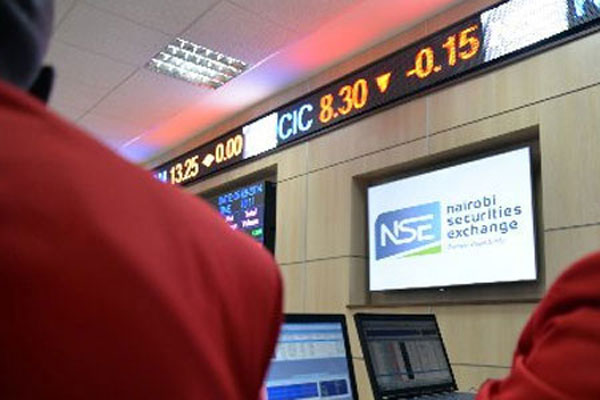
Sisal firm Rea Vipingo will delist from the Nairobi Securities Exchange after REA Trading Ltd acquired a 94.6 per cent stake.

Rea Trading had indicated that it wants to delist from the stock market to allow it to invest more in the sisal processor during the takeover bid.

In a newspaper ad Thursday REA Trading (REAT), which previously held 57 per cent of Rea Vipingo Plantations, finally acquired 94.62 per cent in the sisal firm at Sh85 per share, nearly two years after the offer was made.

REAT is wholly owned by the Robinow family whose other business interests include large-scale oil palm development in Indonesia.

In 2013, REAT expressed interest in buying out minority shareholders in the sisal firm at Sh40 per share. The offer was, however, countered by investment firms, Centum and Bid, with higher offers, a plan that boiled into a dispute spilling into the court.

A resolution of the dispute saw Centum acquire Rea Vipingo’s subsidiary, Vipingo Estates Limited – which owns about 900 acres at Sh340 million. Centum also acquired 9,646 acres of land in Vipingo at Sh180,000 per acre (translating into Sh1.7 billion).

REAT, which has now effectively taken control of the land-rich sisal company following the resolution of a long standing dispute between REAT and Centum, is to venture into renewable energy production among other investments.

“We are delighted with outcome of the offer. This allows us to move forward with our plans for the future, which involve diversification of the REA Vipingo Plantations business in addition to large-scale sisal growing. Amongst other things, we intend to look at the utilisation of biomass for energy generation,” REAT’s chairman Richard Robinow, said.

Shareholders who accepted the offer from REAT will receive Sh85 per share and a cash top-up of Sh15 per share. Settlement of the offer price will be effected as from July 1.

“The next step in the transaction will be de-listing of the company from the Nairobi Securities Exchange,” said the firm.

Speculation was rife that Rea Vipingo’s land straddling Kenya’s coast holds titanium ore, coal and limestone, which could have attracted the huge interest in the firm.

Ibrahim Juma: my dairy goats give me Sh. 85,000 per month

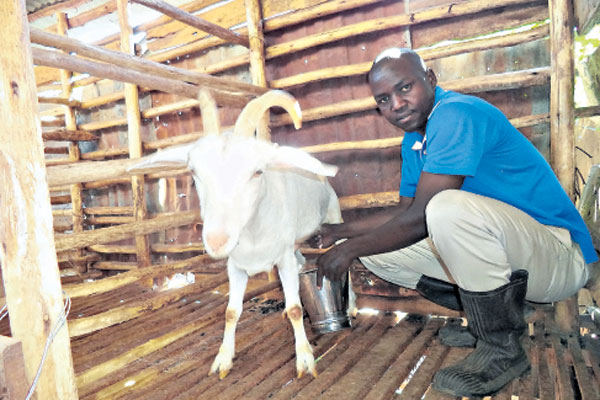
Ibrahim Juma dips his right hand in a bucket he is carrying, scoops some dairy meal and puts it in a feeding trough in the goat pen.

The farmer repeats the task five times and soon he gets the attention of four dairy goats he wants to milk in his quarter acre Kisumu farm.

The big-horned animals had made frantic attempts to try and escape from their wooden pen when they saw him carrying an aluminium bucket for milking.

“Goats are not like cows. They can be stubborn, particularly when they know you want to milk them. They recognise this bucket,” says the farmer.

Juma keeps 17 dairy goats at his home in Migosi, Kisumu, four of which are lactating.

The goats are of the Saanen, Toggenburg and Alpine breeds.

“I get 19 litres of milk a day from the four goats. Each produces between three and six litres of milk in a day that I sell for Sh150 a litre.”

Production of milk, according to the farmer, depends on feeds, vaccination and quality mating.

“I went for dairy goats because I wanted to be different and I knew they do not demand a lot of space. I realised they were the perfect animals to keep on my quarter acre in an urban area under the zero-grazing system.”

He feeds them dairy meal, napier grass and shrubs that he gets from the neighbourhood.

“Dairy meal helps them produce a lot of milk. Most goats give less than a litre per day because farmers give them poor feeds.”

STARTING VENTURE

Juma started the venture with 30 indigenous goats but he realised they were uneconomical.

“I used to keep them free-range. I would release them in the morning and wait for them to return in the evening. The system helped me cut cost but the goats kept on disappearing.”

A visit to the Kisumu Agricultural Show in 2003 opened his eyes on dairy goat farming. Juma got contacts of a dairy goat farmer, who encourage him to embrace the practice. However, he hit a snag.

“He wanted to sell to me a mature Saanen goat at Sh25,000 but that was too expensive.” Juma settled for the alternative, which was to crossbreed the quality breeds with his indigenous ones.

This paid off. The following year the number of his goats doubled to 10 crossbreeds. He sold five of them at Sh25,000 and bought pure Saanen breeds, which produce more milk.

The farmer makes over Sh2,800 in a day. “There is good demand for goat milk from residents because they know its nutritional value. The returns are good, I believe much better than if I was keeping cows which most people in this region rear,” says the farmer, who is eyeing commercial goat farming.

The instructor at the International Youth Fellowship Taekwondo Academy in Kisumu says goats are good for the urban farmer who has a small piece of land.

Dr Joyce Meme, Head of Human Nutrition and Dietetics at the School of Medicine and Health, Kenya Methodist University says goat milk is rich in iron which is essential for boosting the immune system and proper functioning of the liver.

Barclays Bank buys Sh. 2.8 billion majority stake in assurance firm

0

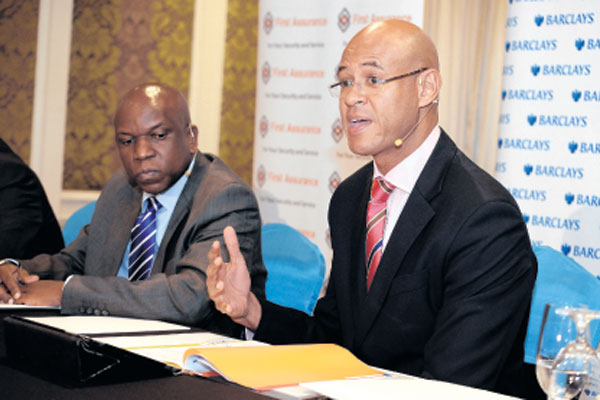
Barclays Africa Group has acquired a majority stake in a general insurance company as it seeks to diversify into the bancassurance business. Barclays Africa yesterday announced that it has reached an agreement to acquire 63.3 per cent of First Assurance in a deal valued at Sh2.8 billion including a Sh722 million capital injection.

“The planned acquisition of First Assurance is a good strategic fit for our business; provides us with a strong platform to expand our bancassurance offering in East Africa, and complements the group’s financial target of increasing our revenues from Africa outside of South Africa to between 20 per cent and 25 per cent,” said Barclays Africa Investment Management and Insurance Managing Executive Lanz Zulu.

First Assurance is among the top 10 largest general insurers in Kenya, offering general cover in Tanzania as well as providing life policies in Kenya.

First Assurance Managing Director Stephen Githiga said the lender would provide a strong brand and increased network distribution.

“Barclays Africa will bring a strong brand as well as technical support for our products and services. Existing First Assurance customers will benefit from access to new products and services as a result of the acquisition,” he said. The insurer reported a profit after tax of Sh518 million and total equity of Sh2.1 billion, excluding the capital injection planned as part of the transaction.

Barclays Life Assurance Kenya (Blak), which was launched in April, will also benefit largely from the over 50,000 existing customer policies by the new acquisition.

It will also give Blak a general insurance presence in Kenya and Tanzania. The transaction now awaits regulatory approvals from authorities in South Africa, Kenya and Tanzania, as the regional lender seeks to follow the rapid revenue diversification plan adopted by banks lately.

Uchumi secretly trading with our customers’ power bills money, says Kenya Power

0

Kenya Power has suspended its bill payments service at Uchumi Supermarkets, claiming the retailer had repeatedly delayed submitting cash paid in by customers. On Tuesday, the power distributor said it has temporarily put on hold the deal earlier signed with Uchumi.

“Kenya Power wishes to inform its esteemed customers that due to unavoidable circumstances bill payment through Uchumi Supermarket outlets has temporarily been suspended,” said Kenya Power in a notice.

The electricity transmitter told customers who pay their monthly bills at the retailer’s cash tills to pay at alternative points.

Kenya Power managing director Ben Chumo said in an interview that the decision to suspend the Uchumi contract was reached after numerous failed deliberations to remedy the situation that eventually led to the termination of the partnership.

“We had a Memorandum of Understanding with Uchumi that allowed them to collect payment from our customers either paying their bills or buying power tokens and later submit the proceeds to us. Uchumi has been delaying to deliver the payments back to us and we decided to end the partnership until further notice,” said Dr Chumo.

“We also found out that Uchumi supermarket was trading using our money without our knowledge,” he added.

Uchumi chief executive officer Jonathan Ciano declined to comment on the matter, saying he was held up in a day-long meeting. He did not also respond to text messages sent to him on the issue.

Kenya Power has been partnering with main retailers and mobile service providers like Safaricom and Airtel to ease customer bill payments and decongest its banking halls.

The firms facilitating the payments get a certain commission based on their value of transactions.

Uchumi Supermarkets is Kenya’s only publicly listed retailer. It has in the recent months faced pressure from its suppliers who claimed their payments were getting delayed.

Last year, Mr Ciano told shareholders during the retail chain’s annual general meeting that the supermarket was working on new terms with the suppliers that would give Uchumi longer repayment periods to avoid straining its cash flows.

Bonds vs Stocks: why investors in equity must watch bond yields

The following analysis by Rufus Mwanyasi was first published in the Business Daily.

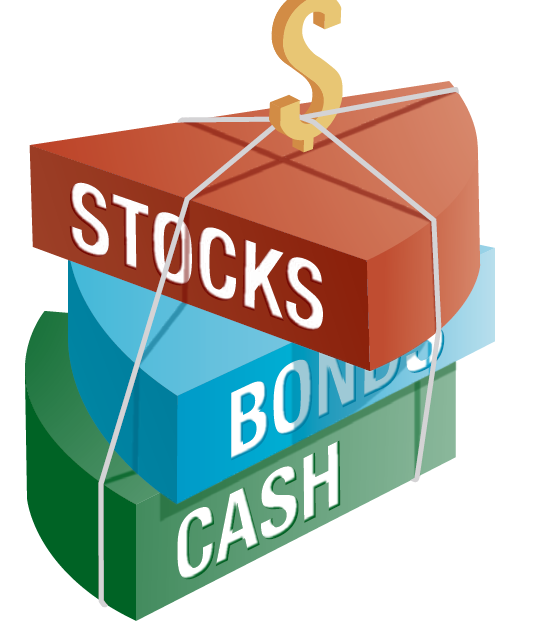
There’s really no way to sugar-coat this: higher interest rates are a huge drag for market returns. A rising-rate environment usually leaves most portfolios susceptible to big losses. But given the choice between the two traditional asset classes: bonds and stocks, I believe that the latter holds up better — at least in the early stages of a rising-rate environment — and should form the bigger piece of a portfolio.

I spare this topic for another day. In this article, I would like to shed light on the implications of an increase and/or decrease in long-term interest rates — as represented by the benchmark 10-year Treasury bond — and how equity investors can use it as a leading signal for their equity investments.

Before we begin, let me lay the foundation on how bonds work. When the economy begins to strengthen, bond yields tend to rise. This is partly because bondholders sell, causing weaker demand which pushes bond prices lower.

If investors believe the economy is improving, they may be inclined to move money into equities in anticipation of an improvement in corporate profits which could propel stocks higher.

When investors are fearful, they always tend to move out of stocks and into bonds but sometimes this is not the case.

Looking at the 10-year (2006 to 2015) NSE 20 share index/10-year Treasury bond chart, it is obvious that there is an inverse leader-follower kind of relationship between share prices and long-term yields.

Take, for instance, the second quarter of 2010 when rates had bottomed out and begun “ticking-up”; it’s after a move of almost 400 basis points before share prices begun their climb down.

Yields went to touch a high at nearly 18 per cent in early 2012 while the NSE 20 Share Index dropped a massive 1,100 points. Had investors acted on this leading signal, perhaps they would have avoided these massive losses.

Likewise, after a sharp drop in yields from 11.9 per cent to 7.71 per cent in early 2010, the move inspired a 16 per cent run-up in share prices by the close of the year.

Currently, as displayed at the far-right of the chart, yields are seen to be steadily climbing which is not a good signal for the equity market.

Perhaps this should explain the meagre returns in the past one-and-a-half years as informed investors, slowly pricing-in near-term interest rate hikes, have been offloading their equity holdings essentially putting a lid on equity gains.

To mitigate this risk, one should take the cue from the rising yields to start re-allocating into growth-oriented sectors such as construction and insurance as they tend to outperform when rates rise while blue chips or dividend yields tend to be more “interest sensitive”.

Hence, going forward, its important for investors to keep an eye on the 10-year Treasury bond as a rising yield could be a signal to continue shrinking your equity portfolio.

Investors need to appreciate that the 10-year Treasury bond market is a good predictor of stock price movements and thus its study should not be left to fixed-income investors.

Prudent investors are better placed to employ this leading indicator whenever possible in their decision-making processes in order to stay ahead of the masses.

How market makers and short selling build liquidity at NSE

The following opinion feature was first published in the Business Daily.

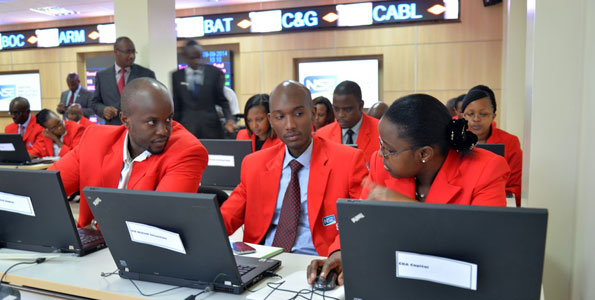
The Nairobi Securities Exchange (NSE) is working with various stakeholders to develop a comprehensive framework and requisite regulations to enable market makers, short sellers and stock lenders to operate in the domestic capital market.

To some Kenyans ‘market making’ and ‘short selling’ may sound slightly ominous and manipulative terms. But these are common in many global exchanges and are an important tool for building liquidity – the numbers of shares being traded – in a market.

Liquidity is the lifeblood of any exchange; it is the ease with which shares can be bought and sold and is critical for buoyant secondary trading.

Some smaller exchanges can suffer from a lack of liquidity – as NSE has on some occasions. Investors want to be able to trade when they choose. Listed companies, on their part, are always looking for liquidity in their own stock, as it tends to lead to a fair market-driven valuation.

An investor on the biggest exchanges – London, New York or Hong Kong – would take for granted that they could trade in a stock at a moment’s notice. For this to occur as it does in these jurisdictions there must be someone buying or selling at the other end of that transaction.

In those bourses, market makers and stock lenders play an absolutely vital role in ensuring that tradable stock is available at any time of the trading day.

In smaller markets, like NSE, if you want to buy equities or bonds, your broker needs to find a willing seller and vice versa.

And from my broking experience, I know it is very difficult to find a buyer or seller for exactly the same value, in the same company, at exactly the same time as you are.

This is where a market maker comes in. These are firms, who meet stringent capital and operational requirements, which are obligated to provide a two-way price in certain securities in order to ensure that there is always a certain amount of liquidity in these stocks.

This means that investors on NSE always have the opportunity to buy or sell.

And it also means that the market can be more sensitive to the performance of, and announcements by, companies listed on the exchange. For a market maker to operate effectively, it must have the ability to engage in short selling.

The firm will need the ability to sell short in order to meet its obligations (i.e. to sell stock which they do not currently have to buyers). This shortfall is covered before settlement from later purchases or from stock borrowing.

In order for the market makers to be able to borrow stock, so as to do their crucial job, a stock lending and borrowing framework needs to be put in place.

Other traders who need to meet unexpected delivery shortfalls or run a short selling operation can also use this service.

KCB-Safaricom mobile banking customers hit 1.8 million

0

KCB, has signed up 1.8 million customers for its mobile phone-based service since it was launched in March. It is on target for 10 million users within a year from now, its chief financial officer said. Mobile technology is seen by executives as the future of banking in Kenya.

Other companies such as Equity Bank and Standard Chartered Kenya have invested in systems to let users access accounts any time. The KCB M-Pesa service, operated jointly with Safaricom, allows users to deposit cash and borrow up to Sh1 million for up to six months via mobile devices.

“KCB has been able to increase its retail footprint by opening over 1.8 million new accounts,” said the newly appointed CFO Lawrence Kimathi. KCB has lent more than Sh1.37 billion to more than 400,000 borrowers on KCB M-Pesa, he said, adding the service was on course to hit a target of 10 million users within a year.

Mercy Ochola: I became a poultry farmer after getting tired of costly fish

One evening in 2007, Mercy Ochola set out to buy fish for her family in Mbero market, Kisumu County.

She visited several fishmongers hoping to get the best bargain, but the mother of four ended up being disappointed because the price of fish was beyond her reach.

A small piece was going for Sh350, which she found unaffordable. She later bought chicken for her family. She did not take that problem lying down as she saw a business opportunity in it. She decided to try her hand in chicken farming.

The farmer purchased five mature indigenous birds at Sh250 each, and her journey as a poultry farmer began in earnest.

The birds soon multiplied, increasing to over 100. Currently, Ochola has over 200 birds.

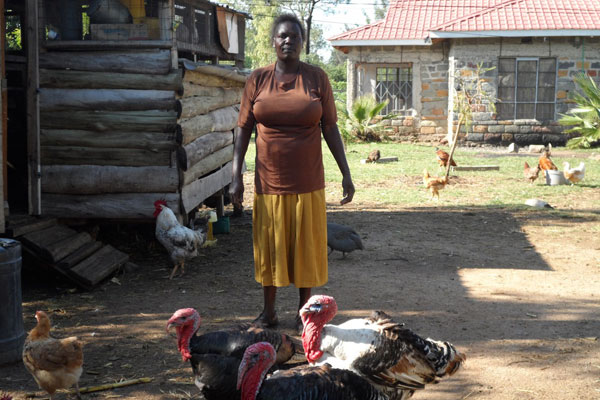
“Chickens multiply fast, you start with a few and end up with a huge number. I keep them under the free-range system.” She has since added turkeys and guinea fowl to her flock.

“My husband made me start rearing turkeys and guinea fowls, besides the kienyeji chicken for diversity and higher returns,” she explains.

“Guinea fowls lay eggs but they do not hatch them. I normally offer the eggs to brooding hens for incubation. Once they hatch, the guinea fowl chicks grow up knowing the hen is their mother.”

She sells a turkey at Sh5,000.

COMMERCIAL FEEDS

The farmer feeds her poultry omena (dagaa), maize bran and rice germ. She buys a bag of rice germ from millers in Katito and Ahero at Sh1,300 while 2kg of omena goes for Sh50.

“I feed the birds early in the morning and let them forage for food. This is cost-effective since I save on feeds because the birds only feed on commercial feeds in the morning and evening,” says the farmer. She adds that only birds aged about two months are left to forage because they cannot be attacked by hawks. The farm has a wire mesh that confines the birds in the compound. She sells an egg at Sh20 to traders in Mamboleo.

“I sell the cocks at Sh800 but I ensure I maintain at least 10 of them for breeding purposes,” says the farmer.

He biggest problem is disease, particularly Gumboro, which once killed 450 of her chicks.

Besides the birds, Ochola has also planted bananas, passion fruits and Rosemary tree (Rosemarinus officinals), a plant with bluish flowers and needle-like leaves used as a culinary spice.

“I harvest the leaves, dry, grind and pack in 25g packets that I sell at Sh50.”

She also has six pedigree dairy goats that she bought at Sh10,000 each and zero-grazes them. “Two of the goats give me three litres of milk each a day that I use at home. I feed them hay and napier grass.”

Dr Mary Muchunguh, a livestock expert, says poultry farming, particularly the free range system is easy to start and manage.

“The only disadvantage is increased susceptibility to parasites and diseases.”

The way out for Kenya Airways

0

The following analysis by carol Musyoka was first published in the Business Daily.

What do Britam, Kenya Tourism Fund, Independent Electoral and Boundaries Commission, Strathmore Business School, MTN Business Kenya, Kenya Commercial Bank and British American Tobacco Kenya Limited (BAT) all have in common? Absolutely nothing. Except that senior executives from these organisations were present in Kigali last month, more precisely on May 26, for various business reasons that were not only mutually exclusive, but it is quite likely that many of these executives never crossed each other’s paths. But they crossed my path.

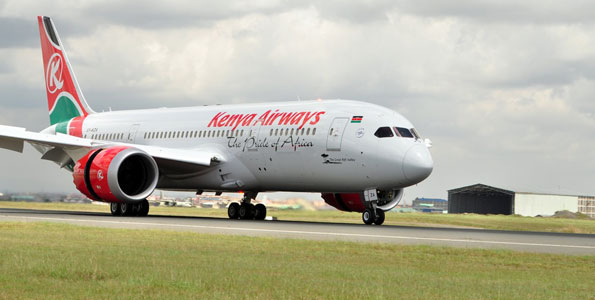
The serendipitous points of confluence were the Kigali Airport and at the Serena Kigali where many of us were staying. Most of the executives had come in using the Pride of Africa, Kenya Airways, which is the lifeblood of business travel in the East, Central and Southern Africa region.

A tiny fraction had used RwandAir, the national carrier for that beautiful nation state nestled in the bosom of the East African Community.

There is massive trading of goods and services occurring across the five EAC members. Pivotal to that business is the travel that the business owners and their managers have to undertake to make that business happen or monitor its performance. Pivotal to that travel is Kenya Airways like the critical aorta in the East African cardiovascular system.

It hit me, after saying hello so many times, that I was starting to think I was at a diluted version of the Kenyan Company of the Year Awards.

Kenyans are doing business aggressively in the region and any problems facing Kenya Airways are problems that will have far reaching impact on business in the region.

Board meetings will be missed, conferences will be delayed, workshops will be remiss without key trainers, and performance appraisals postponed if the airline has just one daily hiccup.

So it was with the deepest regret that I told my workshop organisers in April that they had to book me on RwandAir for the May workshop that took me to Kigali.

I am proudly Kenyan and fiercely loyal to Kenya Airways, so much so that I take deep umbrage whenever the airline is trashed in any gathering.

The golden handcuffs called frequent flyer miles also don’t allow much in the form of adulterous predilections with competitors.

You are penalised heavily via ego bruising downgrades by the Flying Blue program, of which Kenya Airways is a member, for not maintaining a rigorous flight schedule annually.

I was in the tiny fraction that flew the competition simply because the anecdotal evidence of missed and delayed regional flights by our national pride were starting to take their toll on the brand’s promise of reliability.

I ended up being vindicated for my decision as my colleague who chose to fly the airline did indeed have his morning flight to Kigali cancelled.

It is also noteworthy that Kenya Airways is the only decently reliable airline flying to Tanzania and Uganda respectively directly from Nairobi. It therefore has a captive market well sewn up in this region.

The airline has monumental goodwill and plays an undeniably enormous role in flying the country’s flag high. As one of only four African national carriers that are of global significance (the other three being South African Airways, Ethiopian Airways and Egypt Air) Kenya Airways’ financial problems are Kenya’s problems. They merit scrutiny and concern in equal measure, if for no other reason than we cannot, as a proud nation, permit this symbol of nationalism to fly into headwinds as my media colleagues like to infer.

In November 2012, I raised an eyebrow in this column regarding the motive for the rights issue that Kenya Airways had undertaken six months earlier: [Excerpt]

“The timing of the rights issue in April this year was ostensibly to raise the equity for the airline and improve its debt-to-equity ratios for the further leveraging the airline needs to undertake to grow its fleet for its future expansion.

However, looking at the airlines’ statement in changes in equity, if the rights issue had not happened when it did, Sh6.2 billion would have been wiped out from the equity arising from the operating losses as well as losses from the cash flow hedges that have caught the airline on the wrong side of the very necessary derivative bet for a few years now.”

Looking at the half year 2014 results released by the airline, the total comprehensive loss of Sh13.2 billion pretty much almost halved their equity to the position of Sh15 billion from a starting position of Sh28.2 billion at the beginning of the financial year in April 2014.

Cash was down to Sh4.5 billion at half year as well, from Sh11.2 billion at the beginning of the period. The airline is burning through cash at a high rate driven by high loan and interest repayments and basic operational expenses like salaries while grappling with labour relations that are a key cause of the delayed flights across the region.

The recently announced Treasury cash bailout of Sh4.2 billion will be swallowed within the airline’s operational bowels without the pleasure of a satisfactory burp.

That will also be putting an Elastoplast over a gashing wound that needs the kind of suturing provided by a massive capital injection that will be very apparent when they release their full year results for the period ending March 2015.

Some feverish calls will have to be made or are probably being made to the key shareholders – GoK and KLM – to pony up certainly much more than the Sh4.2 billion that has been put in Treasury budget estimates.

If GoK can consider injecting capital into a moribund, badly mismanaged train smash of a sugar miller like Mumias, it goes without saying that an injection into the national carrier is not only inevitable, but it is imperative.

If it doesn’t happen the unimaginable impact will extend beyond Kenya Airways stakeholders: It will impact how business is done in the East African region as a whole.


Joseph Wachira: I gave up on coffee, now I earn from rearing and selling rabbits

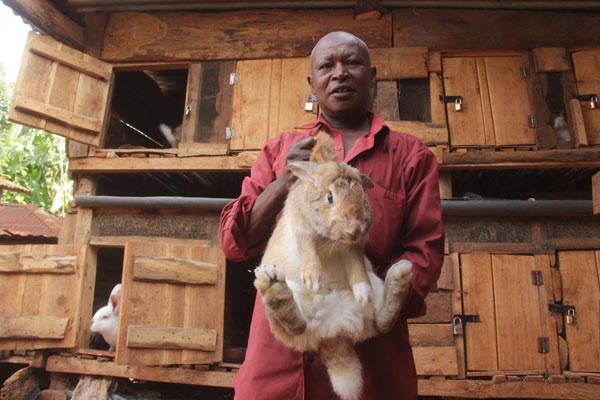
Joseph Wachira has over 100 mature rabbits and 50 kits at his Nyeri farm. While other farmers rear rabbits to harvest their urine, Joseph rears them for meat and for to sell the kits. He cross-breeds some of the rabbits and sells their meat.

“When I started rabbit farming, I wanted to harvest their urine for sale, but I realised there was a larger market in selling kits and rabbit meat,” he says. Joseph went into rabbit farming in July 2012, when rabbit urine was all the rage. The urine is used as organic fertiliser. Before this, he had been a long time coffee farmer.

With Sh5,000, part of his savings from coffee proceeds, he bought three young female rabbits, each costing Sh800. He then mated them with a neighbour’s buck, and by the end of the year, he had 28 rabbits.

Joseph tried harvesting urine by feeding them each day with green hay and vegetables without much success. In May 2013, he decided to use the urine on his coffee farm and instead started selling rabbit meat. He invested Sh10,000 in five breeds of rabbits — California White, Flemish Giant, New Zealand, Chinchilla, Angora and the Earlobe.

Through training offered to rabbit farmers in Nyeri by the Ministry of Agriculture, Joseph learned that breeding rabbits requires a strict mastery of the best breeds and their habits. It is here that he learned that rabbit breeding and husbandry requires maintenance of high hygiene standards to prevent the spread of diseases like diarrhoea.

“Before, I would take the does to my neighbour’s buck for mating and they would get infected with diseases and would infect rabbits on my farm. But after I started breeding at my farm, I encountered fewer diseases,” he says.

Female rabbits mature in six to eight months. The bucks are ready for mating a month later than the does. For mating to take place, the doe is taken to the buck’s cage. Sometimes, mating might not occur as female rabbits tend to be aggressive.

Rabbits have an average gestation period of 31 days, although sometimes it lasts between 29 and 35 days.  According to Prof Margaret Wanyoike of the Department of Animal Production at the University of Nairobi, a female rabbit can give birth up to a maximum of eight to 10 young ones.

She says farmers who choose to cross breed their rabbits should only do so when rearing rabbits for meat because cross breeding tends to alter genetic structures. Continued cross breeding leads to poor performance of the offspring.

Farmers practising rabbit breeding and husbandry should maintain high hygiene standards to prevent the spread of diseases. “It’s advisable for farmers to use their own bucks because using neighbours’ bucks or lending to neighbours can result in transmission of breeding diseases,” she says.

Farmers should also develop a feeding program to enable the rabbits to mature at the right age. With good feeding and for medium size breeds like New Zealand and California white, maturity is attained at four to five months, but for larger breeds such as Flemish Giant and French Lop, this will be at six to seven months.

The common medium size breeds like New Zealand, and California attain an average weight of 4.5kg at maturity while small size breeds like Angora attain an average weight of 2.5kg at maturity.

Joseph sells two and-a-half months to three-months rabbits at Sh1,500 each, four to seven months at Sh3,250 each while those above eight months cost less, Sh3,000, because of their age. In a month, he can sell 10 to 15 rabbits, although the numbers keep on varying. He also offers training to new starters at his farm.