Home Blog Page 2254

Equity Bank signs deal with car deal to ease purchase of commercial vehicles

0

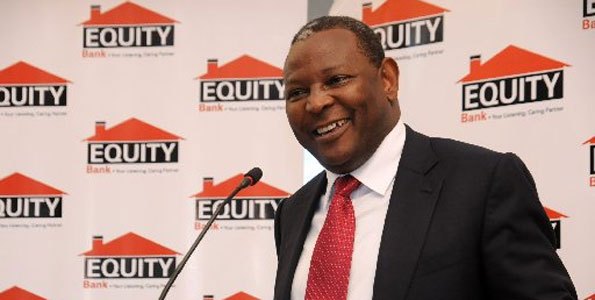
Hino Kenya, a division of Toyota Kenya has signed a memorandum of understanding with Equity Bank Kenya targeting the lucrative commercial vehicle segment.

The partnership will see both Equity and non-banking customers including schools access financing towards the purchase of commercial vehicles and repay through repayment periods of between 48 and 72 months.

The financing for commercial vehicles will be in three categories. In the school buses category, public schools will access 100 per cent financing and enjoy a maximum repayment period of 72 months while commercial trucks and pickups will attract up to 95 per cent financing and repayment period of up to 60 months.

For PSV, customers will access 80 per cent maximum financing and enjoy a repayment period of up to 48 months.

Under the new partnership, Hino fronts its flagship brands Hino 300 and FC 500 configured as 33 and 51 seater buses or 7 tonne and 9.9 tonne trucks, respectively. Hino will offer discounted bodies, extended warranty and free technical training to all customers under the program. Speaking during the signing ceremony, Hino General Manager Wanjohi Kangangi said the automotive industry particularly the commercial segment has a strong multiplier effect and is capable of being the driver of economic growth.

“Hino has created a reputation of utilising partnerships with like-minded corporate to create the most effective one stop shop for our customers,” he said. Equity Bank Chief Operating Officer Julius Kipng’etich said that the move will ease the purchase of commercial vehicles, noting that customers will enjoy competitive interest rates, higher percentage financing and longer repayment period.

“As the country experiences growth in the SMEs, we seek to facilitate the acquisition of commercial vehicles which will be a key driver of their businesses. Customers will go through the normal credit vetting to analyze their repayment ability,” Kipng’etich said.

10 top level managers leave National Bank in 8 months

0

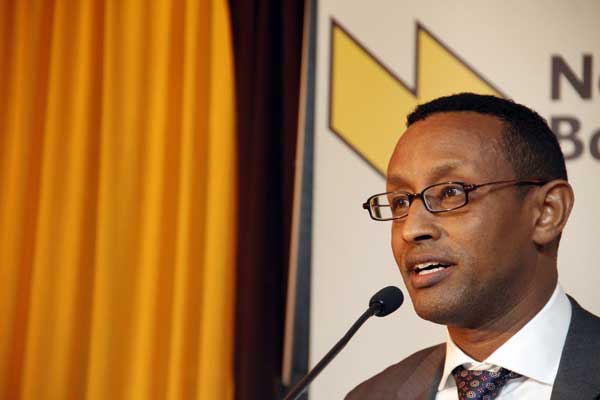
Over 10 top level managers have left the National Bank of Kenya over the past eight months in what insiders say could be a pointer to a bigger problem in the lender’s turnaround strategy.

Initiated by the chief executive Munir Sheikh Ahmed on assuming office in 2012, the plan was to put the bank in the top tier by 2017.
The latest to leave is executive director for retail and business banking, Mr Robert Kibaara, who left on Friday.

Mr Kibaara’s resignation leaves Mr Ahmed alone at the top. The other executive director, Mr Sam Okero, who headed the corporate and institution banking, left mid last year. Contacted for comment, Mr Ahmed did not return calls and text messages, even after asking for the questions to be sent to him.

TRIED TO RECRUIT

The lender advertised for Mr Okero’s replacement without success. Advertisements for the position have been published several times in local media and once in an international executive magazine.

Insiders point to the bank’s appetite for high risk loans as the main cause of disinterest among industry players to take up the position.

Other top level positions to have been vacated over the past six months include that of human resource director, head of credit, director of Islamic banking, head of retail, head of SME banking, head of medium enterprises and head of corporate communications.

The bank recently became the first public institution in the country to hire a Chinese national at directorship level. Ms Yao Sandra heads NBK product development function.

Early this year, Central Bank of Kenya delayed approving the lender’s annual licence on failure to comply with the capitalisation guidelines.

The problem arose due to delay by government to decide on the rights issue. In 2013, shareholders approved a plan to create an additional 800 million new ordinary shares to be floated in the issue that was then expected to raise about Sh10 billion to fund its expansion plans.

During the last financial year, the National Treasury allocated Sh5 billion to take-up of the rights issue but later changed its mind, allocating the money to other functions.

This year, the Treasury Cabinet Secretary Henry Rotich was equally mute on the matter. In 2014, the bank recorded 21.7 per cent net profit decline as high operating expenses and one-time restructuring costs weighed on its profitability.

The bank spent Sh1.1 billion to retrench 190 employees in a cost-cutting measure but operating expenses still increased 12.2 per cent to Sh7.5 billion. It reported a net profit of Sh870.7 million compared to Sh1.1 billion in 2013.

The bank will today hold a media briefing where it is expected to announce its new strategy.

Tom Osborn 19-year-old is winning the clean energy game in Kenya

0

Tom Osborn has a humble manner about him, which is surprising since, at the age of 19, he has already been recognised as one of world’s top young entrepreneurs.

He is the founder of GreenChar in Kenya, a clean energy start-up that produces charcoal briquettes for cooking purposes that are both healthier to use and last longer. His coals are produced from recycled agricultural waste such as sugarcane, which studies show emit 90% less smoke, and have 60% more energy than the normal charcoal used for cooking.

GreenChar is less than two years old, but has already caused a buzz. Osborn has recently been named as one of Forbes‘ global ’30 under 30′ social entrepreneurs, and last year was selected as a 2014 Anzisha Fellow, winning US$10,000 from Donors’ Circle at the Anzisha Prize Gala Awards.

He was also chosen as a global Echoing Green Fellow for 2014, which comes with two years of funding totalling $80,000. He is the youngest recipient to receive the fellowship in the organisation’s 27-year-history.

Humble beginnings

Osborn’s inspiration behind starting GreenChar was based on a concern for the health of his community, particularly his mom. Growing up in Awendo, a small town in Kenya, he watched how women in the community would cook meals for their families on charcoal-fuelled cookstoves. And as a young child, it was Osborn’s duty to light the cookstove for his mother every day for lunch.

But in high school he discovered something that worried him. “I randomly came across a report saying smoke from firewood and charcoal killed more people than AIDS, Malaria and TB combined,” he explained.

“That really shocked me and made me start thinking of my mom, and that maybe she was slowly dying from all the times she had cooked for us. And I felt guilty because I was one of the people she was cooking for. So I wanted to try to help her.”

He started researching online and came across students at MIT who were testing the potential of converting agricultural waste into charcoal. Osborn got in touch with them and found out how to produce the healthier charcoal briquettes that GreenChar now offers the market.

Thinking like a CEO

It wasn’t just a good idea that led to GreenChar’s success today. Osborn had to think strategically to overcome a number of challenges facing adoption of his company’s product in the market. For starters, he needed to convince consumers to change the way they have always cooked. “Initially we had to give free samples, because it is a big thing in Kenya that people don’t like to change,” he said.

The free samples allowed him to educate consumers on the benefit of using his eco-friendly charcoal briquettes. Another strategic decision was to make sure GreenChar’s product could compete with the price of normal charcoal. “For our target customers the biggest factor for them is price. So we believe that even though our product is better quality, it should not be expensive.”

For this reason, Osborn began offering their product at a cheaper price.

“And that is why I think we have been very successful so far with sales. Once someone uses it and is able to experience the benefits, and also realises it is cheaper, they come back to buy it again.”

Growth supported by product diversification

When GreenChar first started it had the capacity to produce 30kgs of its charcoal briquettes a day, but it wasn’t long before Osborn and his team were unable to keep up with demand. Using their revenue from sales, they managed to increase this to 50kgs per day. This soon proved not to be enough either.

However, to increase their production capacity further, he realised they had to hire more staff, and this meant they needed more money. The solution: product diversification.

“At that point we decided to start selling cookstoves to increase our revenue base so that in turn we could scale up the charcoal production,” he recalled.

GreenChar partnered with Envirofit, a global manufacturer of cookstoves that ensured optimum efficiency of his eco-friendly charcoal briquettes. The company started selling these in bundles to groups of women, where the group pays instalments and the women act as security for each other.

The revenue generated from this was enough to allow GreenChar to scale up production to 150kgs a day. But of course even this proved not to be enough.

Using funds Osborn received from Echoing Green last year, GreenChar bought two acres of land and started building its own manufacturing plant. The factory was completed in November and the company produces 2,000kgs of briquettes a day, with the capacity to increase this to 3,000kgs. The company has also set up a research and development team of university students to design GreenChar’s own cookstoves.

Be well aware of risks

“I think in Africa there are a lot of young entrepreneurs who have great ideas but they never get noticed or past the small-scale level. I think one reason is that they poorly position themselves and the organisation.

They don’t know how to tell their story. They don’t know how to create their brand. And I think that is also very important,” said Osborn. “So I think entrepreneurs should spend a lot of time not only on their products, but also on working out how they are going to sell them.”

Osborn believes solutions to many of Africa’s problems lie in its youth, and advises aspiring entrepreneurs to take the most important step and start. However, he added, they should be aware of the risks.

“In my case I have sacrificed a college education for two years, and if GreenChar doesn’t work I might be screwed up for the rest of my life. And that is very scary,” he noted.

The Anzisha Prize is the premier award for African entrepreneurs aged 15-22 who have developed and implemented innovative businesses or solutions that have a positive impact on their communities

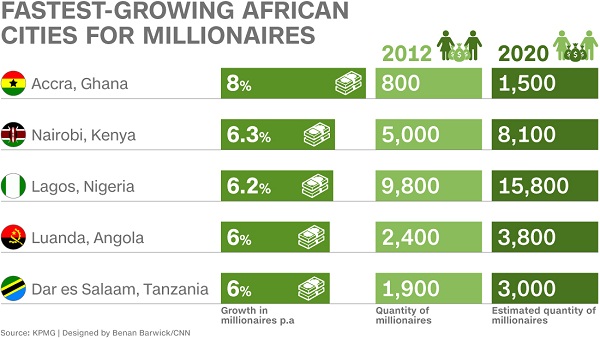
10 Business opportunities in Africa that will create more Millionaires in 2015

It’s true there are lots of amazing business opportunities in Africa. However, it can get very confusing if you don’t know where to look. In this article, we show you ten of the hottest business opportunities in Africa that will create more successful entrepreneurs and millionaires in 2015.

1. Media and Entertainment

Africa’s film industry has become a global and cultural phenomenon that enjoys a huge following within and outside the continent. The industry serves an audience that’s hungry for African stories of love, drama, intrigue, comedy, redemption, action and more. It’s no surprise that Africa’s film industry is currently the third largest in the world behind Hollywood and India’s “Bollywood”.

‘30 Days in Atlanta‘ is a Nigerian romantic comedy film that was released in late 2014. Africa releases hundreds of films every year but this one has totally changed the game. Just seven weeks after its release, ’30 Days in Atlanta’ grossed over $500,000! It’s the largest revenues ever made by a single African movie! This is great news for the continent and a sign of more high-grossing blockbusters to come!

But it’s not just the Africa’s film industry that’s on the rise. African music has become hot cakes too! From Nigeria to South Africa, there’s a wave of raw and promising music talents that is sweeping across the continent. 2015 will surely be an interesting year for Africa’s entertainment industry – and there are opportunities for you!

2. Food & Agribusiness

The opportunities in Africa’s food and agribusiness space remain huge and will not go out of fashion anytime soon. With over one billion people to feed, Africa’s food and agribusiness market is a multi-billion dollar opportunity for entrepreneurs who know where to look.

Food production is still a huge and breathtaking opportunity. Grains, milk and all sorts of raw and semi-processed agro-products are still imported into Africa even though the continent has an enormous capacity to produce these. Entrepreneurs who can produce food products locally could reap very huge rewards.

3. Retail

Africa’s retail market is a multi-billion dollar business opportunity. In addition to its over 1 billion population, more Africans are buying stuff due to their growing economies, rising middle class and rapid urbanization.

Africa’s retail market is going through a monumental shift. Retail is gradually moving away from informal trading in open markets to organized retail in shopping malls and online stores. Africa’s homegrown supermarket chains like Shoprite, Game, Woolworths and Nakumatt are entering more countries and are spreading fast across the continent.

The growth in Africa’s online retail market is more breathtaking. Jumia, one of Africa’s fastest growing online retail businesses, is now worth more than $500 million, it only launched in 2012! With a presence in several African countries including Egypt, Cote D’Ivoire and Nigeria, Jumia is now regarded as the “Amazon of Africa.”

Despite the boom in online retail in Africa, this segment currently makes up less than 5 percent of the continent’s entire retail market. There’s still a lot of room in this space to serve the African market and a lot of money will be made in the process.

4. Fashion & Beauty

Africa’s fashion and beauty market is developing at an impressive rate. The continent’s overwhelmingly young population provides a ready market for trendy fashion. All kinds of apparel, including locally made fabrics and imported designer labels have become hot-selling products across Africa’s rapidly expanding urban areas. Africa has hundreds of rising stars who are building successful businesses in the fashion and beauty industry.

Suzie Wokabi is one of Africa’s leading entrepreneurs breaking into the beauty and personal care market, a sector that is dominated by international giants like Unilever, Procter & Gamble, L’Oréal and Mary Kay. Suzie Beauty, the cosmetic business she started about 7 years ago in Kenya, has become hugely successful – a multi million Dollar business.

The list of promising African entrepreneurs who are building successful businesses in the fashion industry is quite impressive. This would be an interesting industry to watch in 2015.

5. Real Estate

The demand for both residential and commercial real estate continues to grow across Africa. However, there is still a huge accommodation shortage. In countries like Nigeria, for example, over 16 million new houses need to be built to solve Nigeria’s serious housing problem. The estimated cost of providing these homes stands at a whopping $350 billion!

The opportunities in Africa’s real estate market include investing in land and real estate (properties) to take advantage of fast rising property prices. There is also lucrative potential in developing middle and low-income housing and office space for sale, lease or rent.

6. Internet & Tech

Africa’s Internet & Tech space will be a joy to watch in 2015. Tech hubs and incubators are springing up across the continent from Accra (Ghana) to Lagos (Nigeria), Jo’burg (South Africa) and Nairobi (Kenya). These hubs have become Africa’s “Silicon Valley” and continue to produce the best tech innovators and entrepreneurs Africa has ever seen.

Last year, the acquisition of Saya, a mobile messaging phone app developed by two young entrepreneurs from Ghana, made the headlines. This simple app for feature phones, which was created in 2011, started to replace SMS texting and became an instant hit in West Africa and even in faraway India!

Saya is just one of several success stories in Africa’s internet and tech industry. African entrepreneurs are using the internet and technology to solve problems and challenges on the continent. From taxi services to mobile payment systems and motorbike delivery services, African tech startups are buzzing with creativity and promise.

7. The Green Revolution

Around the world, the appetite for green and eco-friendly products and services is growing quite rapidly. Due to the threats of climate change, any solution that preserves the natural environment, reduces waste and pollution, and promotes reuse and recycling have become huge business opportunities. Several African entrepreneurs and startups are already riding the wave of this opportunity and are becoming hugely successful.

In Ethiopia, Bethlehem Alemu’s Solerebels has become the world’s first truly eco-friendly footwear brand. This hugely successful business makes footwear from recycled waste material and sells its footwear products to customers in North America, Europe and as far as Japan. Again, another multi million Dollar company was born!

There’s also Thato Kgatlhanye founder of Repurpose Schoolbags which makes eco-friendly bags from up-cycled plastic shopping bags. And there’s also Patrick Ngowi, the Tanzanian entrepreneur who has built a multi-million dollar business from solar power. Biogas production from organic waste is also another growing opportunity in Africa.

The Green Revolution will definitely be an interesting space to watch in 2015!

8. Building and Construction Supplies

Africa is going through a construction boom, an opportunity that will certainly create a lot of wealth for entrepreneurs on the continent. It’s no surprise that Africa’s richest man, Aliko Dangote, is heavily invested in the cement business. Cement is one of the most important materials for building and construction work – houses, buildings, roads, bridges etc. Africa used to spend billions of dollars to import cement.

But not anymore. Dangote and other cement producers like Lafarge are spreading fast across the continent. Cement is just one example of several building and construction supplies that are growing in demand across Africa. The demand for steel is another multi-billion dollar business opportunity that’s probably bigger than cement. Timber (wood), roofing materials, glass, paints, plumbing and electrical supplies are other products that are enjoying a high demand due to the construction boom that’s happening across the continent.

9. Financial services

Like in other developing regions of the world, the banking, payment systems and overall financial services industry in Africa is one of the least developed in the world. More than 50 percent of Africans still don’t have access to formal financial services and a huge number of transactions are still done in cash. Africa presents a unique opportunity to make money in its financial services market. Entrepreneurs who can provide simple, easy and convenient solutions will be well rewarded.

One interesting startup to watch in this space in 2015 is Nigeria’s SimplePay. This platform, which provides payment solutions to online merchants in Nigeria has already attracted over $300,000 in investments and plans to raise up to $10 million this year. If all goes well, SimplePay could become the PayPal of Nigeria, and could make its young founder a millionaire!

10. Investment

With slow economic growth in North America and Europe, more investment is pouring into fast emerging regions like Africa. In search for higher returns, more investors are now looking to invest in Africa. Whether you plan to funnel funds into Africa’s stock markets or invest directly in African startups, the potential for high reward has never looked better.

Towards the end of last year, a Nigerian billionaire investor, Tony Elumelu, committed to invest $100 million in African startups and entrepreneurs over the next 10 years. This is just one of several ambitious investment initiatives that will create tremendous opportunities and wealth for entrepreneurs who can exploit them.

One interesting trend I’ve noticed is the growing number of venture capital firms and startup funding platforms that are dedicated to the African investment market. More of these platforms will open shop in 2015.

There’s never been a better time to invest in Africa’s future!

Toyota Hilux Invincible X review: a gigantic monument to shininess

0

What a beast, what a gigantic monument to shininess. When they parked the Toyota Hilux Invincible X outside my house, my first worry was I might need planning permission.

It has a massive, open flatbed with a flap-down back door, along the lines of a classic pickup, with extra bling. I texted my mother a picture of it to ask if she needed anything. “Can I have seven labourers from the 1930s?” she said. “I have work they could do and crusts of bread.” Seven cases of wine didn’t even leave a trace on its capacity. I stuck the kids in the back. They begged me to drive down the road. I realised how illegal that was, and how much the world had changed.

It has legitimate seats as well, of course: a double cab and four seats. Imagine yourself in a regular car, with a huge other car stitched on to the back. There is nothing obnoxious, jerky or hard to control, but it’s unlike anything else, even any other SUV, I can think of. It has a 2.8-tonne towing ability; the sheer bulk of the engineering makes it more like a removal expedition, or driving a ski lift.

On a long drive, the slightly sluggish acceleration disappears as a concern – it is plenty poky enough for responsible motorway driving – but the wasted capacity made me feel guilty that I wasn’t transporting a Portaloo and towing a horse.

Through no fault of the car, it was extremely unpopular on the oft-medieval streets of London town. The one I drove was tomato red, which didn’t help, making me look like the kind of person who would buy a car to mess up other people’s mornings. The reversing is hair-raising – a camera but no sensor – yet nothing beats the metallic crumple as you hit a pillar and hear your wheel arch peeling off. I drove off panting. The debris was obstructing the wheel, and I had to stop and bend it backwards. I was so far out of my skill zone, I might as well have been skinning a rabbit.

Other road users started to avoid me after that. Driving with such an injured car is like walking around with fresh stitches in your forehead. A few strangers nodded and said, “Great car”, and, wracked with guilt at what I’d destroyed, I’d poke my head out the window and yell, “When you say ‘great’, do you really mean ‘red’?”

It’s the most CO2 I’ve ever spewed out, with the least to show for it. If you accept, though, that it will make sense only with three tonnes of burden, you will take more pleasure from the drama.

Toyota Hilux Invincible X: in numbers

Price £23,009 as shown (double cab auto; prices start at £17,759)
Top speed 109mph
Acceleration 0-62mph in 12 seconds
Combined fuel consumption 32.8mpg
CO2 emissions 203g/km
Eco rating 3/10
Cool rating 7/10

7 Things Husbands Should Stop Doing

0

1. Stop dishonoring your wife by criticizing her in front of your children or in public. You may think you’re being clever or funny, but it’s not helpful to your marriage or honorable to your wife to criticize her, especially in front of others. Your kids need to see you modeling how to be supportive and complimentary, not critical, of your wife.

2. Stop comparing your wife to other women. Saying something like, “Why can’t you be more like Karen?” is demeaning and devaluing to your wife. She is created with immeasurable value and worth. Cherish and honor your wife for who she is, not for what she does or doesn’t do.

3. When your wife tells you about a problem she’s having, don’t immediately try to solve it. She may just need you to listen to her. It’s in our nature as men to want to fix things. So when my wife, Susan, tells me about something, instead of jumping in to fix it, I often ask her something like, “Do you want me just to listen or do you want my input on how to deal with it?”

4. Stop trying to control your wife. This one has been a struggle for me, especially in our early years in our marriage. I wanted Susan to be more like me … to think, behave and do things just like me. But when I saw her becoming more like me, I didn’t always like it. So I’ve learned to let go of the reigns and let Susan be the woman, wife and mother God created her to be.

5. Stop being passive when it comes to disciplining and training your kids. Parenting is a team effort and is not just mom’s job. Be actively involved with your wife in disciplining your children and in training them up to walk in truth and love.

6. Don’t be alone with any woman who is not your wife or related to you. I’ve always had a personal policy not to travel with, have lunch or meet with any other woman alone. To do otherwise would only invite temptation into my life.

7. Stop feeding your sexual desires from any source other than your wife. Whether it’s flirting with other woman or dabbling with pornography, avoid anything that could take your mind, heart or body away from your wife. Treat your sexual relationship with your spouse as something to be protected, not just enjoyed.

What are some other things you think husbands should stop doing? Sound off, graciously, in the comments section below.

Mark Merrill is the president of Family First. For the original article, visit markmerrill.com.

7 Things Women Should Stop Doing

0

I picked these seven things wives should stop doing from that list and added some of my own thoughts:

1. Don’t put others before your husband. If you don’t make your husband a top priority, your marriage will suffer. Wives, please remember to give your husband your freshest and best, not your leftovers.

2. Don’t expect your husband to be your girlfriend. He converses differently. He thinks differently. He processes things differently. So don’t treat him like a girlfriend or be frustrated if he doesn’t respond to you as a girlfriend would.

3. Don’t dishonor your husband. You can dishonor your spouse by the way you talk about him in a negative light to others or by the way you talk to him as if he were a child or an idiot. Be careful not to question his judgment and abilities.

4. Never use sex to bargain with your husband. Your sexual relationship is not a game. It should not be used to get what you want. It should be a very important part of your relationship. It is not something that must be “earned” by your husband, but rather should be “freely” given in your marriage relationship.

5. Stop giving your husband your long-term to-do list. Keeping your “honey do” list short-term means keeping it manageable. If your husband feels like the list is never done, he may feel defeated and discouraged about helping you with the things that need to be done. Celebrate together the projects that you finish. If you don’t, it may also communicate that you’re never content with anything he has done or will do.

6. Don’t make your husband earn your respect. Just as a husband should unconditionally love his wife, a wife should unconditionally respect her husband. That does not mean that she should like everything he does or agree with him on everything. And it does not mean that she should not address inappropriate behavior or actions with him. But it does mean that no matter what he does or says, she should treat him with dignity and honor because he is her husband.

7. Do not expect your husband to be prince charming. News flash … no husband is the perfect prince charming of your dreams. If you keep expecting him to meet every dreamy expectation you have, you’re bound to be disappointed and he’s bound to feel wholly inadequate. Try to focus on the things that you do appreciate about him.

Mark Merrill is the president of Family First. For the original article, visit markmerrill.com.

What are some other things you think wives should stop doing? Sound off, graciously, in the comments section below.

Lillian Cherono: My Kenbro, Dorep and Cross-breed chicken bring more profits than maize

The farm is situated at a farm in Olala village, Narok South. The village is 900 metres off the Mulot-Sogoo road. It is dotted with many Kipsigis traditional grass-thatched houses.

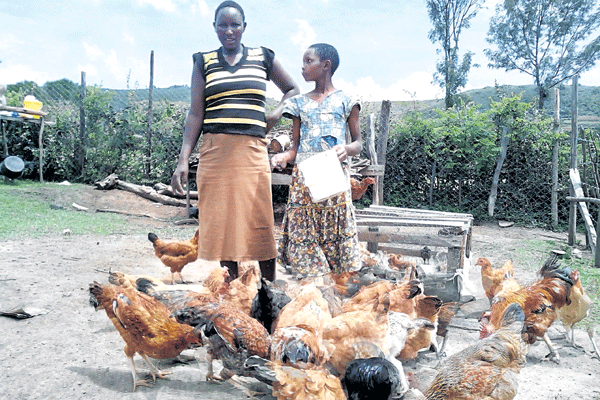
We are welcomed at Mrs Lilian Cherono’s quarter-acre chain-link fenced compound, by the sounds of chicken. She keeps 300 cross-bred kienyeji chicken, 20 mature cockerels and 30 chicks. “I had 200 chicks but a client bought 170 today. Another customer will come for the remaining tomorrow,” she says. She prefers free range chicken, though young chicks are kept in a cage to prevent attacks from predators such as hawks.“They were about 600 in January but I have since sold most of them,” she says.

She tried keeping broilers but abandoned the project due to lack of market and the high cost of feeds. She switched to rearing indigenous chickens late last year with 70 chicks. This was after she attended a one-day poultry farming training session at Kaki Village Enterprise in Gitaru, Kikuyu. It was here that she was introduced to Kenbro and Dorep breeds of chicken.

“Kenbro and Dorep are highly resistant to disease and mature faster. Their productivity in terms of eggs and meat quality is outstanding,” she says.To start off, she bought several indigenous chickens from the local market.

She sourced the Kenbro and Dorep chicken from Membley estate, Ruiru through a referral by one of her friends. She started cross-breeding the local chicken with Kenbro and Dorep cockerels.

The result is chicken with more weight when mature and which grow faster than the kienyeji ones.The chicks are hatched naturally, on old and tattered clothes in cartons.

REPLACE THE HATCHED EGGS

“The old clothes maintain constant warmth to the eggs. I regularly disinfect the cartons to keep away mites and lice,” she says. She selects eggs that are not more than 10 days old for hatching and puts 10 to 12 in each carton, depending on the body size of the hen.

So what is the secret behind her success? “Immediately the chicks are hatched, I replace the hatched eggs with fresh ones. I allow the chicks a few minutes to acclimatise before I take them from the mother hens and place them in an improvised brooder.

This way, the hens continue lying on the eggs. They can hatch a second time as long as they are fed properly,” Lilian says.

The cross breed chicken is a dual purpose breed which has all the characteristics of the indigenous chicken but with the additional advantage of laying more eggs. It matures faster and fetches more money on the market.

She says poultry farmers should vaccinate the chicken to keep diseases at bay. Lilian feeds her chicken sunflower seeds, rastrineobola argentea, popularly known as omena, maize germ, sukuma wiki, green grass and kitchen waste. She also crushes egg shells, which contain calcium, and feeds it to the chicken.

“I also grind garlic, onions and aloe vera leaves, I mixed it with water and put it in the chickens’ drinkers. This prevents worm infestation and boosts their immunity.” This, though, has not be proved scientifically.

Eggs from the Kenbro, Dorep and the cross breed chickens are on high demand with one selling for between Sh20 and Sh30. She is overwhelmed by the demand of the chicks and eggs.

From the proceeds of this venture, she is able to educate her son, who is at a high cost private secondary school in Nakuru County. “I get more than what I used to earn from the sale of maize,” says Lilian. “I quit farming maize this year. My target is to rear 1,500 chicken before the end of this year,” she says.

This is how to stop your dipping egg production

Poultry farming is steadily and surely gaining ground in Kenya. This being a promising business enterprise, farmers need to be equipped with the right information to optimise yields.

However, chicken farming can be quite tricky. There are several challenges that poultry farmers face, with disease outbreaks being the most dreaded.

But sometimes even when all things within the farmer’s control are running all right, the farmer may notice a steady decline in the daily egg production of the flock. This is a common occurrence and is a critical setback to this otherwise profitable enterprise.

Typically, a hen will begin to lay eggs at 18-22 weeks of age and the egg production will peak about six to eight weeks later. A drastic change in this expected peak can be as a result of various factors. The upside of this is that most of these factors also have some quick-fixes.

REASONS

One of the primary reasons is stress and change. Most hens often are affected by sudden changes in their usual patterns. Change of position of nesting boxes often throws the laying hens off-balance and could result in reduced egg production. Farmers should avoid moving or handling these birds once they start egg laying.

Another factor is introduction of new flock members or removal of roosters from the flock. Often, this may cause some perceived “coup d’é·tat” and should be avoided at all costs.

Overcrowding, weather changes, change in feeds both in composition and time of feeding could ultimately also result to reduced egg production. Farmers should also watch out for drastic changes in temperature such as chilly and damp conditions especially in the nesting boxes. They should ensure daily change of the litter lining. Another key issue is frightening of the birds by dogs and noises from machinery. Clearly, these hens want to remain as undisturbed as possible, apart from the loud characteristic cluck announcing the arrival of a newly laid egg.

Decreased lighting conditions have an adverse effect on the perceived reduced day length. It has been scientifically proved that the length of exposure to daylight affects egg production. Egg production is stimulated by increased lighting and a farmer should strive to provide additional lighting in the coop. At least 14-16 hours of adequate lighting should be provided.

DETRIMENTAL EFFECTS

Improper diet also has detrimental effects on egg production. Laying hens require diets that are rich in energy, protein and calcium. Farmers should ensure that they give calcium supplements in the feeds.

The diet should be nutritionally balanced. Farmers may need to avoid just giving table scraps of plain maize grains to egg-laying hens. Most commercial layers mash feeds are well balanced and egg-laying boosters may be added in the hens’ drinking water to provide the necessary amino-acids and minerals required during this critical period.

Broodiness, a normal behaviour exhibited in laying hens, may trigger the decline in egg production. The challenge here is that this condition is innate. However, the farmer could discourage broodiness by increasing artificial lighting.

Last but not the least, occurrence of diseases and parasites in the flock can also cause a decline in egg production. If and when a farmer notes the drop in egg production, it is crucial to look out for any infections and attend to them as quickly as possible. Dusting of the birds for any ecto-parasites is important and deworming for endo-parasites.

Farmers, if you want to hear the characteristic clucking after a hen has just laid her coveted egg, just follow the drill.

Honda Fit Review

0

When the Honda Fit debuted eight years ago it quickly became a favorite of economy car shoppers. It’s fair to say it wasn’t because of the car’s rather controversial styling, but with its flexible configurations for interior seating and cargo, a fuel-efficient engine and a relatively fun-to-drive demeanor, the Fit proved that you didn’t need to suffer an anonymous econobox just for good mileage.

The Honda Fit is available in two main trim levels: base and Sport. Both come with a fuel-efficient 1.5-liter four-cylinder engine that produces 117 horsepower and 106 pound-feet of torque. A five-speed manual transmission is standard, with a five-speed automatic transmission being optional. Paddle shifters are included with the automatic for the Sport version. Fuel economy is respectably good with either transmission.

On the base Fit, air-conditioning, cruise control, keyless entry a tilt-and-telescoping steering column and a four-speaker audio system with a CD player, auxiliary audio jack and iPod/USB audio interface are standard. The Honda Fit Sport gains bigger wheels, sportier exterior trim details and a six-speaker audio system. Fit Sports can also be optioned with a touchscreen navigation system that includes Bluetooth phone and audio connectivity and voice controls.

The Fit is Honda’s smallest automotive product, but it nearly matches the total passenger space of the larger Civic sedan. To help achieve this, Honda has installed a compact rear suspension design and placed the fuel tank underneath the passenger seat. Another key advantage for the Fit is its innovative, highly versatile rear seating arrangement.

The “Magic Seat” has seatbacks that fold flat and seat cushions that can be flipped upward, creating a tall load area right behind the front seats — sort of like a crew cab pickup’s rear seats. Maximum cargo capacity is an impressive 57 cubic feet.

Now entering its third generation, the 2015 Honda Fit looks to keep the good times rolling while also becoming even more appealing.

Body Styles, Trim Levels, and Options

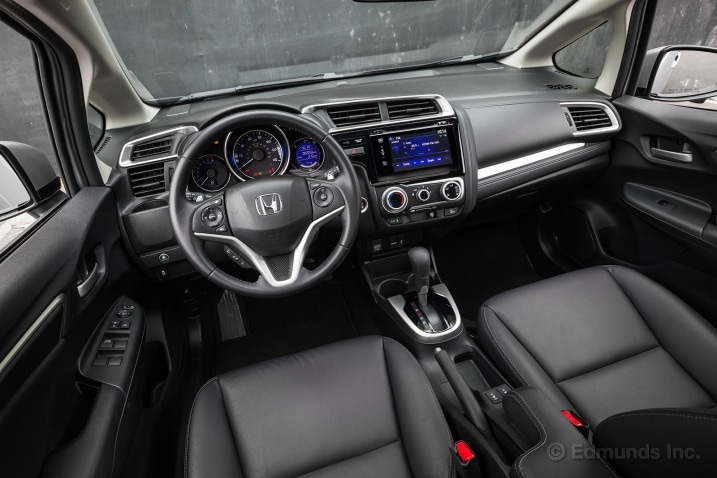
The 2015 Honda Fit is offered in LX, EX, EX-L and EX-L with Navi trim levels.

Honda Fit Review

A 7-inch touchscreen interface is included starting at the EX trim level. Leather upholstery is standard in EX-L models.

Powertrains and Performance

The 2015 Honda Fit features a 1.5-liter four-cylinder engine generating 130 horsepower and 114 pound-feet of torque. A six-speed manual transmission is standard on LX and EX models, while a continuously variable automatic transmission (CVT) is optional. EX-L models are only offered with the CVT.

During Edmunds testing, a 2015 Honda Fit EX-L with Navi ran from zero to 60 mph in 8.8 seconds; that’s pretty quick for the subcompact segment.

Equipped with the manual transmission, the Fit returns an EPA-estimated 32 mpg combined (29 city/37 highway). CVT-equipped models deliver 35 mpg combined (32 city/38 highway), except for the entry-level LX. At 36 mpg combined (33 city/41 highway), it yields the best fuel economy of the lineup.