

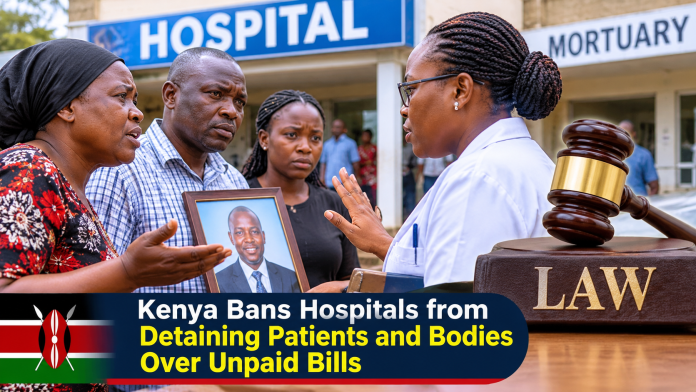
Health (Amendment) Bill, 2024: The proposed law seeks to protect patients and bereaved families from hospitals and mortuaries that withhold patients or refuse to release bodies of deceased people as security for unpaid medical bills.
Kenya’s efforts to protect patients and families from the distressing practice of hospitals detaining patients and mortuaries withholding bodies over unpaid medical bills have received a major legislative boost following the passage of the Health (Amendment) Bill, 2025, by the National Assembly.
The Bill, sponsored by Kirinyaga Woman Representative Jane Njeri Maina, seeks to outlaw the practice of healthcare facilities retaining patients or withholding the bodies of deceased people as a means of forcing families to settle outstanding medical expenses.

The proposed changes are intended to strengthen patients’ rights, safeguard human dignity and ensure that financial difficulties do not prevent people from receiving their freedom or families from giving their deceased relatives a dignified farewell.
Endometriosis: Understanding the silent pain affecting millions of women
What the Health (Amendment) Bill Seeks to Change
The Health (Amendment) Bill, 2024, National Assembly Bill No. 56 of 2024, proposed amendments to the Health Act, Cap 241, to address practices that have left patients and bereaved families in difficult situations.
Its key proposals include:
- Ending detention of discharged patients: Hospitals would be prohibited from preventing medically discharged patients from leaving their facilities because they cannot pay outstanding medical bills.
- Releasing bodies for burial: Hospitals and mortuaries would not be allowed to withhold deceased persons’ bodies as security for unpaid medical expenses.
- Protecting emergency patients: Healthcare facilities would be required to provide emergency medical treatment without first demanding deposits or proof that a patient can afford treatment.
- Introducing alternative debt recovery mechanisms: Hospitals would be encouraged to pursue outstanding payments through structured arrangements rather than detaining patients or withholding bodies.
The proposed amendments will ensure that financial disputes between hospitals and patients do not undermine fundamental rights, including human dignity, freedom and access to healthcare.
Hospitals Could Face Millions of Shillings in Fines
The proposed legislation introduces financial penalties for healthcare facilities and public officers who violate its provisions.
Public healthcare facilities that demand prepayment before providing emergency treatment could face fines of up to KSh3 million.
Additionally, public officers who authorise or facilitate the detention of deceased persons’ bodies over unpaid medical bills could face fines of up to KSh2 million.
The proposed framework also seeks to establish alternative payment arrangements that would allow hospitals to recover outstanding medical debts without violating the rights of patients and their families.
Man who sold all his property to fund 10 surgeries appeals for help for India treatment
Jane Njeri Maina’s Fight Against Hospital Detention
The Bill is sponsored by Kirinyaga County Woman Representative Jane Njeri Maina, who has argued that no Kenyan should be denied freedom, emergency medical treatment or the right to bury a loved one because of financial difficulties.
During parliamentary debates in February 2026, Maina highlighted the experiences of families who had been forced to endure prolonged delays in collecting the bodies of deceased relatives because of unpaid hospital bills.
One case she cited involved Kelvin, a former medical student who turned to the boda boda business after struggling to secure employment.
Kelvin died in a road accident, but his body was reportedly held at a funeral home for nearly a year as his family struggled to raise an outstanding hospital bill of KSh1.42 million.
Maina said she had offered the family free legal assistance and witnessed the emotional pain experienced by Kelvin’s mother, who could not give her son a dignified burial.
The legislator argued that withholding deceased persons’ bodies does not provide a humane solution to hospitals’ financial challenges and instead places additional suffering on families already dealing with loss.
MPs Support Protection of Patients and Bereaved Families
The proposed legislation received support from several lawmakers during parliamentary discussions, with members highlighting the need to prioritise saving lives and protecting human dignity.
Dagoretti South MP John Kiarie argued that emergency departments should focus on assessing patients’ medical conditions rather than their financial capacity.
He questioned the practice of checking whether patients can afford treatment before assessing their vital signs.
Embakasi East MP Babu Owino also criticised the commercialisation of healthcare, reminding medical practitioners of their professional responsibility to provide treatment and uphold the principle of doing no harm.
National Assembly Health Committee Chairperson James Nyikal, who supported the proposed reforms, noted that sustainable participation in the Social Health Authority (SHA) scheme would also help address the financial difficulties experienced by patients and healthcare facilities.
Lawmakers also emphasised the importance of establishing payment arrangements that allow hospitals to recover their revenue without compromising patients’ rights.
When Every Second Counts: What You Need to Know About CPR
What Happens After the National Assembly Passes the Bill?
The passage of the Health (Amendment) Bill, 2024, on Wednesday, November 11, 2026, marks an important step in the legislative process.
However, the Bill has not automatically become law following its approval by the National Assembly.
It will now proceed to the Senate for consideration before being presented to President William Ruto for assent, according to reports on the parliamentary proceedings.
Once the required constitutional processes are completed and the legislation comes into force, healthcare facilities will be subject to the new legal requirements.
Until then, the proposed amendments should not be confused with an already enacted law.
What the Proposed Law Means for Kenyan Families
For many Kenyan families, hospital bills have become a major financial burden, particularly when a patient requires prolonged admission, specialised treatment or emergency medical attention.
In some cases, families have been forced to organise public fundraising initiatives to clear medical debts before their relatives can leave hospital or their deceased loved ones can be released for burial.
The proposed legislation seeks to separate the responsibility of paying medical bills from the fundamental rights of patients and bereaved families.
Hospitals will still be entitled to pursue legitimate outstanding debts through lawful channels. However, they would no longer be permitted to use the detention of patients or withholding of human remains as debt recovery mechanisms.
The proposed changes also reinforce the principle that emergency medical treatment should be provided based on medical necessity rather than a patient’s ability to pay upfront.
For families who have experienced the pain of being unable to bury loved ones because of outstanding hospital bills, the proposed law represents an important development in the protection of human dignity and patients’ rights in Kenya.