



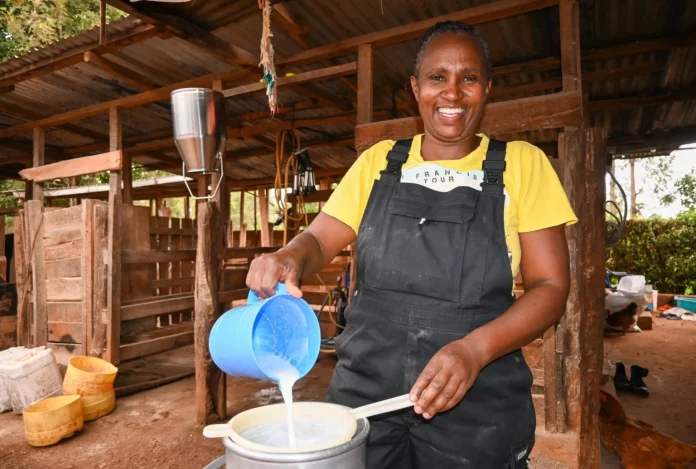
In the rolling highlands of Meru County, a quiet agricultural revolution is underway, led not by policymakers or multinational agribusinesses, but by women whose resilience is reshaping Kenya’s dairy sector.
At the forefront stands Racheal, a 50-year-old dairy farmer whose journey from grassroots farming to cooperative leadership offers a testament to the transformative potential of women in agriculture.
Racheal’s story began in 2011, when she purchased land and received her first heifer from her mother, drawing on a childhood steeped in farming.

Though she remembers watching her mother milk cows after long days, it wasn’t until later in life, after marriage and the realisation that her household needed milk, that she fully grasped the economic value of dairy cattle.
Starting with a single cow, Racheal gradually built her herd, adopting improved practices and expanding her expertise. Through diligent record-keeping and farm management, skills she attributes to her upbringing, her farm now boasts 15 cows, producing up to 164 litres of milk per day.
Her operation has become a model of smallholder efficiency, supporting her family and demonstrating the economic viability of well-managed dairy enterprises.
But her impact extends far beyond her own paddocks. Frustrated by the under-representation of women in agricultural leadership, Racheal entered the cooperative arena in 2016 when she was elected to represent farmers in the Nyaki dairy cooperative.
At the time, few women held formal leadership roles despite their heavy involvement in daily farming.
In 2021, determined to improve governance and accountability within the cooperative, Racheal ran for the position of chairperson.
Her campaign struck a chord with fellow members, leading to her election and ushering in a more inclusive era of cooperative leadership. Under her stewardship, milk collection soared from 1,200 litres per day to 3,750 litres, benefiting more than 400 active farmers.
Racheal credits part of her leadership success to training she received through the Economic Recovery to the Impact of COVID-19 on Agri-Food Value Chain project, a programme funded by the Italian Agency for Development Cooperation and implemented in partnership with AVSI Foundation, E4Impact, and local county governments.
These capacity-building sessions equipped her with governance know-how, conflict management strategies, and business planning tools, crucial for steering the cooperative through growth and change.
One of her most notable achievements was securing a matching grant that enabled the cooperative to purchase a milk transportation truck. The truck has reduced spoilage, improved market access, and strengthened pricing returns for producers.
Beyond administrative leadership, Racheal has embraced the role of mentor and teacher. Her farm has become a learning hub where other farmers, particularly women and youth, visit to observe best practices and gain practical insights.
“I invite farmers to my farm so they can learn. When we learn together we grow together,” she says.
Also Read: Kenyan entrepreneur transforms arid Kajiado land into thriving farm and eco-retreat