


On November 3, 2025, at around 1.30am, Judy Okeyo arrived at Harmony Medical Clinic in Nakuru County a worried mother. Her fourteen-month baby had come down with sudden fever that wouldn’t drop with over-the-counter paracetamol medication she had stored at home.
“I grabbed my phone, called for a taxi and dashed my daughter to hospital. Her eyes had started to turn inwards. Her feet and hands were getting cold even though she had a very high fever,” she says.
Okeyo, who runs a hotel business around one of the local matatu terminals in Nakuru town, says that it was only after seeing a doctor that she remembered that she had not paid for the taxi.

“The driver was kind enough to see a mother in panic. He did not rush me to pay him. He waited and made sure that my baby had been stabilized before he asked for his pay,” she says. “I didn’t have cash on me. I asked if he could accept an M-Pesa transfer and he offered me Pochi la Biashara,” says Okeyo. “I paid Sh1,500 for the taxi.”
Laboratory tests established that her daughter had a bacterial infection. “We were treated and released the following day at noon with medications and follow up clinics. The medical bill was Sh6,500. I had a balance of Sh4,800 which I topped up with a Fuliza credit of Sh1,700,” she says.
Ms. Okeyo is one among the more than 50 million of Kenyans whose daily lives have become integrated with Kenya’s leading telecommunications firm, Safaricom, over the past 25 years.
Started in October 2000, Safaricom has not only grown into the biggest company in East and Central Africa; it has also evolved into a way of life for ordinary Kenyans and their businesses. In fact, when Bizna Kenya visited Ms. Okeyo at her place of work, one of the most prominent things we noticed were the Lipa Na M-Pesa and Pochi la Biashara tags that she had strategically placed on tables for customers to settle their bills with.
Eliud Wanjiru, a business development consultant and financial markets analyst based in Nairobi, points out that Safaricom’s integration into the daily economy has made the organization a conduit of success for small and medium enterprises.
“A couple of years ago, every entrepreneur had to contend with cash transactions; moving from business to bank. This has now changed. Virtually all businesses now come with an option to transact via mobile money, a space that is dominated by Lipa Na M-Pesa which was started in 2013 and other Safaricom Paybill options,” says Mr. Wanjiru.
“The admirable thing is that this integration has profoundly boosted micro small and medium enterprises which account for up to 98 percent of all businesses, create 30 percent of all jobs annually and contribute 40 percent to the country’s GDP.”
His sentiments resonate with the experience of Ms. Okeyo. She remembers that when she started her business about eight years ago, it was common to have one employee running up and down in search of loose change. “It was a disturbing inconvenience both to the business and to the customers, especially during peak lunch hours. This is a high traffic environment and nobody has the time to wait as you seek for loose change; they will prefer to go to establishments that don’t have cashflow problems,” she says.
Things have changed since she adopted the various forms of payments offered on M-Pesa. “Everybody has moved to M-Pesa. We very rarely receive cash payments.” She adds that this has not only made her operations more efficient, but has also enhanced her bookkeeping. “I am able to get an M-Pesa transaction statement whenever I want, which has made tracking inflows and outflows much easier.”
This ease of doing business is the fruit of the telecommunication evolution that began in 2000 when Safaricom entered the scene. Back then, Kenya was attempting to break away from the traditional landline connectivity. The country had 23,757 mobile connections with a network connection capacity of 24,000.
“To set off, Safaricom took in 17,000 customers from the government’s Telkom and an investment of Sh2.06 billion from Vodacom,” says Mr. Wanjiru. “It also launched at a time when rivals such as Kencell had already gained traction in the mobile market.” Its entry, though, was a major relief to consumers. “At the time, Kenyans were billed per minute. Safaricom introduced per second billing and prepaid services. This allowed mobile users to spend on what they had,” says Mr. Wanjiru.
Over the next few years, Safaricom concentrated its investment on building a network infrastructure that saw base transmission stations and airtime outlets set up in most parts of the country. By May 2013, Safaricom had over 250,000 retail outlets for selling airtime.
“The idea was that Kenyans could obtain Safaricom services wherever they turned. This made the colour green synonymous with Safaricom services,” says Mr. Wanjiru. “25 years later, what we have is a company that has enabled Kenyans to meet their daily needs such as paying electricity bills, shopping, paying court fines, utility bills, and even sending relatives money, all with the touch of a mobile button. They have basically brought the solution to the consumer’s finger tips.”
Safaricom has responded to growing usage and needs with improved offerings including increased transaction limits. For instance, in August 2023, Safaricom more than tripled the daily transaction limits on its mobile money platform to Sh500,000. At the same time, Safaricom also allowed individuals and businesses to hold half a million shillings in their M-Pesa wallets.
“The increased account limits provide customers and especially small businesses with increased convenience as the share of cashless transactions continues to rise,” says Safaricom chief executive officer Peter Ndegwa.
An analysis by Bizna Kenya has further shown that over and beyond innovative business and personal financial solutions, Safaricom has sent out over Sh1 billion in appreciation rewards to customers over the past two and a half decades.
“The company’s first major promotion was in 2001. It offered subscribers a chance to win brand-new Volkswagen Beetles,” says Samson Kibet who is a marketing consultant and market trends analyst. “About ten years later, Safaricom had the Masonko na Safaricom which was made up of a Sh150 million prize pool.”
In 2020, the company marked 20 years with a Sh250 million campaign dubbed Shukrani Kocho Kocho Kenya Nzima! Over the last 25 years, some of the main promotions the company has used to rewards its customers have included Shine Kenya Shinda Mamilii Kama Bingwa, Stori Ibambe, Shinda Ma Mili na Stori Ibambe, Masonko na Safaricom, Shukrani Kocho Kocho Kenya Nzima, and Gomoka na Go Monthly.
Currently, Safaricom is running the Shangwe@25 campaign to appreciate its customers for their continued support and loyalty over the last 25 years. This campaign started on October 31, 2025 and shall run until January 19, 2026.
A spot check by Bizna Kenya shows that Kenyans have been receiving cash rewards, TukTuks, home accessories, free minutes, free SMSes, and free data. In addition, 25 Kenyans are set to walk home with Sh1 million cash rewards. They will also be asked to nominate a community project in their areas which shall be awarded Sh250,000.
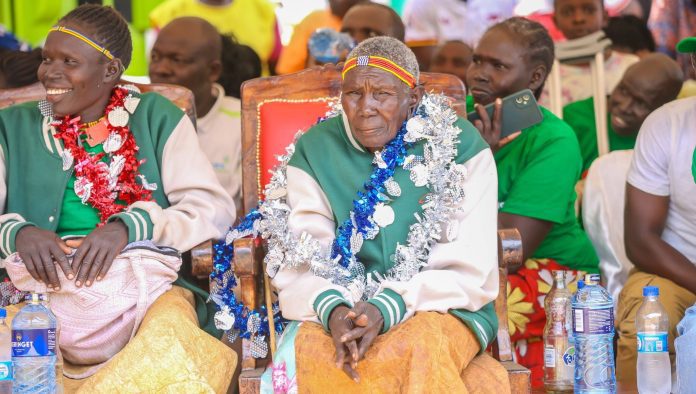
For instance, when 85-year-old Talaa Chelangaa from Songeto in Elgeyo Marakwet was awarded with Sh1 million, she nominated Songeto Primary and Junior School from her home area to receive the Sh250,000 community prize for desks and lockers.
“My daughter is the one who received the call from Safaricom telling her that I had won Sh1 million. I will now use this money to buy land. My message to Safaricom is a heartfelt thank you. I also want to pass my blessings to Safaricom. May God bless you as He has blessed me,” said a jovial Mrs. Talaa.
The life-changing award was clear for all to see. Mrs. Talaa has been living in a desolate iron sheet room in Songeto which was erected next to mud huts. She had no electricity, no tables and no chairs. The toilet in her home compound had no doors. It was covered in gunny bags that flapped over and over in the winds of Songeto.
Samson Koiyet, a farmer based at Songich Farm in Ainabkoi Constituency in Uasin Gishu County is another beneficiary. He has received a brand new TukTuk from Safaricom.
“This is a machine that we have been looking forward to buy. However, it seemed out of reach for us due to its cost which was very high. This reward is truly a landmark that will make our work more efficient at this farm,” he says.
Koiyet says that he has employed a number of farmhands at his farm. He has been paying them using M-Pesa, which has been more convenient than traveling to town to make bank withdrawals.
According to Safaricom, Shangwe@25 is about creating real opportunities for businesses across Kenya. “We recognize and celebrate hardworking entrepreneurs whose everyday use of Safaricom business solutions is now opening new doors for growth,” Safaricom states.
Safaricom Shangwe@25: How to participate and become a millionaire