

The labour market in Kenya is now placing more emphasis on practical skills and real-world experience, since an increasing number of young people are looking for education routes that will lead directly to employment or self-employment.
The change is becoming more and more apparent in the field of technical and vocational education and training (TVET), since learners are able to gain specific skills without having to enter into long academic programmes.
Instead of spending several years obtaining a qualification before joining the labour market, modular training enables learners to concentrate on the particular skills that they need. For instance, someone who is interested in vehicle maintenance can gain specific abilities such as wheel balancing, oil changes or filter replacement without having to complete the full automotive course.

The method is also attracting the interest of students who are looking at alternatives to traditional university degrees, especially since digital platforms and remote work are still providing opportunities for those with special skills.
People in the industry say that qualifications are still important, yet employers nowadays want to find out if the candidates are able to carry out the tasks which they claim to have been trained for.
This is especially relevant in jobs related to the fields of science, technology, engineering and mathematics, since practical assessments can play a significant role in the recruitment process.
The greater focus being placed on skills is at the same time creating new opportunities for women, since they have usually been poorly represented in a number of technical jobs.
Because of cultural expectations, economic problems and other obstacles girls and young women are unable to go beyond their basic education and to get technical training; this causes a large number of them to end up in jobs that require low skills and to have few opportunities for moving up in their careers.
The project, which lasted six months, aimed at overcoming some of these obstacles by providing vulnerable young women with technical training and work experience.
The project, which was carried out by the CAP Youth Empowerment Institute (CAP YEI) in cooperation with the Partnership for Economic Policy (PEP) and financed by Global Affairs Canada, provided training for 1,363 girls in its first three groups.
The trainees were selected from vocational training centres in various parts of the country, such as Homa Bay, Kisumu, Siaya, Kakamega and Nyeri, and a subsequent impact evaluation covered 1,154 of them.
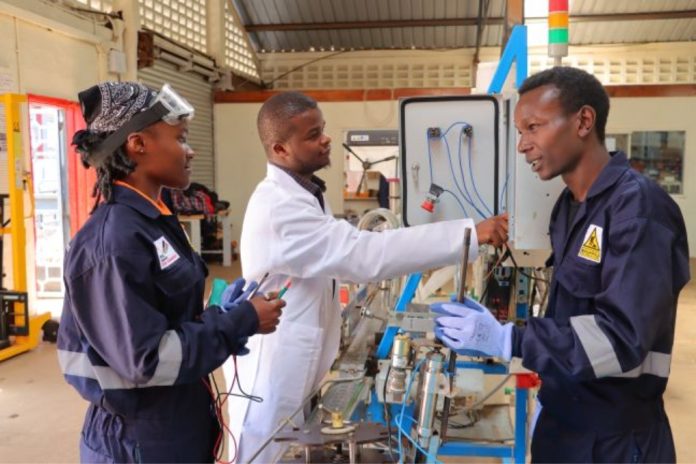
The programme included both technical education and training in the skills needed for everyday life and work. The participants stayed for four months receiving classroom and hands-on training before entering a two-month internship in an industry setting.
There were four options for training: plumbing and pipe fitting, electrical installation and wiring, solar photovoltaic systems, and food and beverage production and service.
The training included more than just technical instruction; it provided mentorship and coaching, taught the participants how to prepare their CVs and deal with job interviews, and gave them life skills designed to boost their confidence and prepare them for the workplace.
The programme also included education on sexual and reproductive health, taking into account the wider difficulties that some of the young women who were the target of the initiative were facing.
HELB opens first-time loan scholarship applications for university, TVET students
The internship section allowed the participants to put their skills into practice in real work settings, with some being assigned to construction sites, such as those involved in affordable housing, and others gaining experience in the hospitality and other related sectors.
For certain participants, the experience gained at the workplace led to them securing employment, while for others the skills and networks obtained as a result of the programme were put to use in pursuing freelance work or setting up their own activities designed to generate income.
Denis Mushiri, who is the Director of the CAP Youth Empowerment Institute, stated that the project showed the value of bringing together the government, private-sector employers and communities when implementing skills-development programmes.
He also mentioned that carrying out vocational training through centres administered by the county governments would be a way of making sure that useful practices continue after the externally funded project has ended.
Phyllis Machio, who is a lecturer at the University of Nairobi and also a researcher with the Partnership for Economic Policy, stated that it is still a important policy aim to increase women’s involvement in STEM since technical skills can lead to better employment opportunities.
She observed that a great many women are still concentrated in low-skilled jobs and therefore considered it especially important to introduce interventions which give them technical skills.
Machio also emphasized the need to deal with the stereotypes which depict technical jobs as being unsuitable for women.
She said that by removing cultural and social barriers young women will have more freedom to choose careers in the STEM fields on the basis of their own interests and abilities.
The STEM Education for Empowerment Project also shows that modular and practical training has potential as Kenya considers how it can prepare young people for the changing labour market.
For employers, the capacity to show that one is competent is just as important as having a certificate proving that one has received training. For learners, shorter and more flexible courses offer a means of gaining their skills step by step and allowing them to enter the job market earlier.
The people in charge of the project hope that the model will be able to secure additional funding and offer lessons which can be more widely adopted by government and vocational training institutions.
At the heart of the approach is a simple proposition, education should not only provide qualifications, but also equip people with skills they can use to earn a living, create businesses and participate meaningfully in the changing economy