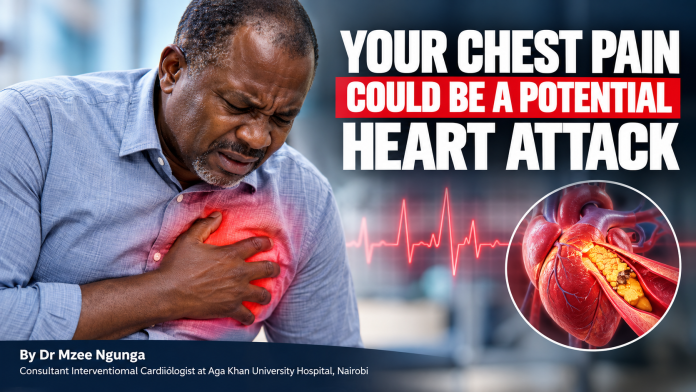
Heart attack: Chest pain or discomfort can be an indicator of serious and life-threatening conditions and should be evaluated promptly with minimal delay. It is critical to visit a hospital with a proper pathway for management of an acute coronary syndrome. This is a set of steps, based on the current scientific evidence, which guide the patient, family, health care professionals and other hospital staff involved in the patient’s care on efficient management of patients with chest pain. This helps ensure early identification of life.
What should I do if I develop chest pain/discomfort?
Chest pain, especially if it develops within a few minutes to an hour, needs urgent evaluation to rule out potentially serious causes. The recommended course of action is to present to a hospital which is capable of diagnosing and treating acute heart condition emergencies. You should go to the emergency department (casualty) and inform the medical staff immediately that you are experiencing chest pain /discomfort. It is recommended that you use the fastest means possible to reach the hospital.
What should I expect when I present to the hospital emergency department with chest pain?
The nurse and doctor who will attend to you will measure your blood pressure, pulse, oxygen saturation and temperature. You will be asked a few questions about your chest pain, perform a physical examination and an electrocardiogram (ECG) – a recording of the electrical activity of the heart. All this should be done within 10 minutes of your arrival.

The ECG forms the basis of early decision-making and helps the doctor decide whether you are having an acute heart attack (ST elevation myocardial infarction (STEMI)), which is a type of heart attack resulting from total occlusion of the arteries that supply the heart muscles. An acute heart attack (STEMI) requires prompt treatment to re-establish blood flow in the blocked artery. Other tests you can expect to be done while in the emergency department include blood tests that check for heart enzymes, blood counts, electrolytes, a chest X-ray or CT scan of the chest and an echocardiogram (ultrasound of the heart).
Are you at risk of heart failure? See Types, Causes, Symptoms, Treatment
What is a heart attack?
A heart attack occurs when deposits in the arteries cause a blood clot to form, causing either partial or complete blockage in the artery. This blockage slows or blocks blood flow to the area of heart muscle supplied by that artery. If prolonged, the muscle can become damaged or die.
What symptoms accompany a heart attack?
A heart attack will present with symptoms like chest pain/discomfort, which typically occurs on the left side of your chest but can be anywhere between the neck and the umbilicus. It is often described as a squeezing pain or heaviness. Pain may sometimes be felt in either arm, the jaw, teeth, neck, upper abdomen or back. With a heart attack, you are also likely to have difficulty breathing, nausea or vomiting, sweating, dizziness or loss of consciousness/collapse.
In addition, some people suffer a stop of the heart (Cardiac arrest), usually because of an electrical heart rhythm problem, causing the heart to stop beating. This is often fatal if it occurs outside of a hospital, as it requires a special electric shock (defibrillation) to treat. These common presentations highlight the need to seek urgent evaluation for any chest pain or other symptoms suggestive of a heart attack.
How is a heart attack diagnosed?
There are two main types of heart attacks: an ST elevation myocardial infarction (STEMI) and a non-ST elevation myocardial infarction (NSTE-ACS). STEMI occurs due to the complete blockage of an artery and time is of the essence in opening up the blocked artery to prevent death and complications. The diagnosis of STEMI is made by performing a test on the electrical activity of the heart (ECG) within 10 minutes of patient arrival.
Blood will be taken for heart enzymes, but the doctor will not wait for the results to initiate treatment. An NSTE-ACS occurs due to partial blockage of an artery. The blockage is, however, severe enough to cause some muscle damage. An ECG may have some abnormalities, however usually the diagnosis is made on finding elevated heart enzyme levels called troponin. The turnaround time for the test from the lab is approximately one hour.
How mothers can cause their babies heart defects unknowingly
What is the treatment for a heart attack?
For complete blockage (STEMI), the blocked artery should be opened up as soon as possible. Two options are available:
Primary Percutaneous Intervention (Primary PCI) – This procedure is performed in the cardiac catheterization laboratory (cathlab), which is a special X-ray suite. An interventional cardiologist passes a thin catheter through your wrist or groin into the heart, and a special dye (contrast) is injected into the heart arteries (coronary arteries). This is called a coronary angiogram and can help to visualize blockages in the arteries on the x-ray.
Once the problem is identified, a thin balloon is passed into the blockage and expanded, allowing the artery to open. A metal scaffold (stent) is then placed inside the artery to keep it open. This procedure re-establishes blood flow to the heart muscle. This is the gold standard treatment for heart attacks, and if done early provides the best results.
The second treatment is a clot-busting/dissolving drugs or thrombolytic. These are medications that are injected into a vein and work by circulating in the bloodstream and dissolving the clot in the heart. While thrombolysis is a very effective treatment, it may fail to reopen the artery, thus necessitating the patient to be taken for angioplasty anyway, rescue PCI. The risk of bleeding is high in thrombolysis, since it circulates in the whole body. Bleeding in the brain is the most serious consequence, and the doctor will go through a checklist for thrombolysis before administering the drug. Patients who are at high risk of bleeding may not be candidates for thrombolysis.
When can I resume sexual activity after a heart attack?
Most people have anxiety about returning to sexual intimacy after a heart attack. It is good to discuss with your cardiologist when it is safe to resume sexual activity. For most people, this may be possible once they can tolerate a moderate amount of physical exertion. Generally, this is after at least two to four weeks of having a heart attack. Some of the medications prescribed for your heart may interfere with your sex drive or ability to maintain an erection and achieve an orgasm.
If you feel this may be the case, please bring it up with your cardiologist to see if there are alternative medications. You should not stop any of these medications on your own accord. Medications which contain nitrates (e.g. nitroglycerine tablets, patches and sublingual sprays) may cause dangerous drops in blood pressure if taken together with medicines that treat erectile dysfunction, such as Viagra and Cialis. You should always discuss with your cardiologist before you use any of these medications.