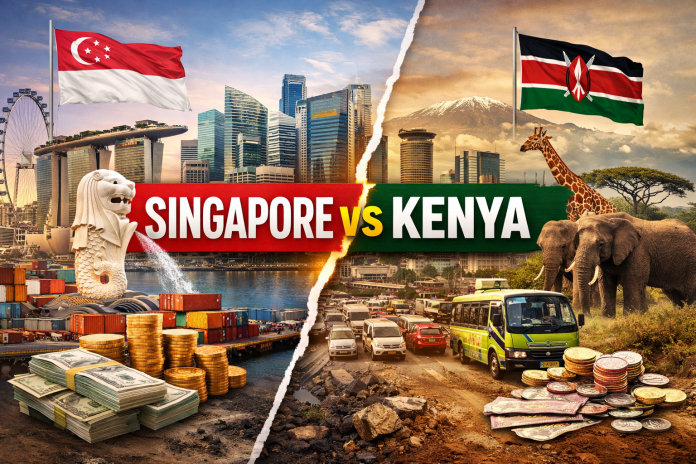
Singapore is roughly the size of Nairobi County. Kenya is nearly 800 times larger. Yet in 2024, Singapore’s GDP stood at approximately USD 500 billion, while Kenya’s hovered around USD 110 billion. The difference is not geography, population, or intelligence. It is execution.
Kenya has long described itself as “a country of immense potential.” Singapore never did. It described itself as vulnerable—and then built systems accordingly.
Economic Output: Productivity tells the real story
Singapore’s GDP per capita exceeds USD 80,000. Kenya’s is just over USD 2,000. This gap is often framed as a development problem. In reality, it is a productivity problem.

In Kenya, over 60 per cent of the workforce is employed in the informal sector, according to KNBS. In Singapore, informality is statistically negligible. Formalization matters because it enables taxation, planning, skills development, and credit access—inputs Kenya’s economy chronically lacks.
Ease of Doing Business: The cost of time
In Singapore, company registration is almost entirely digital and can be completed within a day. In Kenya, despite the eCitizen platform, business owners still navigate KRA, county governments, sector regulators, and compliance renewals that vary by location.
For SMEs, these delays are not minor inconveniences. A World Bank estimate previously showed Kenyan firms spend over 200 hours annually on tax-related compliance alone. Time that could be spent selling, innovating, or expanding is absorbed by administration.
Corruption: A tax without a receipt
Transparency International consistently ranks Singapore among the top five least corrupt countries globally. Kenya, by contrast, ranks in the lower half, with corruption estimated by local business associations to add between 10–20 percent to project costs in certain sectors.
4 Kenyan women arrested at Singapore airport with 27kgs of cocaine
This is not abstract. It affects procurement, licensing, enforcement, and dispute resolution. In Singapore, contracts are enforced swiftly. In Kenya, court cases can drag on for years, forcing businesses to price legal uncertainty into their operations.
Infrastructure: Investment vs output
Kenya deserves credit. Over the past decade, the country has invested heavily in infrastructure—roads, the Standard Gauge Railway, port upgrades, and renewable energy. Installed electricity capacity now exceeds peak demand, and over 90 percent of power generation comes from renewables.
Yet manufacturers still cite power reliability and cost as top concerns. Logistics inefficiencies between Mombasa Port and inland destinations add days and costs that Singapore eliminated decades ago through process discipline and port automation.
Infrastructure spending alone is not enough. Infrastructure must reduce friction measurably.
Urban Planning: Productivity lost daily
Nairobi loses billions of shillings annually to traffic congestion. Average commute times exceed 90 minutes for many workers. Singapore’s average commute is under 45 minutes, supported by an integrated mass transit system.
Time is economic output. When workers spend hours in traffic, businesses pay through lost productivity, burnout, and higher operating costs. Singapore treats mobility as an economic lever. Kenya still treats it as a transport problem.
Housing: Stability enables growth
In Singapore, more than 80 percent of citizens live in Housing Development Board (HDB) estates—planned, affordable, and mortgage-financed. Home ownership anchors social stability and workforce predictability.
In Kenya, the housing deficit exceeds two million units, with an annual demand of about 250,000 units against supply of less than 50,000. Informal settlements house a significant portion of the urban workforce, undermining health, productivity, and social outcomes.
Housing is not just a social issue. It is an economic one.

Education and Skills: Alignment matters
Kenya produces thousands of graduates annually, yet employers consistently report skills mismatches. Singapore’s education system is tightly aligned with industry needs, emphasizing STEM, technical skills, and continuous re-skilling.
Kenya’s human capital is strong, but coordination between education, industry, and policy remains weak. Talent exists. Systems to deploy it efficiently do not.
Natural Resources: A false comfort
Kenya has fertile agricultural land, geothermal energy, tourism assets, and mineral prospects. Singapore has none. Yet Singapore built a global trade, finance, and logistics hub by monetizing trust, efficiency, and predictability.
Kenya’s reliance on commodities and consumption leaves it exposed to shocks—droughts, currency depreciation, and global price swings. Singapore built resilience through diversification and value addition.
The Entrepreneur’s Reality
Despite the challenges, Kenya remains one of Africa’s most entrepreneurial economies. MSMEs contribute over 30 per cent of GDP and employ the majority of the workforce. Digital payments, mobile banking, and platform businesses have scaled faster here than in many richer economies.
This is the paradox. Kenya’s systems lag, but its people adapt.
For entrepreneurs, every broken process is an opportunity. Informal logistics birthed last-mile delivery startups. Banking gaps birthed mobile money. Weak retail infrastructure birthed e-commerce and social commerce.
The opportunity is not in copying Singapore wholesale. It is in applying its core lesson: discipline beats destiny.
The Strategic Takeaway
Singapore did not wait for perfect conditions. It built institutions first and wealth followed. Kenya has vision documents, policy frameworks, and national plans—but execution resets every election cycle.
Until institutions outlast politics, progress will remain uneven.
Still, for builders willing to endure friction, Kenya is not a lost cause. It is an unfinished one.
And unfinished markets, for the disciplined and patient, are where outsized returns are made.