

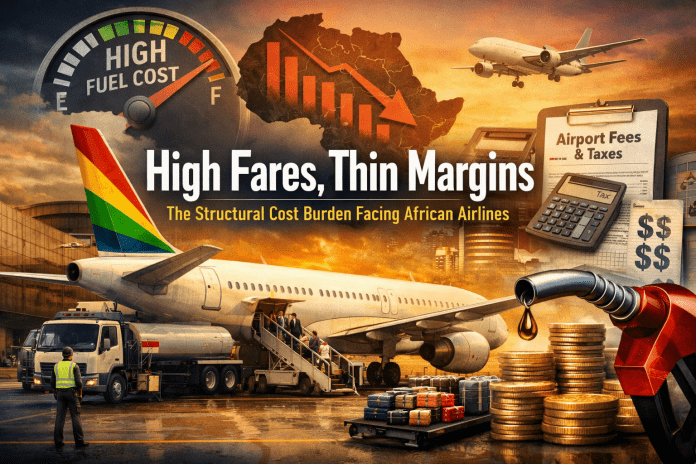
A familiar refrain in discussions of air travel is that African airlines are expensive. This prompts a puzzling question: why are fares high when most carriers on the continent still lose money? The answer lies in their revenue structures and the costs they must bear, which together reveal an unforgiving economics. Here is an analysis of airline revenues and costs and what they portend for the profitability African carriers.
-
- For the world’s most successful airlines, passenger tickets account for only 60-70% of revenue. Cargo can contribute as much as 40% in some cases, while ancillary services, such as baggage fees and seat selection, typically generate 15-30% for full-service carriers and as much as 60% for low-cost airlines. African airlines, by contrast, remain heavily reliant on ticket sales, which provide up to 80% of their income. Cargo yields an average of just 9% and ancillary services way below 15%. This imbalance is costly: cargo and ancillary activities are usually the most profitable parts of an airline’s business.
- Fuel is one of an airline’s largest expenses, typically accounting for 20-30% of revenue. In Africa, it is about 17% more expensive than elsewhere. When global prices swing, these higher costs are passed on, pushing air fares beyond the reach of many African travellers.
- Labour costs are another heavy claim on an airline’s revenues. It is reportedly up to 30% of total operating expenses. Passengers tend to notice only check-in staff and cabin crew, but a far larger workforce operates out of sight. Baggage handlers, ground-equipment operators, turnaround coordinators and cleaners are all essential in keeping aircraft on schedule. Turning around an international flight within a tight time window can require at least 100 people working in concert. However, Africa tends to have far lower labour costs than most of the world’s regions. Where the continent suffers a disadvantage is in the automation of airport operations. In other jurisdictions, automation reduces labour costs through self-check-in kiosks, automated bag drops and biometric technology for passenger processing. Smart gates and drones enhance security and cut on long-term costs while ensuring shorter queues and better passenger flow.
- Aircraft operating fees account for roughly 11% of global airline revenue. In Africa, the share is typically higher. Unlike regions dominated by large, consolidated fleets, the continent’s airline industry is fragmented among many small carriers. Lacking scale, these operators face higher unit costs as they cannot secure the savings that come with bulk purchases of spare parts, fuel or spread training and insurance costs across larger fleets. Airport charges in Africa are also unusually steep. Landing, parking and handling costs are markedly above the global norm with passenger charges often twice the world average.
- The aviation policies of most African countries reflect a mix of protectionism and fiscal opportunism. Several governments favour domestic carriers, imposing hefty fees on other airlines from within the continent seeking access to their airports. In some cases, aviation is treated as a luxury and high taxes on airlines and passengers are seen as an easy source of government revenue. Africa needs to hasten the implementation of the Single African Air Transport Market so that policy barriers to free air movement within the continent are obviated.
How airlines heat in-flight meals at 35,000 feet, and it’s not a microwave
The International Air Transport Association (IATA) forecasts a global airline net-profit margin of 3.9% in 2025. In Africa, the outlook is far bleaker: margins are expected to reach just 1.1%. Measured per passenger, that translates to a profit of only USD1.40 or about Ksh182. With such thin returns, African airlines are especially vulnerable. Disruptions from VIP movements, bird strikes and global supply chain problems, often delaying aircraft from returning to service after scheduled maintenance, can quickly turn modest profits into losses, weighing heavily on already fragile balance sheets.