“Mr Donholm”, James Kerr Watson remains one of the lesser-known yet structurally significant figures in Nairobi’s colonial history. A Scottish-trained architect, contractor, and settler-farmer, Watson’s work bridged private enterprise and public infrastructure at a time when Nairobi was evolving from a railway depot into a colonial capital. His legacy is embedded in land development, transport networks, civic architecture, and agricultural innovation, particularly in what is today eastern Nairobi.
Early Life and Arrival in Colonial Kenya
Born in Ayrshire, Scotland, on 3rd October 1881, Watson was trained as an architect during a period when the profession emphasized permanence, functionality, and material discipline. He arrived in British East Africa around 1908, drawn by opportunity following the completion of the Uganda Railway and the designation of Nairobi as the colonial administrative centre. At the time, skilled professionals were scarce, and individuals with technical expertise were quickly absorbed into both private and government-supported development initiatives.
Soon after his arrival, Watson acquired 5,000 acres of land east of Nairobi, which he named Doonholm Farm, after a Scottish estate. The land lay well beyond the town’s limits and was largely undeveloped, positioning Watson as one of the earliest settlers on Nairobi’s eastern frontier.

Doonholm Farm and Architectural Firsts
Watson approached settlement with an unusually long-term perspective. He established a stone quarry on his land, providing building material not only for his own projects but also for the growing town. Using stone from this quarry, he constructed the first two-storey stone house in the area for his family at Doonholm, marking a departure from the temporary timber and iron structures common among early settlers.
He built the first St Andrew’s Church, the original MacKinnon Building, Whiteway Laidlaw & numerous other buildings in Nairobi. He built Kampala Post Office, Namirembe Cathedral, Uganda. Socially and culturally, Watson also stood out. He was among the first settlers in Kenya to own a piano, a detail that, while minor, illustrates the gradual transplantation of European domestic life into the colony and the transition from frontier existence to settled society.
Roads, Milk Supply, and Early Transport Infrastructure
One of Watson’s most consequential development initiatives was road construction. As a dairy farmer supplying milk to Nairobi, he faced persistent transport challenges. To address this, Watson sought permission from the colonial administration to construct a Road. Permission was granted, and he constructed Doonholm Road on his land to facilitate the efficient movement of milk and farm produce into the city.
Meet owners of Donholm’s multi-billion Greenspan Mall
This road, later renamed Jogoo Road, became one of Nairobi’s earliest engineered roads and a critical transport corridor linking the eastern hinterland to the city centre. Watson’s involvement extended beyond alignment and advocacy; he played a direct role in its design, construction, and early tarmacking. What began as a private logistical solution evolved into a public infrastructure that continues to serve Nairobi more than a century later.
Contractor, Quarry Owner, and Builder of Nairobi
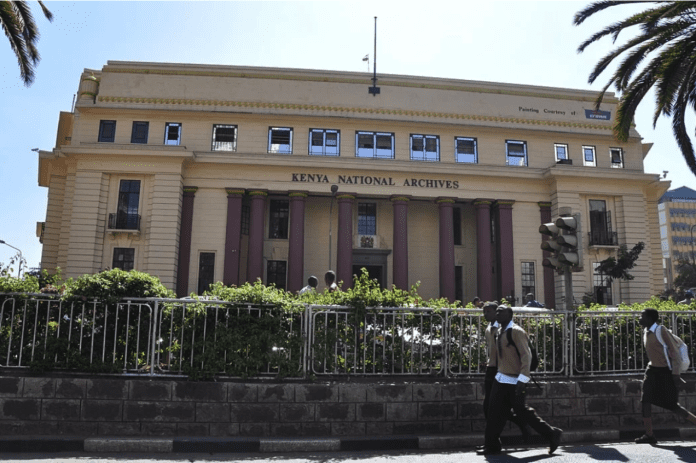
Watson’s quarry positioned him as a key contractor during Nairobi’s formative construction phase. He participated in several landmark projects that helped define the city’s civic and commercial identity. Among these were the Cameo Cinema, originally known as Theatre Royal, one of Nairobi’s earliest entertainment venues; sections of Kenyatta Avenue, the city’s principal boulevard; and the Kenya National Archives, an institution central to Kenya’s administrative memory.
While some of these buildings were completed or modified after his most active years, Watson’s role in supplying materials and undertaking construction work places him among the builders who laid Nairobi’s physical foundations. His architectural training ensured that these projects emphasized durability and order, aligning with colonial objectives of permanence and authority.
Agricultural Innovation and the First Cattle Dip
Agriculture remained central to Watson’s enterprise. Doonholm Farm operated as a mixed-use estate with a strong emphasis on dairy and livestock. When his cattle began dying from East Coast Fever, a devastating tick-borne disease, Watson responded pragmatically by constructing what is widely regarded as the first cattle dip in Kenya.
This intervention was critical not only to saving his herd but also to introducing a disease-control mechanism that would later be adopted widely across colonial Kenya. In this respect, Doonholm functioned as a site of agricultural innovation, influencing livestock management practices beyond its boundaries.
Financial Strain and Land Disposals
By the 1940s, Watson had largely withdrawn from active construction and contracting to focus on farming. However, financial difficulties persisted. Rising operational costs, declining agricultural margins, and accumulated debt forced him to begin selling portions of Doonholm Farm incrementally.
A significant portion of the land was acquired by the colonial government for the construction of Nairobi’s airport, later Jomo Kenyatta International Airport (JKIA), at a compensation rate of £8 per acre. In retrospect, this valuation underscores the imbalance of power between settlers and the colonial state and the long-term economic consequences of compulsory acquisitions.
Succession, Sale, and Post-Independence Legacy
After Watson died in 1955, the farm passed to his son, Nick Watson. Nick shifted operations toward pig rearing and managed the remaining land until 1966, when he sold the final 1,554 acres to William Malu, the Member of Parliament for Machakos West (Kilungu), for £18,000. This transaction marked the end of the Watson family’s direct involvement with Doonholm.
Following independence, the name Doonholm was adopted for a new parliamentary constituency, initially represented by Mwai Kibaki, who would later become Kenya’s third President. Subsequent administrative changes saw the constituency renamed Bahati and later Makadara, while Doonholm Road was officially renamed Jogoo Road.
Conclusion: An Enduring Urban Footprint
James Kerr Watson was more than a settler-farmer. He was an architect of systems—roads, buildings, agricultural infrastructure, and supply chains—that underpinned Nairobi’s early growth. His initiatives, driven by practical necessity and professional discipline, produced enduring structures that shaped the city’s eastern expansion. Today, although little remains of Doonholm Farm itself, Watson’s imprint survives in Nairobi’s roads, neighbourhoods, and institutions, quietly anchoring the modern city to its colonial-era foundations.