


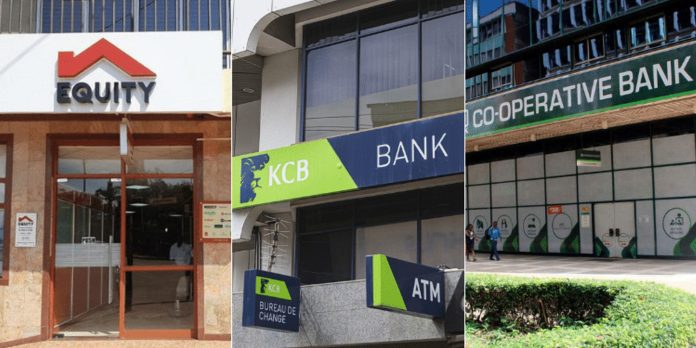
All major listed Kenyan banks released their 2025 annual results, and what a year it was. Kenyan banks collectively made over Sh300 billion in profit before tax. Here’s the breakdown of who did what:
1). Equity Group – The big winner
Equity Group had the year every bank dreams about. They made Sh75.5 billion profit after tax, a 55 percent jump and the highest profit ever made by any company listed on the Nairobi Securities Exchange.

Their secret? They cut the cost of deposits faster than anyone else, and their businesses across the continent (DRC, Uganda, Rwanda and others) contributed roughly half of total earnings. If you hold Equity shares, you earned Sh5.75 per share in dividends, up 35 percent from 2024.
2). KCB Group – Rebuilding stronger
KCB made Sh68.4 billion profit, up 10.6 percent. But their loan book crossed Sh1 Trillion for the first time ever. After two years of struggling with bad loans and the drag of National Bank of Kenya, they sold NBK to Access Bank in 2025 and the cleanup is done.
Shareholders got a record Sh7 per share in dividends, more than double what they received in 2024. The NPL (bad loans) ratio is still a bit high at 16.9 percent, but the direction is the right one.
3). Co-op Bank- The quiet one that delivered
Not many people were talking about Co-op Bank. Their profit before tax hit a record Sh40.3 billion, and shareholders got Sh2.50 per share in dividends, a 67 percent jump, the biggest dividend increase among the big banks. Total assets grew to Sh827 billion. The one thing to watch is bad loans that went up 12.7 percent during the year, so management will need to stay on top of that in 2026.
4). ABSA Bank Kenya – Quality over size
Absa made Sh22.9 billion profit, up 10 percent. They have the cleanest loan book of any big bank in Kenya, their bad loan ratio is around 12 percent, well below most peers. What’s impressive is that they grew profits even as interest rates fell which usually hurts banks.
They did it by growing fee income and cutting impairment charges. Shareholders got Sh2.05 per share, the fifth year in a row of dividend growth. A solid, steady performer.
5). NCBA Group – The digital bank
NCBA’s headline profit of Sh23.4 billion, up 7 percent looks modest, but look at what they’re doing in mobile. They lent out Sh1.4T through mobile platforms like Fuliza and M-Shwari, up 33 percent and digital banking now makes up 32 percent of their total profits. Shareholders get Sh7.10 per share in dividends, up 29 percent.
There’s a big deal on the horizon too as Nedbank from South Africa is buying a 66% stake in NCBA, which could be transformational. The risk; their loan loss provisions jumped 46 percent as some mobile borrowers struggled to repay.
6). Stanbic Holdings – Steady but under pressure
Stanbic made Sh13.7 billion profit basically the same as last year. Revenue actually fell because interest rates dropped and their forex trading income collapsed, a stable Kenyan Shilling was bad news for that business line. What saved them was a big drop in money set aside for bad loans.
Rhina Namsia: How greed ruins investors’ chances of making money from stocks
Their assets grew 18.9 percent, the fastest of all six banks and they paid out a record Sh22.35 per share in dividends. If you’re a Stanbic shareholder, the dividend is great. But revenue recovery is the challenge for 2026.
Takeaway…
Kenyan banks that cut their funding costs fastest won 2025. When the Central Bank of Kenya cut interest rates, the banks that repriced deposits quickly especially Equity and KCB made the most money.
Not all Kenyan banks improved their loan quality. Absa and Stanbic got better. Co-op and NCBA’s digital lending are showing stress. This is something to watch in 2026.
Shareholders had a great year. These six banks together paid out about Sh90 billion in dividends in 2025. That’s real money returning to Kenyan investors.
If you own shares in any of these banks, 2025 was a good year to be holding. The question now is whether 2026 can keep up the momentum as interest rates keep falling and some of those one-off gains like lower loan provisions start to fade. Stay invested. Stay informed. Be A Smart Investor.
Rhina Namsia is the founder and chief executive officer of The Acemt Consulting, a training and consultation company that provides financial planning and investment advisory.