

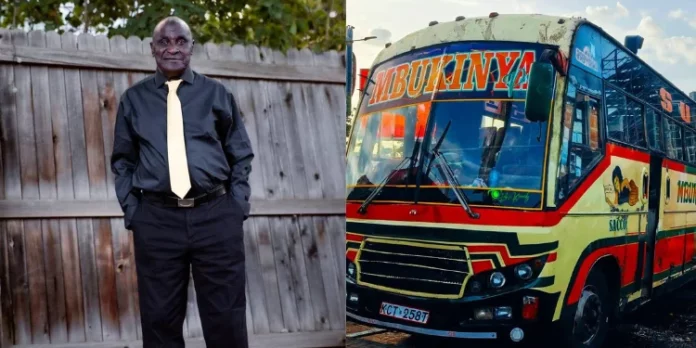
Paul Mburu Kinyanjui, the founder of Mbukinya Bus Company and one of Kenya’s pioneering transport entrepreneurs, has died at the age of 91.
The businessman passed away on July 19, 2026. His family has not publicly disclosed the cause of death.
His passing marks the end of an era for Kenya’s public transport sector, where he built one of the country’s oldest and most respected long-distance bus companies.

Over several decades, Mbukinya Buses Company has been a reliable provider of passenger and parcel transport services, connecting Nairobi with major towns across Western Kenya, Nyanza and the Coast.
Born and raised in Limuru, Mburu developed an interest in the transport business at an early age. While still in secondary school, he often told his classmates that he would one day become a successful investor in Kenya’s transport industry.
Although many dismissed his ambitions because of his humble background, he remained determined to pursue his dream.
Inspired by the buses that regularly passed through his hometown, Mburu resolved to venture into business instead of seeking formal employment after completing school.
Without the financial backing to launch a transport company immediately, he began building capital through small-scale trade.
After completing his final examinations in 1952, Mburu started selling eggs and chicken in Limuru. Eleven years later, he had saved Sh6,000, enough to purchase his first second-hand bus.
He supplemented the amount with a Sh5,000 loan and began operating passenger services between Limuru and Nairobi. As the business expanded, he sold the vehicle and acquired a second-hand Mercedes-Benz bus.
“I was the driver, and I had hired a conductor. Since it had now become my full-time business, I got better at it day by day,” Mburu said in a previous media interview.
His breakthrough came in 1972 when he purchased his first brand-new bus and expanded into long-distance routes serving Kisumu and Kakamega.
The move significantly increased the company’s operational capacity and accelerated its growth.
“With the new bus, I was able to operate for 24 hours, and this grew the business by leaps and bounds. I increased my buses quickly,” he said.
By the 1980s, Mbukinya Bus had grown its fleet to 48 buses, making it one of the country’s largest transport operators.
However, rising insurance costs in the 1990s forced the company to scale down its operations. The business later regained momentum, increasing its fleet to 39 buses after acquiring 21 Hino buses from Toyota Kenya in 2014.
Today, the family-owned company is managed by Mburu’s children under the leadership of his eldest son, who is reported to be in his 70s.
Mbukinya continues to operate key routes linking Nairobi with Western Kenya, Nyanza and Mombasa, maintaining relatively affordable fares that remain competitive within the industry.
Despite its decades-long success, the company also faced significant setbacks. In 2019, Mbukinya was embroiled in a dispute involving 41 Toyota Hino buses acquired from Toyota Kenya after the vehicles reportedly developed serious mechanical defects before their warranties expired.
The company cited fatal engine failures, overheating, brake malfunctions and cracks on the chassis among the problems affecting the buses.
Mburu subsequently returned the vehicles to Toyota, which bought out CFC Bank and Tsusho Capital, the financiers of the buses, and assumed ownership.
“Toyota moved fast to agree a deal in which Toyota Kenya reportedly paid off CFC Bank and Tshusho Capital to own the 41 vehicles,” COFEK reported in 2019.
Although the buses were later repaired and offered back to the company, Mburu accepted only 14 vehicles whose logbooks reflected joint ownership with Toyota Kenya.
Reports at the time indicated that he received Sh60 million in compensation, but he maintained that the business had suffered losses running into billions.
Mburu leaves behind a legacy of resilience, entrepreneurship and innovation that transformed a modest dream into one of Kenya’s most enduring transport brands.
His contribution to the country’s public transport industry leaves behind key lessons for aspiring business owners:
- Have a vision in life – Mburu set his sights on owning a transport company while still in secondary school, long before he had the resources to achieve it.
- Do not let criticism discourage you – Despite being mocked by his peers because of his humble background, he remained focused on his dream.
- Start with what you have – Instead of waiting for capital, he began by selling eggs and chicken to raise money for his first investment.
- Practice financial discipline – Mburu saved consistently for 11 years before purchasing his first bus, demonstrating the importance of patience and prudent financial management.
- Use loans strategically – He complemented his savings with a Sh5,000 loan, showing that borrowing can accelerate growth when used responsibly.
- Presence in business matters– In the early years, he personally drove the bus while employing only a conductor, helping him reduce operating costs and understand the business firsthand.
- Continuously improve your skills – Mburu noted that he became better at the business every day, highlighting the value of learning through experience.
- Reinvest profits for growth – Rather than remaining with one vehicle, he upgraded to better buses and expanded into new routes as the business grew.
- Expand when opportunities arise – Purchasing his first new bus enabled him to introduce 24-hour operations and venture into long-distance travel, significantly increasing revenue.
- Scale cautiously but confidently – His fleet grew to 48 buses by the 1980s, illustrating the rewards of strategic expansion over time.
- Adapt to changing business conditions – When insurance costs became unsustainable in the 1990s, he downsized the fleet instead of risking the company’s collapse.
- Recover from setbacks – After reducing operations, he later rebuilt the business by acquiring additional buses.
- Protect your business interests – When the Hino buses developed defects, Mburu pursued compensation and sought accountability instead of absorbing the losses silently.
- Build a business that outlives you – Mburu involved his family in the enterprise, ensuring that Mbukinya Bus Company continued operating under the next generation.
- Resilience is the foundation of long-term success – From humble beginnings to building one of Kenya’s oldest transport companies, Mburu’s journey demonstrates that persistence and determination are often more valuable than starting with wealth.
Also Read: Messi’s 2026 World Cup: 8 Business Lessons on Strategy, Tenacity and Talent