


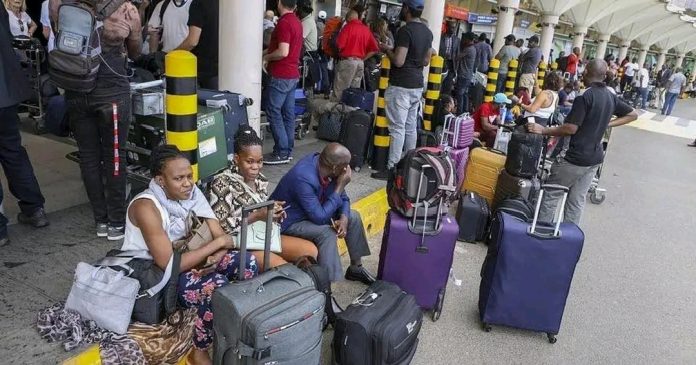
Every time our air traffic controllers threaten industrial action, the public picture is always the same exhausted travellers sitting on their suitcases at Jomo Kenyata International Airport (JKIA), staring at departure boards full of delays.
That image, as painful as it is, is only the tip of the iceberg. The real damage happens quietly, thousands of kilometres away, in the operations rooms of airlines in London, Amsterdam, Dubai and Doha, long before any of those planes even leave the ground and nobody pays a heavier price for this than our own national carrier, Kenya Airways.
So what exactly Is a “Go-Slow”?
Most people assume a strike means workers walk out and the airspace shuts down. A go-slow is far more subtle, and in some ways more damaging.

Nobody walks off the job instead, air traffic controllers follow every single safety rule and regulation to the absolute letter, with none of the normal flexibility and judgement that keeps traffic moving efficiently.
In ordinary operations, controllers use experience and confidence to compress the gaps between landing and departing aircraft, while still keeping everyone safe.
During a go-slow, that flexibility disappears controllers double the spacing between arriving planes, take the maximum allowed time to issue every clearance, and stop using the shortcuts that keep traffic flowing.
If JKIA can normally handle 20 arrivals an hour, a go-slow can quietly strangle that down to five. Aircraft end up circling for hours in holding patterns, or sitting on the tarmac waiting endlessly for a departure clearance.
Why airlines cancel flights before they even take off. This is the part most Kenyans never see, a foreign airline does not need to wait until its plane is stuck over Nairobi to feel the pain of a go-slow.
The moment global flight-tracking systems show that JKIA’s acceptance rate for incoming aircraft has slowed down, alarm bells go off at airline headquarters on the other side of the world.
Hersi: How Kenya Airways pilots sabotage the loss-making national airline
Three things make this an unacceptable risk for any serious carrier:
✅️1. Fuel and diversions. A pilot cannot simply hope for the best. If Nairobi is delaying arrivals, an inbound aircraft will burn through its reserve holding fuel while circling. Once it hits its minimum safe fuel level, it has no choice but to divert, often to Mombasa or Kilimanjaro. That single decision triggers unscheduled landing fees, emergency hotel bookings for hundreds of passengers, and total chaos across the airline’s onward network.
✅️2. Crew running out of legal hours. Pilots and cabin crew operate under strict legal limits on how long they can stay on duty. If a flight is stuck waiting for a landing slot, or held on the ground at its point of origin because Nairobi cannot guarantee it a slot, the crew can simply “time out.” Once that legal limit is hit, they are not permitted to fly, full stop, and there is rarely a spare crew sitting nearby to take over a multi-million-dollar aircraft in a foreign country.
✅️3. A grounded aircraft earns nothing. Long-haul aircraft are built to keep moving. A plane flying Amsterdam to Nairobi is usually scheduled to turn around and fly straight back within a few hours. If a go-slow traps that aircraft on the ground in Nairobi for six hours, it misses its return flight entirely. That single missed rotation then cascades into cancelled or delayed flights across the airline’s entire global network, often affecting routes that have nothing to do with East Africa at all.
Faced with the choice between risking a $200 million aircraft in an unpredictable operational environment or simply cancelling the Nairobi flight altogether, foreign airlines almost always choose the second option. The painful part cancellation happens at the destination’s expense, not theirs.
Why this hits Kenya Airways hardest
All foreign carriers can absorb a cancelled Nairobi rotation by simply shuffling one aircraft in a fleet of hundreds. Kenya Airways does not have that luxury, and this is where the real national tragedy of a go-slow lies.
KQ’s whole network runs through JKIA. Unlike KLM, Emirates or Qatar Airways, which can reroute a single aircraft around a problem hub, Kenya Airways operates a hub-and-spoke model built entirely around Nairobi.
Almost every regional and long-haul KQ flight touches JKIA at some point in its rotation. When JKIA slows down, it is not one route that suffers, it is the entire airline’s schedule that unravels at once, because there is no alternative hub to fall back on.
A far smaller fleet means far less room to recover. International carriers can absorb a stranded aircraft because they simply have more aircraft to substitute. Kenya Airways operates a comparatively small fleet.
Losing even two or three aircraft to diversions, crew timeouts, or missed rotations during a go-slow can knock out a meaningful share of the airline’s entire flying capacity for that day, with knock-on delays lasting for days afterwards as the schedule is rebuilt.
KQ absorbs costs that foreign airlines simply pass on.
When a foreign carrier cancels its Nairobi flight, the cost and inconvenience largely lands on Kenya. lost tourists, lost cargo revenue, damaged reputation but when the disruption instead forces Kenya Airways itself to divert, rebook passengers, and pay penalty costs, those costs hit the national carrier’s own balance sheet directly.
KQ, an airline that has spent years fighting to return to profitability, simply cannot afford self-inflicted disruptions of this scale.
KQ’s own aircraft get stranded abroad, unable to come home. This is perhaps the most painful part of all, and one the public rarely hears about.
A go-slow does not just disrupt flights trying to land in Nairobi, it also traps Kenya Airways aircraft on tarmacs in London, Amsterdam, Guangzhou or Mumbai, unable to depart because they have no confirmed landing slot back home.
❗️1. . Every hour that a KQ aircraft sits idle on a foreign apron costs the airline real money. Parking fees charged by the foreign airport.
❗️2. landing and handling charges that keep accumulating the longer the aircraft overstays its slot.
❗️3. Hotel accommodation for a full crew that is now stuck in a foreign city, and per diem allowances that keep running regardless of whether the plane ever takes off that day.
❗️4. Meanwhile that same aircraft was very likely scheduled to operate two or three more sectors before the day was out, so every hour stuck abroad quietly cancels flights and revenue further down the schedule.
Unlike a foreign carrier, which can simply leave a delayed aircraft in Nairobi and fly a spare plane home while sorting out the mess later, Kenya Airways typically has no spare aircraft waiting in London or Amsterdam to plug the gap. The stranded jet is the only jet, so the airline has no choice but to wait, and to keep paying, until Nairobi’s skies clear.
❗️Reputational damage falls hardest on the home team. When international passengers experience a cancelled or delayed flight because of a Nairobi go-slow, many will simply blame “flying to Kenya” in general and quietly switch their booking to a codeshare partner or a completely different route next time but it is Kenya Airways, as the flag carrier permanently associated with Nairobi in the public mind, that carries the reputational scar longest, even when the disruption was never the airline’s own fault.
❗️Regional connectivity ambitions take the biggest hit. Kenya Airways has worked hard to position Nairobi as the preferred East African hub for onward connections across the continent. A go-slow undermines exactly that pitch.
Every delayed or cancelled connection through JKIA quietly reminds international travel agents and cargo forwarders that alternative regional hubs like Addis Ababa, Kigali or Dar es Salaam might be a steadier bet.
The bigger picture , an ATC go-slow is often treated as an internal labour dispute between the Kenya Civil Aviation Authority, the Kenya Airports Authority, and their staff. That framing is dangerously narrow.
In reality, a handful of controllers following the rulebook too literally can freeze aviation confidence in Nairobi on the other side of the planet within hours, and it is Kenya Airways, our national carrier and one of our proudest continental brands, that absorbs the deepest and most lasting damage.
If we are serious about protecting Kenya Airways’ recovery and about positioning Nairobi as Africa’s premier aviation hub, then resolving labour disputes at KCAA and KAA before they escalate into go-slows cannot be treated as an afterthought. It must be treated as a matter of direct national economic interest.
This article was written and published by Kenyan hotelier and aviation enthusiast Mohammed Hersi.