

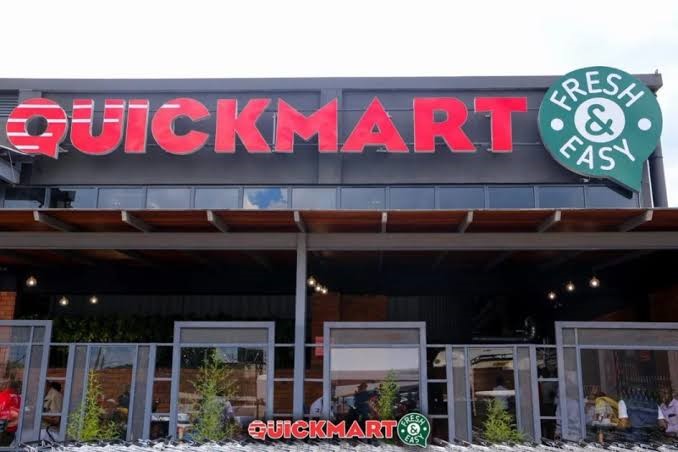
Quickmart Supermarket is one of Kenya’s largest supermarket chains, ranking second-biggest in the country in branch network after Naivas.
The retailer currently operates 72 stores across 16 counties, a remarkable expansion from the small family-run outlet with which it began in Nakuru two decades ago.
The retailer’s origins can be traced to 2006, when the late John Kinuthia and his wife, Zipporah, ventured into supermarket retail after years of running other businesses.

The couple had started as farmers after marrying in 1976, keeping livestock before moving into a bar business that also incorporated a butchery and lodging facilities.
In an account shared by Quickmart, Zipporah said it was her idea to enter supermarket retail after she began looking for a different business opportunity.
“We started out as farmers, keeping a few cows while we were still young. When we eventually got tired of farming, we ventured into a bar business that also had a butchery and lodgings. At some point, however, I felt I wanted to do something different, so I told my husband, ‘I have a dream. Why don’t we open a supermarket?’ she said.
John was initially reluctant about the proposal but eventually agreed. The family started the supermarket business from a small kiosk in Nakuru in 2006.
Their son, Duncan Kinuthia, later joined the business after completing Form Four and spending time studying accounting. His involvement in the day-to-day running of the business grew over time, eventually leading him to suggest taking the retailer beyond Nakuru.
That ambition was realised in 2010 when Quickmart entered the Nairobi market, marking the beginning of its transformation from a local family business into a broader retail chain.
The family business faced a major transition in 2016 following the death of John Kinuthia. The family retained control of the business, with Duncan later becoming managing director.
The retailer’s significant chapter came in 2019 when Adenia Partners, a Mauritius-based private equity firm, invested in Quickmart. Adenia had also invested in Tumaini Self-Service, another Kenyan supermarket chain.
The two businesses were subsequently brought together under the Quickmart brand in 2020, providing a larger platform for expansion.
The merger and subsequent investment accelerated Quickmart’s growth. The chain expanded its presence across the country through new outlets and the integration of existing retail locations.
From family business to NSE listing
Quickmart is now preparing to list on the Nairobi Securities Exchange (NSE) marking another defining moment in its history.
The retailer plans to offer 2 billion existing shares, equivalent to 50 per cent of its issued share capital, through a sale by its sole shareholder, Sokoni Retail Kenya Limited (SRKL). The proposed listing is expected around September 30, 2026, subject to regulatory approvals.
The offer could rise to 2.3 billion shares, or 57.5 per cent of the company, if the over-allotment option is exercised in full.
The transaction is an offer for sale rather than a fresh share issue. This means the proceeds will go to the selling shareholder rather than to Quickmart as new capital.
“The shares to be sold by SRKL under the offer will be sold in a manner that results in a pro rata partial exit by the shareholders of SRKL. Following completion of the offer, if the over-allotment option is not exercised, SRKL is expected to retain approximately 50 percent of the company’s issued share capital. If the over-allotment option is exercised in full, SRKL’s remaining shareholding would reduce to approximately 42.5 percent,” the statement reads.
Quickmart’s financial statement for the full year ended December 2025 shows the retailer posted Sh50.4 billion, an 8 per cent increase from the previous year. This was slower than the average annual revenue growth of 18.4 per cent recorded since 2021.
Despite the slower top-line growth, profitability improved significantly. Net profit increased by 32.9 per cent to Sh1.51 billion.
Quickmart’s gross margin remained broadly unchanged at 22 per cent, while its operating margin improved to 6.8 per cent from 6.4 per cent. Its net profit margin also increased to 3 per cent, up from 2.4 per cent.
Also Read: Quickmart CEO shares lessons on retailer’s fast growth