



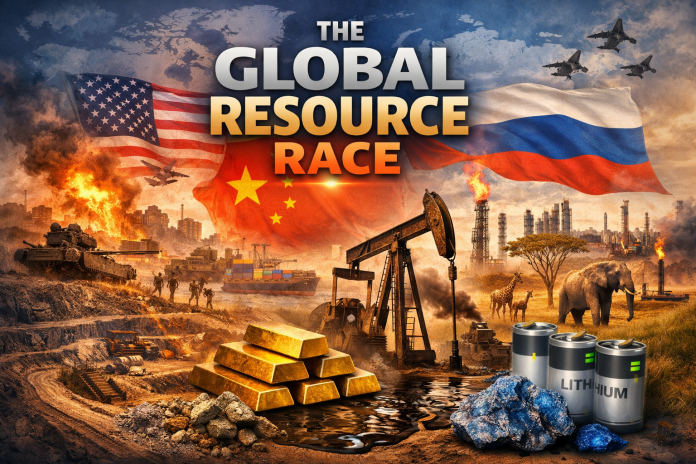
A familiar pattern is re-emerging across the global landscape. Beneath the language of diplomacy, ideology, and humanitarian intervention lies an enduring driver of conflict and cooperation alike: control of resources. What the world is witnessing today is not a new phenomenon, but a modern rebranding of an old reality — a renewed global rush for real value.
From Eastern Europe to East Africa, power struggles increasingly revolve around access to minerals, oil, gas, water, fertile land, and strategic infrastructure. While conflicts are often framed as battles for democracy or sovereignty, history shows that material interests have always sat at the core of geopolitical competition. Control of natural wealth translates into economic leverage, political influence, and long-term security.
This logic is deeply rooted in history. The creation of rigid borders and international treaties, dating back to the medieval era, was rarely driven by social cohesion. Instead, boundaries were drawn to secure trade routes, agricultural land, and extractive resources. The Roman Empire refined this model through conquest and systematic extraction. European colonial powers later expanded it globally, claiming territories not for cultural integration, but for gold, rubber, ivory, oil, and arable land.

Modern governance systems have since diverged along two broad economic philosophies. Capitalist systems tend to rely on partnerships between states and private corporations to control and monetize resources. Socialist and communist systems emphasize state ownership and centralized control, arguing that natural wealth should serve collective national interests. In practice, both models grapple with the same question: who controls value, and who ultimately benefits?
These tensions are visible within Kenya and across Africa. County governments increasingly seek greater control over local assets — from sugar factories in Western Kenya to tourism revenues in Narok’s Maasai Mara, and calls by Mombasa County to play a greater role in managing port operations. These debates are not radical departures from global norms. They reflect a broader desire to retain value locally rather than see strategic assets controlled externally, often with limited public benefit.
The Case for Africa as the Next Factory of the World
Globally, a structural shift is underway. Power is moving away from purely currency-based dominance toward tangible resource ownership. Nations now highlight gold reserves, lithium deposits, rare earth minerals, and energy assets as markers of strength. This partly explains the strategic push to integrate resource-rich countries such as the Democratic Republic of Congo and South Sudan into regional economic blocs. DRC alone holds some of the world’s largest reserves of cobalt, copper, and other critical minerals essential to modern technology.
Yet resource strategy and politics frequently collide. In the DRC, decisions around security partnerships and foreign troop presence have revived uncomfortable memories of historical exploitation. While national leaders act within complex domestic pressures, such choices inevitably raise questions about sovereignty, influence, and long-term control of national wealth.
The Russia-Ukraine conflict further illustrates this reality. Beyond questions of borders and alliances, it is also a contest over food security, energy supplies, and financial systems. Both countries remain major global exporters despite prolonged conflict, underscoring the scale of their underlying resource wealth. External involvement, particularly from Europe, is shaped as much by strategic interest as by humanitarian concern.
The United States, long dominant through its currency and financial systems, is also adjusting to a changing landscape. The rise of cryptocurrencies and alternative financial instruments has exposed vulnerabilities in fiat-based power. In response, attention has increasingly shifted toward securing supply chains and access to critical natural resources.
Fixing Kenya’s food crisis: Why policy and distribution matter more than production
China’s approach has differed in form, though not in intent. Its pursuit of resources is often paired with visible infrastructure development — roads, railways, ports, and energy projects — offering host countries tangible assets alongside extraction. While not without controversy, this model contrasts sharply with earlier eras of exploitation that left little lasting value behind.
The broader lesson is clear. The global system is re-anchoring itself around real value rather than abstract financial instruments. Former colonial powers, once driven overseas by resource scarcity at home, now face similar pressures in a more competitive world. The hunger for resources did not disappear; it evolved.
Africa, Asia, and the Americas remain richly endowed. Yet Africa, in particular, faces a defining challenge: translating natural wealth into shared prosperity. Long before colonial borders, resources flowed across communities without rigid ownership lines. Today, inherited legal and political frameworks often work against collective benefit.
History, in this sense, is not repeating itself — it has been continuous. The conflicts shaping today’s world are fundamentally about narrative control and resource access. If global imbalances persist, the pressures that once drove conquest may re-emerge in new forms.
The responsibility for African leaders, policymakers, and citizens is clear. Stewardship, accountability, and long-term thinking must guide how resources are governed. Real value lies not just in what is extracted, but in how wisely it is managed for generations to come.
About the Author
Mulumi Mwangi is a seasoned businessman with more than five decades of life experience, bringing a rare depth of perspective to both enterprise and writing. Trained as an electrical engineer, he has founded, built, and managed ventures across diverse sectors, including advertising, marketing, agribusiness, real estate, and fintech.
His writing is firmly grounded in lived experience. It draws from family life as a father, husband, brother, and uncle; from public life through his service as a political party official; and from the hard lessons of business, both failure and success. These experiences, combined with everyday social interactions, have shaped a reflective and pragmatic worldview.
Mulumi’s work is offered as a personal perspective rather than a prescription. His views are candid, experience-driven, and open to debate—acknowledging that insight is often refined through dialogue, reflection, and the humility to accept that one may be right or wrong.
Contact: [email protected]