



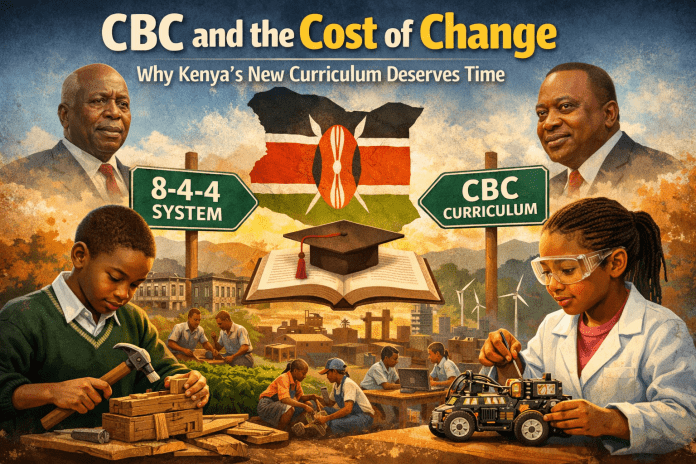
Since independence, Kenya has never stood still on education; the country has experimented, adjusted, and at times overcorrected. From the early post-colonial systems to the 7-4-2-3 structure, then the 8-4-4 system introduced in 1985, education has always mirrored Kenya’s economic and social ambitions. The Competency-Based Curriculum (CBC) is simply the latest chapter in that long story, and despite the loud public outcry, it is a step in the right direction.
The 8-4-4 system replaced the CPE/KCE framework during President Daniel Arap Moi’s era. It was not a random shift. Moi was an educationist, supported by seasoned professionals like Dr Aloo Aringo and Prof Jonathan Ng’eno. Their goal was clear: move Kenya away from a purely academic, colonial-style education to a more practical, localized, and skill-oriented system. Subjects like agriculture, home science, wood technology, and art were central, not decorative. Teachers at the time were trained to pass on basic life and vocational skills such as sewing, carpentry, farming, and mechanics.
For a while, 8-4-4 worked reasonably well. Its biggest problem came later, not at birth. During the Kibaki era, under Prof George Saitoti and Prof Sam Ongeri, skill-based subjects slowly lost priority. Many were made optional, TVET colleges were converted into universities, and success became narrowly defined as a white-collar job. Kenya began producing graduates faster than it could create professional jobs; the economy, meanwhile, needed technicians, artisans, and innovators.

By the time President Uhuru Kenyatta took office, this mismatch was obvious. Promises of jobs to the youth collided with a workforce trained mainly for offices that did not exist. Kenya needed industrialization, but lacked hands-on skills at scale. CBC was introduced to correct this structural failure. It aimed to refocus education on competencies, talent, creativity, and practical problem-solving rather than exam survival.
Why converting Grade Tens to Form Ones is curriculum justice, not a setback
The biggest flaw of CBC was not the idea but the execution; the rollout was before the sector was ready. Teachers were not adequately retrained, the infrastructure was uneven, and learning materials were rushed. Unlike the Moi era, when teachers themselves could comfortably teach practical skills, many modern teachers had never been trained that way.
Resistance first came from teachers, not parents. Over time, teacher frustration spilt over to parents, who were suddenly expected to support practical learning despite lacking similar skills or time.
This context matters. CBC is not bad. It struggled because it was introduced in an unprepared environment. Even so, current data shows that CBC has over 38 per cent approval, a significant figure for a system still in transition, teacher capacity improves, materials stabilise, and schools adapt; acceptance is likely to grow.
Change is rarely welcomed, especially when it disrupts routine. Humans adapt easily to entertainment and convenience, but resist structural change that demands effort.
Education reform is slow by nature. Its results are measured in generations, not election cycles.
CBC pushes Kenya toward a future where skills are valued early, innovation is normal, and a capable workforce supports industrialization.
Skills are not just for older artisans; they must be cultivated from a young age, with patience, investment, and honest correction of early mistakes. CBC can help Kenya move from credentialism to productivity.
The noise will fade, the outcome will remain.
About the Author
Mulumi Mwangi is a seasoned businessman with more than five decades of life experience, bringing a rare depth of perspective to both enterprise and writing. Trained as an electrical engineer, he has founded, built, and managed ventures across diverse sectors, including advertising, marketing, agribusiness, real estate, and fintech.
His writing is firmly grounded in lived experience. It draws from family life as a father, husband, brother, and uncle; from public life through his service as a political party official; and from the hard lessons of business, both failure and success. These experiences, combined with everyday social interactions, have shaped a reflective and pragmatic worldview.
Mulumi’s work is offered as a personal perspective rather than a prescription. His views are candid, experience-driven, and open to debate—acknowledging that insight is often refined through dialogue, reflection, and the humility to accept that one may be right or wrong.
Contact: [email protected]