

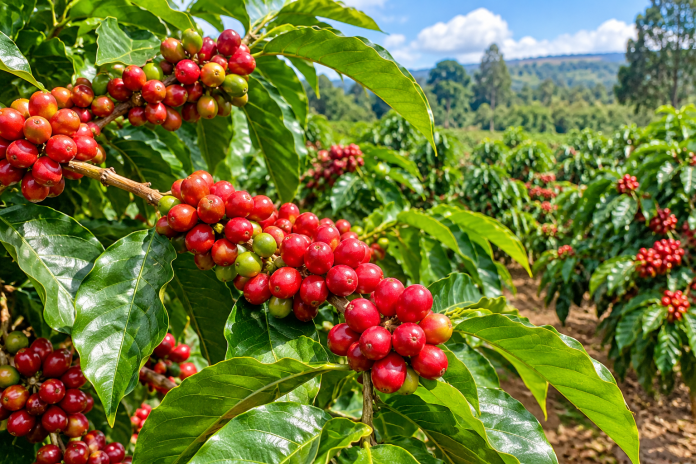
Coffee farming has, over the years, been one of the most viable agricultural ventures driven by strong demand in international markets and improved prices.
Kenya’s coffee is sought after in global markets for its quality and distinctive flavour, making it an important agricultural export and a source of foreign exchange.
According to the Kenya National Bureau of Statistics (KNBS), the country’s marketed coffee production increased from 32,400 tonnes in 2023 to 44,900 tonnes in 2024, before settling at 41,600 tonnes in 2025.

In addition, the Kenya Export Promotion and Branding Agency (KEPROBA) reported that coffee production reached 50,589 tonnes during the 2024/25 coffee year, while exports totalled 50,675 tonnes, earning the country approximately Sh43.89 billion.
Also Read: Meru farmer develops first locally bred dragon fruit variety
Samuel Macharia, a coffee farmer in Kiambu County, is among the big list of farmers earning big from the beverage sector.
Speaking during the Co-op Youth Forum on Friday, November 20, Macharia recounted how he ventured into coffee farming in 2021, transforming a neglected family farm into a productive enterprise.
The agripreneur revealed the journey began following his father’s death, which forced him to go back home to help care for his mother and grandmother. It was a decision that eventually introduced him to the financial potential of coffee farming.
Upon returning, Macharia found about 1,200 coffee trees that his father had left behind. The trees were in poor condition and produced just 128kg of coffee, which fetched about Sh50 per kilogramme at the time.
Through improved farm management, he has since increased production to between 4,000kg and 6,000kg, with coffee selling at approximately Sh115 per kilogramme at his factory.
“Growing up, I saw coffee as a burden. Every morning we had to go in and pick coffee or even weed before school. Yet we never saw the money. At some point I realised there is something my dad did not teach me, coffee pays,” Macharia said.
Farmers earning millions from coffee
Macharia attributed the crop’s profitability to sustained demand in both domestic and international markets, noting that farmers who invest in proper management are earning substantial returns.
“The highest amount I have seen a farmer earn from coffee is Sh14 million from one season’s product. Not a leader of the cooperative, just a member. He has about 5,000 trees,” he said.
Macharia added that he knows other farmers who earn Sh1 million and Sh2 million from coffee, demonstrating the income potential of the crop when production is well managed.
However, he cautioned prospective farmers against investing in seedlings and other inputs before understanding the suitability of their land.
He recommends conducting soil tests to establish the nutrients available and determine the requirements for successful coffee production.
He takes his samples to the Coffee Research Institute, where he said testing costs approximately Sh1,000.
For farmers with existing coffee trees, Macharia advises rehabilitation instead of uprooting old plants and starting afresh.
He recommends pruning, applying manure, weeding, mulching and controlling pests and diseases to restore productivity. He also urges farmers to explore grafting to improve the performance of existing trees.
“If your farm is producing little produce, do not abort it. It is cheaper to rehabilitate than to plant afresh,” he said.
Choosing the right coffee varieties
For those establishing new farms, he emphasised the importance of selecting coffee varieties suited to their geographical location and production objectives.
According to Macharia, an acre can accommodate approximately 1,000 Ruiru 11 trees, compared with about 540 SL28 trees. He estimates the cost of a seedling at Sh55.