



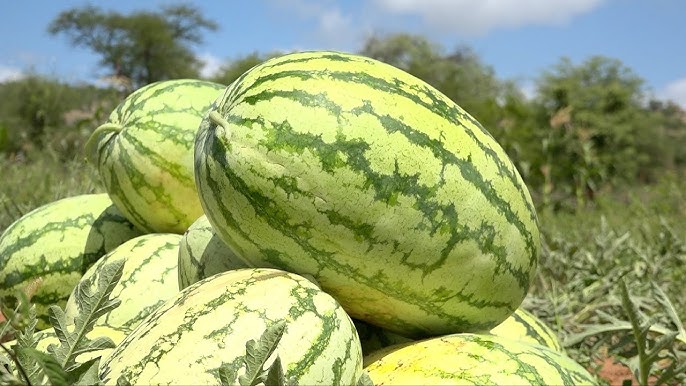
Watermelon farming is one of the most profitable ventures for farmers in Kenya. The cost of production for watermelon farming is relatively low, as most of the inputs needed, such as seeds and labor, are readily available.
Watermelon farming can yield an average of around 15,000 – 20,000 kg per acre. However, to make a kill in the venture, you need to start by making the right seed selection.
You will need to plant high-yielding, disease-resistant, and early-maturing watermelon seeds.

There are a number of watermelon varieties in Kenya which include Pata Negra F1, Augusts F1, Sentinel F1, Fahari F1, Sugar Baby, Sukari F1, Sweet Rose F1, Zuri, Anita F1, and Crimson Sweet, among others.
All these varieties are high yielding under several ecological zones and can give a farmer some good profits. They are also suitable for both export and local markets.
Amiran Kenya introduced another high-performing watermelon variety known as Maridadi F1. The fruit, which is green with white stripes, is high yielding but cheap making it ideal for low-earning small-scale farmers.
Early Maturity and High Yields
One of the main advantages of Maridadi F1 is its relatively short maturity period. The variety typically reaches harvest within about 75 to 90 days after planting, enabling farmers to bring their produce to market faster.
Under good agronomic practices, the crop is capable of producing high yields. Each fruit weigh between 8-10 kilograms. The cost of seeds is around Sh1,856 for 100 grams, and a farmer requires 500 seeds per acre.
“Maridadi F1 is pocket friendly, yet high yielding. One hundred grams of seeds cost Sh1,856. This means that those farmers who cannot afford other expensive varieties are not denied a chance of trying their hand at this hot-selling juicy fruit,” said Amiran’s Johnson Makau.
Attractive fruit for the market
Beyond productivity, Maridadi F1 is known for its appealing characteristics. It features a dark green rind with distinct dark green or blackish stripes and deep red, sweet, crisp flesh.
The fruit’s firm rind helps reduce post-harvest damage, enabling farmers to deliver fruits to distant markets without significant losses.
Planting and Maintenance
Maridadi F1 is adapted to local growing conditions. The fruit is resilient to common environmental stresses and diseases, contributing to its consistent performance and reliability
To grow the fruit, a spacing of between 4,000 to 8,000 plants per hectare is recommended.
The seeds must be transplanted and watered immediately after they have been obtained from the nursery. Farmers should be keen when transplanting to avoid damaging the roots.
Watermelon is sensitive to salt, and therefore farmers should seek guidance on fertilization. Soil specialists recommend a particular fertilizer based on the soil status after testing. For pests and disease control, experts recommend the use of agrochemicals.