



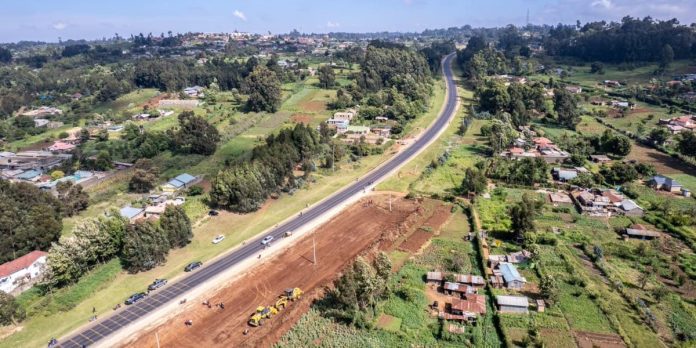
It is not in doubt that the construction of a dual highway along the Rironi-Mau Summit route has been long overdue. However, economic experts have come out with concerns about the Rironi-Mau Summit A8 toll highway financing model under which the highway will be constructed.
The Rironi-Mau Summit A8 toll highway, which is expected to consume Sh170 billion, will be constructed under a public-private partnership (PPP) model, in which two Chinese companies shall build and operate for a period of about 30 years. The two Chinese firms shall charge motorists tolls to use the highway.
This is the main bone of contention. A group of petitioners under the banner Motorists Association of Kenya have gone to court challenging the construction of the road through a toll plan. They argue that the highway toll amounts to double taxation, unlawful tolling, and the creeping transformation of Kenya’s public roads into lifetime revenue streams for private concessionaires.

According to respected economic and financial analyst Ephraim Njega, there are valid concerns about the use of the public-private partnership in the construction of the toll road.
Writing on his platform, Mr. Njega argues that there is a lack of a credible toll-free alternative for the highway that is on the exact route. He says that the options that the Kenya National Highways Authority (KeNHA) are issuing as alternatives are not viable or even realistic.
“During public participation, KeNHA lied that the current road would be left as a toll-free option. This has now been vacated, turning the public participation exercise into a deception campaign contrary to the constitution, which demands effective public participation,” he adds.
Two of these options include the Ngong-Suswa-Narok-Mau Summit-Nakuru route and the Nairobi-Thika-Magumu-Njabini-Ol Kalou-Narok-route.
Mr. Njega further points out that the viability of the highway will be hinged on the absence of the Standard Gauge Railway and a toll-free alternative along the route.
“If KeNHA leaves the existing road as a toll-free alternative, the project’s commercial viability as a PPP will just collapse,” Mr. Njega argues. “If a credible toll-free alternative is provided and the SGR is extended to the border, the commercial viability of the PPP will cease.”
This, says Mr. Njega, raises the question of how far the taxpayer has been exposed in the deal that the government is entering into with the Chinese contractors who will also operate the highway for a period of 30 years to recoup their investment turn a profit.
“There are no disclosures on the extent to which the public is exposed in case of the PPP failure. The PPP is exposed to risks such as resistance to tolls by citizens. Will they be compensated should such risks materialize? What guarantees and assurances has the government provided, and at what cost?” poses Mr. Njega.
He further cites the case of the Kenol-Marua road which heads to the Central region has been dualled by KeNHA. Mr. Njega argues that this road is toll free. As such, charging tolls on the highway that will head from Nairobi to Western Kenya is discriminatory.