

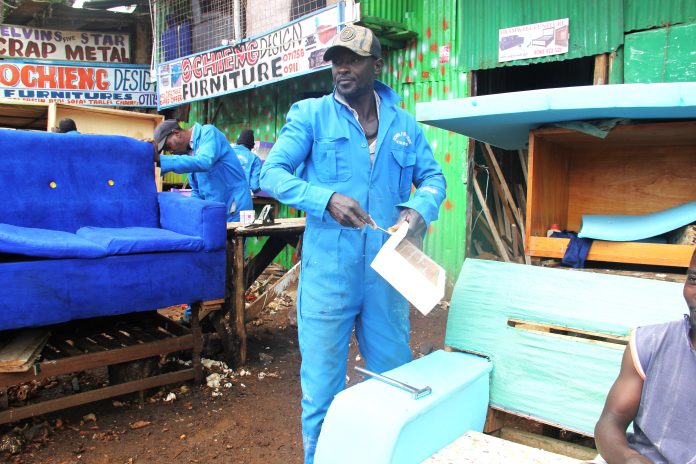
Every successful business begins with a single opportunity. For William Ochieng, that opportunity came with little more than determination, practical skills and a commitment to start small.
Today, his furniture workshop in Kericho has grown into a flourishing enterprise employing several young people and serving a steadily expanding customer base.
The rhythmic sound of woodworking tools and sewing machines echoes through his workshop as artisans assemble sofa sets, beds, cupboards and customised furniture for clients.

Behind the thriving business lies a carefully planned journey built on discipline, patience and an unwavering belief in the value of craftsmanship.
Ochieng’s entrepreneurial journey began after his release from prison towards the end of 2024. Although he had acquired extensive vocational skills in joinery, carpentry, upholstery, tailoring and architectural design while incarcerated, freedom presented an entirely different challenge.
With limited employment opportunities and no capital to launch a business, he knew he had to begin wherever an opportunity emerged.
Rather than waiting for ideal circumstances, he secured employment with an established furniture maker in Kericho.
The work involved cutting timber, assembling furniture frames, stitching upholstery and learning the commercial side of the furniture industry.
While the wages were modest, the experience proved invaluable in sharpening his technical skills and understanding customer preferences.
His first earnings was Sh6,000 from furniture work and an additional Sh700 from upholstery stitching.
Instead of spending the money, Ochieng made a deliberate decision to save every shilling, viewing the income as seed capital for a future enterprise rather than immediate consumption.
The turning point came when two customers entrusted him with an order for a seven-seater sofa set worth Sh6,000.
Delivering the project successfully boosted his confidence and convinced him that he could operate independently.
Encouraged by the customers’ trust, he continued saving until he accumulated Sh7,000, enough to establish a small furniture workshop.
What started as a modest operation has since developed into a growing business serving clients across Kericho and neighbouring areas.
Today, Ochieng’s workshop produces an extensive range of furniture, including sofa sets, beds, cupboards and tailor-made pieces designed to suit individual customer specifications.
His reputation has steadily grown through referrals, with clients returning for quality workmanship and customised designs that distinguish his products from mass-produced alternatives.
A key driver of the business’s growth has been his ability to offer multiple services under one roof.
Unlike many furniture makers who specialise only in carpentry, Ochieng personally undertakes upholstery, stitching and interior finishing.
The business has also become a source of employment as he currently employs five workers, including skilled artisans and trainees undergoing industrial attachment.
Beyond creating jobs, he invests time in mentoring young people interested in furniture making, convinced that vocational skills offer a practical solution to unemployment.
“There is work everywhere if people are willing to learn,” he told KNA. “The problem is that many people want quick money before understanding the value of hard work.”
At least two trainees have already completed their training and moved on to pursue opportunities of their own.
Financially, the workshop continues to record steady returns despite fluctuations in customer demand. On productive days, the business generates between Sh5,000 and Sh10,000.
A single cupboard can earn about Sh3,000 in profit, while customised sofa sets attract higher returns depending on their design and materials.
Standard sofa sets retail for between Sh10,000 and Sh15,000, with premium designs selling for more than Sh20,000.
Ochieng attributes much of his success to a willingness to embrace even the smallest jobs. He believes consistent income comes from completing every assignment professionally, regardless of its value, because small projects gradually build both capital and customer trust.
Innovation has also enabled him to carve out a unique niche in the competitive furniture market. His workshop designs customised furniture inspired by football clubs, producing sofas upholstered in team colours and personalised to reflect customers’ favourite clubs.
The concept has become increasingly popular among football enthusiasts seeking furniture that mirrors their passion while giving his business a distinctive identity in the local market.
Looking ahead, Ochieng plans to expand beyond furniture manufacturing into construction and interior design by leveraging the architectural knowledge he acquired through vocational training.
His long-term ambition is to build a company capable of offering comprehensive construction, furnishing and interior solutions while creating more employment opportunities for young artisans.