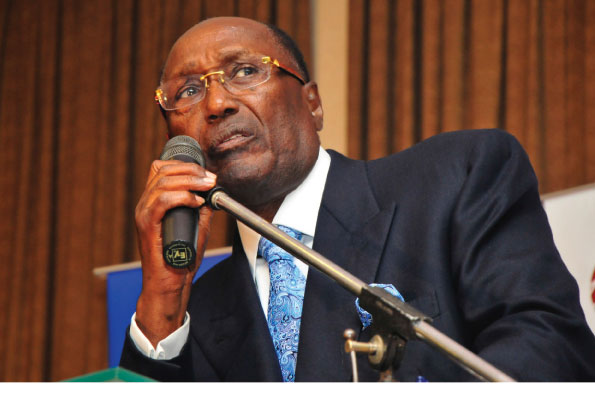
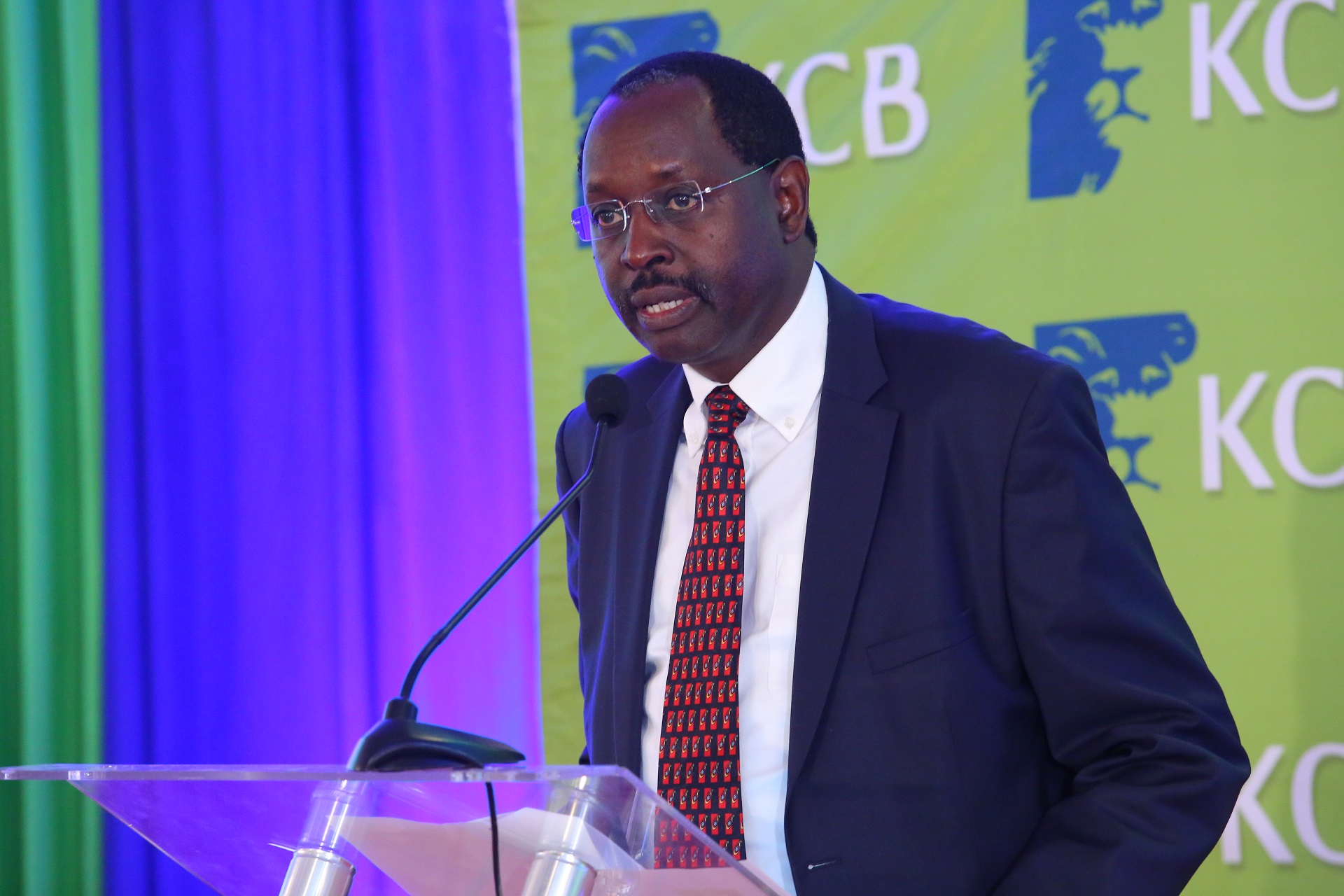
Kirubi who attended the Thursday investor briefing, feels that it was time to stop doing the same thing and expect different results by continuing to pile debts at Kenya Airways and expect it to get back to profitability.
He says that instead of watching the ship sink, a better option could be “take off KQ from the stock market and let it belong to the key investors.”
“Every year you are borrowing and borrowing and borrowing and borrowing. You can’t run a business of this size on loans. You arrange a loan of Sh20 billion, you have made a loss of Sh20billion; next year you will have made a loss of Sh40 billion.”
“I feel sorry for you Ngunze (CEO KQ) and my friend Alex (Group Finance Director) as you try to run a commercial business and walking against the tide. We need to buy out KLM for whatever value they have now, and get them out and really try to have an East African common market strategy.”
For Kirubi, we need to bring investors who this business hurts if it does not exist.
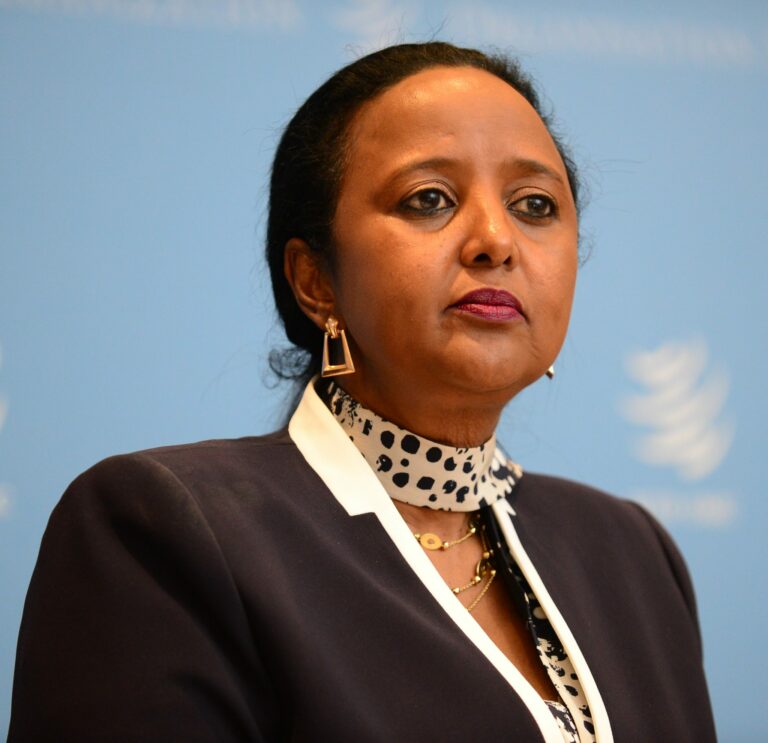
The Kenya mini-exhibition launched Monday in Geneva, Switzerland, by Cabinet Secretary Ambassador Amina Mohamed, generated wide interest and enquiries.
The mini exhibition which wound up on Wednesday targeted investors as well as officials of multilateral institutions attending the World Trade Organization (WTO) 10th Ministerial Conference Informal Session.
Speaking in Geneva, Amb. Mohamed said the mini-exhibition typified the unwavering efforts of the Kenyan government to market Kenyan goods and services around the world.
“Trade is an important aspect in our national development. Through this mini-exhibition, a wide array of Kenyan goods and services were displayed,” said Amb. Amina Mohamed.
The Cabinet Secretary said Kenya is benevolently endowed in human capital and natural resources which has enabled the country to produce a wide variety of products and services for export, especially in the agricultural and services sectors.
“Kenya has a diversified production capacity and high quality products epitomizing a touch of Kenya,” said the CS.
“We believe the development of export capacity is an imperative for rapid and sustained socio-economic development,” added the Cabinet Secretary.
Amb. Amina Mohamed however decried distortions in the multilateral trading system that continue to limit growth of trade in many products from the developing world.
The Cabinet secretary cited various impediments to trade including tariff and non-tariff barriers, sanitary and phyto-sanitary standard requirements as some of the key obstacles to Africa’s trade in the global arena.
The CS called for the elimination of trade impediments and expressed hope that the forthcoming WTO Conference in Nairobi will open a new chapter in this regard.
“We hope that the MC 10 will usher in a regime that will be more open towards exports from developing countries,” said the CS.
The Cabinet Secretary further revealed that Kenya will stage a major exhibition during the MC10 in Nairobi in December.
A report from the National Aids Control Council indicates that Nairobi and Migori counties top in the new HIV Infection cases.
The report further says over 100-thousand new cases are reported across the country annually with victims being married couples cohabiting partners, sex workers and youth of between 15- 24 years.
The Director of National Aids Control Council Dr. Nduku Kilonzo while making public the report says the disease still remains a major health burden in the nation despite governments’ accelerated efforts to contain HIV and AIDs scourge in the country.
The disease is still proving a challenge as new infections continue to be recorded in the country.
According to the report, over 100,000 new infections are reported annually in the country 51 percent of those new infections occur in Nairobi, Homabay, Kisumu, Siaya, Mombasa, Kisii, Migori and Turkana counties.
Speaking at a two day forum that brought together the 47 governors spouses, Dr. Kilonzo laments that the country is failing in controlling the menace.
According to Nduku youth especially girls between the ages of 15- 24 are at a high risk of contracting HIV and Aids with the disease still the number one cause of death in the country mostly occurring in children under the age of five.
The report claims that 1.6 million people leave with HIV and Aids and wants efforts scaled to fight the virus.
Negative travel advisories and the impact of the Ebola crisis in West Africa last year pushed TPS Serena into loss in the first six months of this year.
The hotel chain made a loss of Sh97 million in the first half of 2015 compared with a net profit of Sh41 million in a similar period last year.
Turnover declined by a marginal 1.48 percentage point to Sh2.67 billion from Sh2.71 billion in the period under review.
Management blamed negative travel advisories to Kenya in light of insecurity incidents by the Al-Shabaab terror group to the poor performance in the period under review.
“Continued negative international publicity last year on the East African region in relation to insecurity, terrorism threats, the Ebola epidemic and the poaching menace cumulatively led to a slowdown in international leisure bookings to Kenya and Tanzania as it is usually during the second half of the previous year that holiday plans/commitments for the first half of the following year are made,” the hotel chain said.
Kenya continues to witness terror threats from the Al-Shabaab. In April this year, the terror group claimed responsibility for an attack on Garissa University College in which 148 lives were lost.
The group also claimed responsibility for an attack on the Westgate shopping mall in Nairobi in September 2013 in which 67 lives were lost.
Coupled with other terror attacks at the coast and in the northeastern frontier of the country, the tourism sector has received a beating due to persistent travel advisories on the country.
The latest British travel advisory to the Kenyan coast was lifted on June 19, a development likely to lead to the revival of the tourism industry. The government also allocated Sh5 billion as part of the recovery plans for the sector this financial year.
“These will be key in turning around the tourism in destination Kenya, with an indirect positive impact expected within the East African region,” the hotel chain said.
Recently, Kenya hosted the Global Entrepreneurship Summit, which has reignited interest in the country as an investment and tourism destination.
In 2015 and 2016, Serena Hotels is expected to begin extension and refurbishment projects for the Nairobi Serena, the Kampala Serena and the Dar-es-Salaam Serena in anticipation of increased business as the region continues to witness increased business and leisure travel.
The following analysis by George Bodo was first published in the Business Daily.
You should no longer buy stocks at the NSE. Instead, you should closely watch them and consider shift to bonds. There have been three risks to buying stocks currently. One of the risks, interest rates, is about to start crystallising, hence my downgrade.
Interest rates are already pointing north. Yields in July’s primary auction edged up by one hundred basis points.
The Central Bank of Kenya, (CBK) through its open market operations, is picking term auction deposits (TADs) at 14 per cent levels, which is an increase of nearly four percentage points since July began.
Kenya Banks Reference Rate (KBRR) was adjusted upwards by a hundred basis points this month and banks are already giving upward repricing of loans notices to their variable-rate borrowing clients.
And with the exchange rate still volatile, there is a high likelihood that a majority of CBKs monetary policy committee (MPC) members could vote for a third rate increase in their August 5th meeting, as the apex bank sweats to cool the market.
Aside from exchange rate volatility, inflation is also posing significant risk to price stability, and is actively tracking the depreciative trend of the shilling.
This is because, and as I have repeatedly pointed out before, the exchange rate remains a significant pricing component of pump prices and hence basic commodities. Consequently, rates could peak at 17 per cent levels before starting to glide down.
However, I’m not putting any timeline to this. Historically, short-term interest rates have had an inverse relationship with stocks.
One simple explanation for this phenomenon is the fact that whenever short-term rates rise, a yield curve inversion occurs, thereby crowding out risky assets (stocks included).
This then results into a flight into fixed income asset classes, which is often accompanied by disorderly and sometimes violent sell-off of risky assets. At the current levels, interest rates are already hurting stock market valuations.
Month-to-date, stock market valuations are down by seven per cent while the NSE-20 Share index has declined by eight per cent peak-to-trough.
And the decline is accompanied by strong volumes, which is a further confirmation of an underlying weakness in the market.
Any more rise in rates, especially in the quantum of two to three percentage points, could further narrow betting spreads in the market. Which is why, in addition to downgrading my earlier buy call on equities to watch, I’m also calling for a portfolio shift towards bonds.
At the current valuations, bonds are looking juicy and could offer some refuge from the gliding stock market valuations. And, if the MPC votes for a third rate rise, a yield curve inversion could follow, making bonds even more attractive, from a purely coupon perspective.
When Kennedy Kachwanya and his 42 peers founded the Bloggers Association of Kenya in early 2010, the government got weary.
“At the time, no one knew what blogging was about. We were assumed to be trouble makers who were using the written word,” Kennedy Kachwanya, CEO of Bloggers Media Limited says.
Armed with Sh50,000, Kachwanya instead registered the company as Blogger Media Limited, which then parented Bloggers Association of Kenya which is a community of Kenyan bloggers.
Today, the company has gained fame online and offline due to its biggest product yet: Bloggers Awards of Kenya or simply BAKE Awards, which recognizes and awards the best blogs in the country.
“Our reason for choosing to establish Bloggers Awards of Kenya was simple. There were so many negative stories about Africa and Kenya in specific by foreigners. The only people who were writing positive stories were Kenyans.
However, no one was appreciating their work. Hence our decision to establish the award,” says Kachwanya who is also the Chairman of Bloggers Association of Kenya. An established blogger, Kachwanya knows firsthand the kind opportunities that are available in the Kenyan’s online market.
“The Internet offers limitless opportunities for Kenyans especially the youth. If you can find your niche and give them value, then there is money to be made,” he says. But before a blogger makes money, they have to pass the blogging litmus test.
According to Kachwanya, a blogger must first and foremost have compelling content. “Content is king. It is the first thing that makes people come back to your blog.”
The second thing that Kachwanya recommends is having the numbers, especially if one is hoping to monetize the blog. He recommends bloggers to ensure that their site is easy to comment on, share and even navigate.
These, he says, are able to attract readers and fans in general. Kachwanya also talks about consistency, saying that even with great quality and a large social media fan base, it is easy to be irrelevant and forgotten if one is not consistent. “By consistency, I do not necessary mean posting a new blog post every thirty minutes. If you are able to do that, well and fine, however, let your readers know when you post and make it consistent,” he says.
Of the 15,000 blogs in Kenya, at least 2,000 are active. However, not all of them are making money. To make money from blogging in Kenya, Kachwanya says that it is not only possible, but also profitable.
“A blogger can make money through subscriptions whereby people pay to receive and read blog posts. To achieve this, a blogger needs to have compelling content that is also consistent and timely,” he explains.
One way of making money online includes having a large readership base as advertisers will pay a blogger to reach this audience. Another way is selling content, whereby a blogger is paid to write content about a brand on their blog.
The company, which not only awards and trains bloggers, it is also actively working to encourage the country to not ignore the power of blogging.
“Anyone who is avoiding the power of blogging needs to stop doing so right away. There are blogs in the country that are determining how a media house will operate.
Look at Ghafla for instance; it is setting the pace on how media houses conduct their business. Every media house now has a gossip column just to leverage with the entertainment site,” he says.
When applying to the job, you may have skimmed through the duties and requirements needed, applied for the position but then closed that chapter and moved on to the next one. You are probably a victim of this and have never really thought about the impact it would have on your job interview.
Going back to the requirements helps you identify and understand the exact qualities the employer is looking for. Go through them over and over and understand, then think about the questions that would centre around them and rehearse your way to nailing the job interview.
2. Focus on learning about the company
Now, this is where every job seeker’s obsession resonates, and while that is not necessarily a bad thing, you need to have a strategy for what you want as the outcome. Identify the company areas you need to familiarize with before any interview and research on it.
You can get the information you need from the company’s website, their social media pages (Facebook, LinkedIn, Twitter, Google+) and of course the one marketplace for information – Google.
Here you can find any recent events or accomplishments, you will be able to read on any financial gains or losses or any other company dirt you may come across. However, you must be selective of the information you decide to take in.
3. Stalk your Interviewers on Social media (LinkedIn)
Some organizations will give you the names of people going to interview you. They may say, ‘when you get to the office ask to speak to so and so (name given)”. Use this to your advantage by searching them on Social media.
LinkedIn or Twitter would be appropriate. This will give you an opportunity to identify with them before you actually meet them. Know what they look like and their standing points on trending issues.
Like researching the company on Google, plan what you will be looking for and leave out unnecessary information. The purpose of checking out an interviewer’s LinkedIn page is to gauge the questions they are likely to ask and improve your confidence.
4. Visit a recruitment company’s Advice page
Why? Most firms will have information on what you are likely to come across during the interview, mistakes that you should avoid or even success and failure stories from job candidates as well as other career advice. Use all this information as a point of reference in your preparation.
4 best ways you can effectively research for a job interview
KCB has posted a Sh. 13.2 billion profit before tax and a Sh. 9.2 billion net profit for the 2015 half year. This was an increase of 13 per cent from the Sh. 11.7 billion the bank recorded the previous year.
Further, KCB announced that it would not be pulling out of South Sudan. The bank’s customer deposits went upwards by 26 per cent from Sh. 352 billion to Sh. 443 billion while total assets grew by 29 per cent from Sh. 440 billion to Sh. 567 billion.
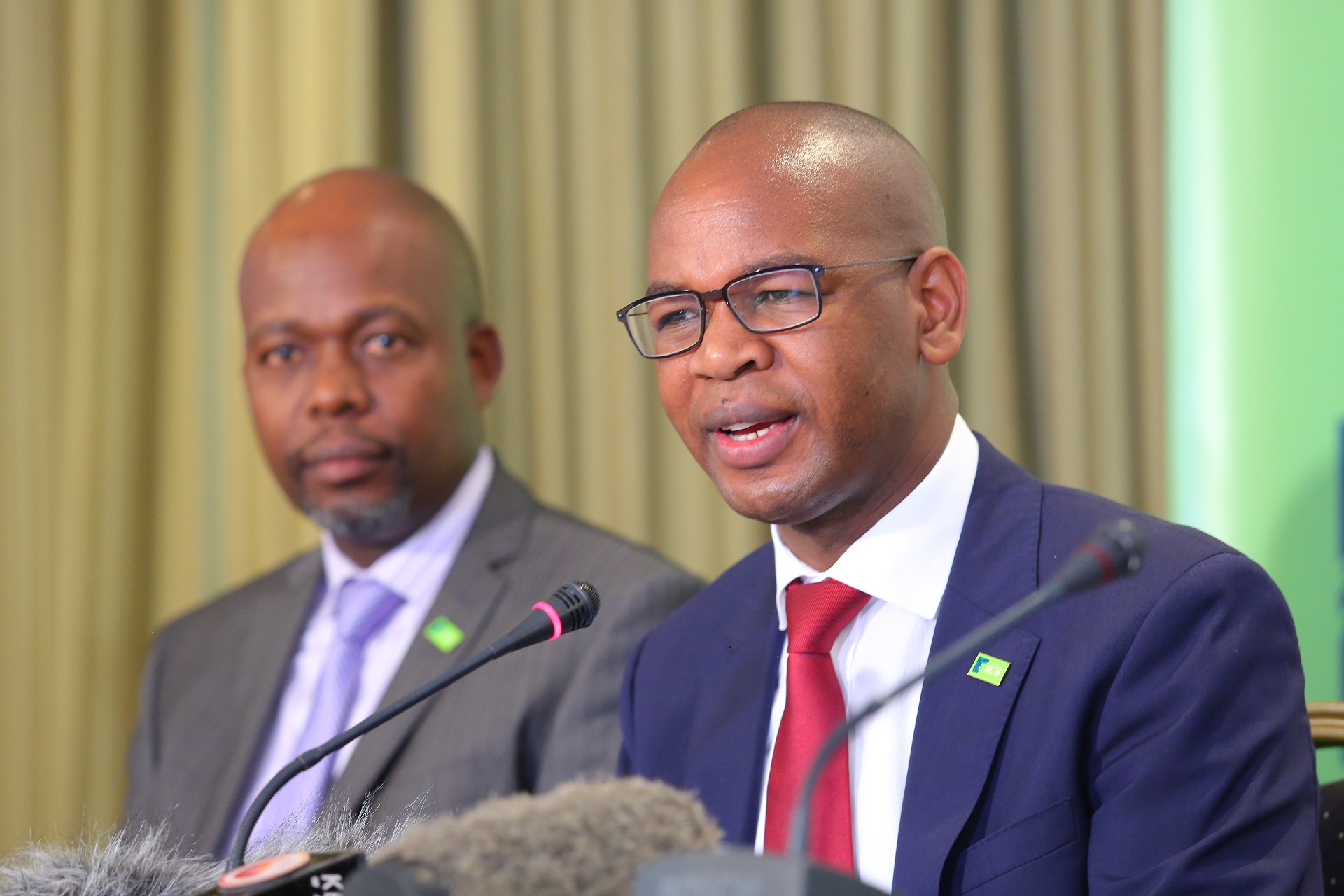
KCB Group CFO Lawrence Kiambi (l) and Group CEO Joshua Oigara (r)
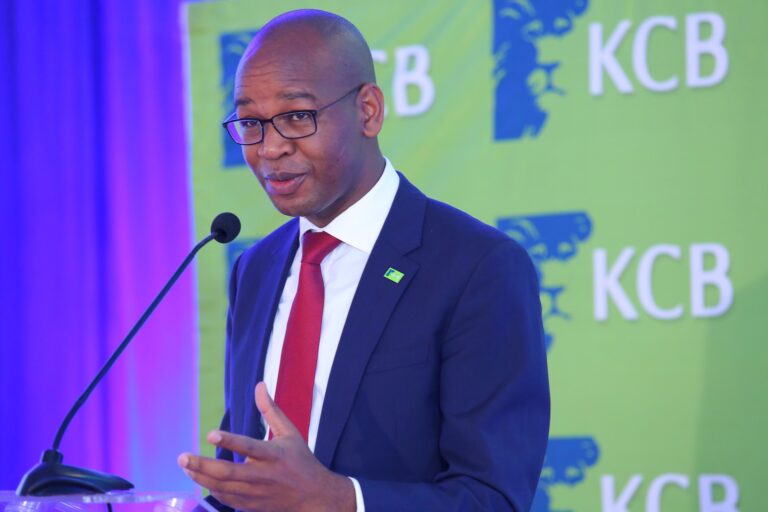
According to KCB’s CEO Joshua Oigara, KCB will be focusing more on digital channels in its growth strategies. The CEO added that KCB would lending to small and medium enterprise to Sh. 40 billion within the next three years. “We have consistently focused on growing new business lines and strengthening the subsidiaries to drive the business to higher profitability and guarantee its sustainability. This is bearing fruit as seen in the increased earnings,” added Mr. Oigara.
KCB Group CEO Joshua Oigara addresses the audience at the KCB 2015 Half Year Results Briefing at the Hilton Hotel, Nairobi
Within the period, KCB improved its Non-Performing Loans to 6 per cent while its customers grew by 30 per cent. In the same vein, KCB’s joint partnership mobile money platform with Safaricom, KCB Mpesa has 2.1 million subscribers who have borrowed Sh. 2 billion in the past four months of the channel’s existence.
L – R KCB Group CFO Lawrence Kiambi, Group KCB Group CEO Joshua Oigara, KCB Group Chairman Ngeny Biwott and KCB CBO-MD Kenya Sam MakomeKCB Group Chairman Ngeny Biwott addresses the audience at the KCB 2015 Half Year Results Briefing at the Hilton Hotel, Nairobi
Kenya Airways has set the lowest record in the history of Corporate Kenya after recording a net LOSS of Ksh 25.7 Billion for year 2014. Enough money to build an overpass “Dual carriage” from JKIA to Waiyaki way or another Thika road Super Highway!! This is the highest ever loss in corporate Kenya since independence. This is happening when other Global airlines like Ryanair recorded 66 % profit increase in the same period!! I’m a bit hesitant to casting aspersions to the current CEO since everything was pointing red when he took over. In a nut shell, the former CEO of is the author and finisher of KQ’s loss of fortunes.
As it is, KQ and Mumias sugar, whose Boards are heavily controlled by government are doing more harm than good to us as Kenyans and much more to investors. The solution to this kind of nonsense is to fully privatize these companies. The Government should only hold minority stakes in companies and have ZERO voting power.. What is the business with a government owning companies in sectors where private sector has consistently done better? In efficient economies, governments are never in the business of business – They should act as enablers.
The best examples locally are KCB, Safaricom etc where the government has stakes but doesn’t meddle. These companies have been able to unlock all the potential optimally. In Private sector, a CEO earning Ksh 1.2 Million a Month can be sacked for a simple “corrupt” act of like forging a Ksh 4,000 lunch receipts. In GoK controlled companies, “eating” the entire company is still not considered worthy of sacking a “dedicated” officer from “our tribe”. This is the fact, we need Board and governance reforms in KQ, Kenya Power, Kengen, Kenya RE and all other government controlled companies.
The government should actually be forced to dilute their stakes or sell them. It makes more sense to all stake holders. I can’t imagine what Safaricom or KCB would be if they were not independent. I’m not against the government but business souls be left to Private sector. I’m sad, almost depressed by the bad news from KQ. The so called Pride of Africa has turned into National Shame.. It is unacceptable at best.
Kenya Airways has reported a record Sh25.7 billion loss after tax attributable to competition from Middle East carriers and high operating costs.
The airline also blamed travel advisories that led to a slump in the tourism industry, as well as runway closures for renovation, for eating into the company’s 2014/2015 full-year earnings.
The airline has received a beating from the slowdown in tourism industry that has seen it extend its pre-tax losses from the Sh4.8 billion loss it made in the previous year. “There has been a reduction in tourism numbers. We are a significant carrier of tourists into the country,” KQ Managing Director Mbuve Ngunze said at an investor briefing in Nairobi.
The flag carrier has secured a Sh20 billion loan to avoid sinking into complete bankruptcy.
Shareholders and analysts raised concern over the airline’s ability to survive any longer after it posted a negative equity of Sh6 billion, which means the company is insolvent or technically bankrupt. The only thing that has saved it from closing down is a Sh20 billlion loan secured by Afriexim bank. KQ, which has been in an aggressive aircraft purchase program that has seen its fleet rise from 43 to 52 including two freighters, says it plans to sell some aircrafts to raise additional capital.