Home Blog Page 2236

Equity Bank has been picked as GES sponsoring bank

Equity Bank will be the official GES banker this weekend at the Global Entrepreneurship Summit (GES).

The bank will offer delegates end-to-end banking solutions at all GES locations. Equity Group Holdings Managing Director James Mwangi added that a number of executives from the firm would speak at the summit on Equity’s development models.

On the heels of Monday’s launch of the Equitel Thin Sim, the firm will showcase entrepreneurship opportunities in the convergence of banking and telecommunication sectors.

Mwangi will be one of the speakers at GES, with his presentation slotted for the official opening session tomorrow that will be attended by US President Barack Obama.

He will also participate as a panelist on Sunday, speaking on local investment opportunities in agroprocessing.

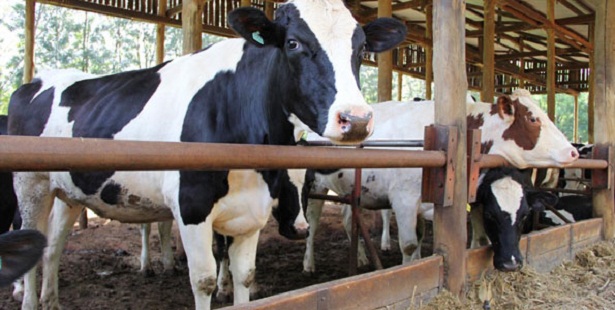
Conditions that prevent your cow from getting a calf

Heifers of pure exotic breeds should give birth by 24 months from the day they were born. This means they should have been pregnant by 15 months of age. Older cows should get pregnant by 85 days after the previous calving if the cows are to give you a calf every year and maximise on milk yield.

To achieve this, the farmer has to invest in confirming that each of her heifers and cows will attain these targets by first ensuring the animals are fed with the recommended balanced diets and secondly ensure the animals are free of conditions that can interfere with heat signs (cycling) and conception. The 24 months and 85 days are important because research has shown that a cow will be able to give its maximum milk potential and calves if these standards are maintained. Therefore, confirm your heifer is cycling properly before 15 months of age and start it on Artificial Insemination (AI) at about 14 months.

For the older cows, start cycling as early as 24 days after last calving so confirm they are cycling before day 50 after calving by which time about 95 per cent of the animals will have started cycling and you can start the cows on AI. If no signs are seen for both heifers and cows despite all efforts, you need to invite a vet to check the status of the ovaries as soon as possible. The vet may find the cow’s ovary is showing signs of egg growth but the farmer has not been able to observe the heat signs or that there are no eggs growing. The vet will advice on which day AI should be given in the former case. The solution for the latter is to inject the correct hormone to kick start the growth of an egg in which case the animal can then be given AI.

On the other hand, the vet may find the egg may be present and mature but the ovary is unable to release it in which case the vet will give it the correct hormone to cause the release of the egg followed by AI.

Other conditions that may cause the farmer to miss getting a cow pregnant is a reproductive track that is infected. This infection may be from problems associated with the previous calving such as difficult calving and/ or retained after birth (placenta). Forcefully pulling obstructed calves will result in reproductive track injuries resulting in infections that will cost you a lot of money to treat and the loss of milk production during recovery. It is much cheaper to call a professional to deal with it promptly.

The reproductive tract can also get infected from previous encounters with diseased bulls. This is a common problem in Kenyan herds when farmers take their cows to communal or neighbours or own bulls of unknown disease status for natural service whereupon they become infected with venereal diseases that infect the reproductive system of the cow resulting in no conception.

When to call a vet The farmers then try the AI which fails. Some venereal diseases can take months to get resolved and for the animal to regain its fertility. So farmers be warned: stick to AI alone! And if you must use a bull (even an own bull ) it should be known to be free of diseases that affect reproduction. Animals that are not well fed or have hormonal imbalances will have a problem with releasing the afterbirth (placenta).
It should drop off by five hours after calving and if not a vet should examine it as soon as possible to determine the best action in each specific case to avoid the infection of the reproductive tract which will occur within the second day. Serious infections can be seen as pus drooping from the back of the animal, again it is much cheaper to call a vet to deal with it within 24 hours after calving.

High fever from diseases like East Coast Fever, anaplasmosis and heavy infestations with worms like flukes, lack of protein, energy and mineral salts can cause growing embryos to die. The solution to many of these is to take prompt proactive actions that will prevent them from occurring such as spraying, deworming and feeding your animals effectively. Have your heifers also examined for breeding fitness to identify congenital abnormalities like kinked cervixes.


Female entrepreneurs to watch: Jackie Malomba, Owner of Parlisa Fitness Club, SME business liaison manager

0

Jackie Malomba is the owner of Parlisa Fitness Club. She is also an SME business liaison manager at a regional bank. For that young person who just started working and is flirting with thoughts of quitting to start a business, Jackie’s advice is to slow down.

Entrepreneurship is fulfilling, she says. But there are aspects of it that you can only learn from the workplace. There are things about it that you can’t learn from workshops. And she should know because she is both an employee and a successful entrepreneur.

By day, Jackie is a small and medium enterprise (SME) business liaison manager at a regional bank. She also owns Parlisa Group of Companies which include a gym and a laundry business.

“My business has been successful largely because I was able to put up working systems and processes that I learnt from employment,” she says.

Entrepreneurship was a longtime passion for her. She however only acted on it after two decades of working in a bank during which she had risen to top management. She felt that she had reached the glass ceiling and left her job with the intention to go back to school and to start a business.

“I had the option of using the benefits to pay off my mortgage but I instead took the risk of investing it in a business with the hope that it would pay off,” she says.

It has been four years running her business. She has made mistakes, lost money to unscrupulous employees but she has also learnt from those mistakes.

She is also a member of the Kenya Association of Women Business Owners (KOWBA). The mentorship she has gotten from here, she says, is invaluable. Her clientele has grown and from her own lessons, she offers consultancy services to people seeking to put up fitness centres.

“I made the mistake of starting off with cheaper alternatives and when these machines started breaking down, I knew I had made a costly mistake. I help my clients source for machines, recruit their staff and make the process less painful than it was for me.”

When she graduated earlier this year, she went back to work. She was lucky to find an employer whose passion for empowering women is in line with hers. Her job and her business feed off each other. Her clients are mainly female entrepreneurs. She either teaches one or learns from them. She reckons that there are many working women with excellent entrepreneurial skills who are not bold enough to start.

“You can successfully do both. Do a job you love and grow leaders in the form of people you assign the day-to-day running of the business to.”

Female entrepreneurs to watch: Akinyi Odongo, CEO of Mefa Arts Centre

0

Evelyne Akinyi Odongo is the CEO of Mefa Arts Centre and the owner of Akinyi Odongo Kenya, a high fashion brand. She also dresses First Lady Margaret Kenyatta.

Evelyne Odongo is a wife, a mother and entrepreneur. In a crowded fashion industry, she has managed to carve out a niche for herself. In fact, she is set to showcase her latest achievement, an international fashion brand at the Global Entrepreneurship Summit 2015 this weekend. What did she do different? What sets her apart?

“I focused on my designs and refused to get derailed by sideshows like seeking fame which can easily distract one in this industry,” she shares.

She comes off as polished and glamorous but her journey which started in Rang’ala, a small village in Nyanza hasn’t been a smooth one.

She registered her business Mefa Creations 10 years ago and has watched it grow slowly. Every time she steps out of her house, she makes sure that she is wearing her designs. She reckons that she needs to believe in her brand before other people can and this has worked for her. She gets direct feedback and through word of mouth, has watched her business grow and added big names to her client list. Last year, she had an opportunity to design for the First Lady Margaret Kenyatta who also in support of the textile industry graced a runway at Origin Africa by gracefully giving the first catwalk.

“It isn’t an easy industry, there isn’t structure, and financial institutions do not take one seriously. Sometimes it can be such a lonely place to be.”

For her, the success can partly be attributed to the fact that she has always been looking for challenges. Five years into her business, she expanded it to include a training centre where she coaches aspiring designers on everything from how to go about registration to where to source for fabric. She is aggressive. She doesn’t wait for things to happen to her.

Two years ago, she took the initiative to go into government offices to get information on what opportunities for growth were available for her out there. She learnt that there was demand out there for the products that were produced here. She has worked with the Export Promotion Council, African Women Entrepreneurs Program, and Africa Cotton and Textile Industries Federation, to get her products out there. She stayed involved and this year, she is going international with a high-end fashion brand.

“We are at a good place. There is opportunity here. I believe that at this moment it is a great thing to be an African woman, especially in Kenya.”

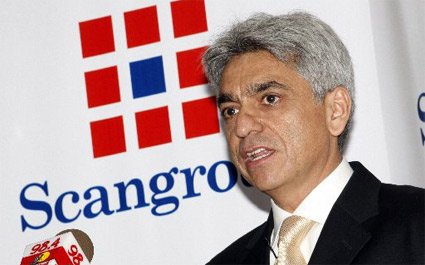
WPP Scangroup records flat half year growth

Marketing and Communication group WPP’s subsidiary WPP Scangroup 2015 half year earning were almost unchanged rising a paltry 1.4 per cent.

The Sh14.7 billion company as valued by the stock market reported a net profit of Sh185 million in the first half of the year, a 1.4 per cent growth from to Sh182 million in a similar period in 2014, aided by higher interest income.

The counter Friday experienced selling pressure closing at Sh38 a share from Sh39 on Thursday.

“The business delivered revenue growth of 6.5 per cent but due to continuing pressures on currencies in the countries in which we operate, our overall growth rate was reduced to 2.3 per cent,” the company said in a statement Friday.

Interest income grew by 73 per cent to Sh194 million from Sh112 million arising from “our strong improvement in working capital during 2014. The improvement has continued into first half of 2015.”

TURNOVER

Turnover rose by 2.3 per cent to Sh2.3 billion from Sh2.26 billion in the period under review.

“This growth is expected to continue during the second half of the year in line with prior years,” the firm said.

Expenses grew by 7.6 per cent due to expansion into new geographies. New operations are in Nigeria, Uganda and Zambia which were opened between end of 2014 and early this year.

From Sh4,500 salary to a thriving cooking gas shop

0

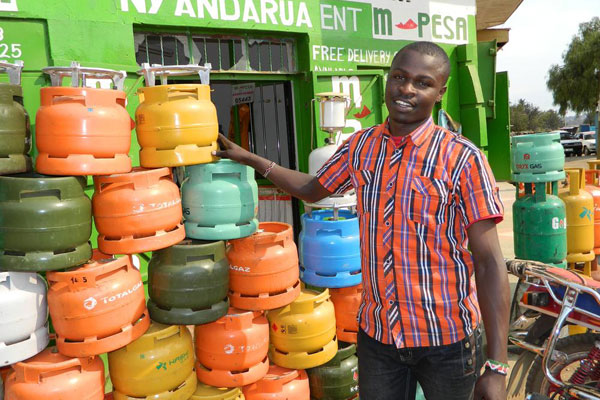
Although Paul Gitachu runs what many would consider a small shop, he is en route to recording Sh1 million annual turnover.

Uttah — as Mr Gitachu is popularly known — has a cooking gas and M-Pesa shop in Ol Kalou town, Nyandarua County. His determination to succeed is illuminated by the tenacity that has characterised his life.

“I hate poverty,” says Uttah, 25. You see, seven years ago, he had lost hope. “I attended a village day secondary school. To raise fees, my father pruned flowers at the school,” he says. “Watching him labour was a constant reminder that we were poor.”

After sitting for his KCSE exam in 2007, which he scored a C, Uttah started working as a labourer at construction sites earning Sh150 per day.

“I couldn’t go to college so I started working to help raise my younger sister’s school fees.”  In 2008 though, he got a relief when he was hired as a salesman at a cooking gas store in Ol Kalou. “The Sh4,500 per month salary was a better.”

QUIT MUSIC

From his first pay, Uttah rented a one-bedroom wooden house. And in the following six months, he saved Sh10,000 and recorded three songs at a cost of Sh3,000 per track.

“I was good in music at school and I dreamt of recording my own.”

He then saved another Sh10,000 and recorded three new songs with his friend, James. However, the quality of his music was poor. It did not get airplay.

“I was consoled by a week’s invitation to perform at a gospel music show in Arusha, in 2009.”

In January 2010, Uttah decided to drop music and concentrate on his sales job. But in 2011, he jumped into youth politics contesting for the Ol Kalou town sub-location delegate’s post in the National Youth Council.

“I won with a landslide. My dream to escape from poverty was finally dawning.”

As fate would have it, however, the National Youth Council collapsed a week later. And as he dusted himself, he reverted to his old job, selling gas, this time for good. “I began to think that perhaps my success lay in business.”

Throughout 2011, Uttah saved Sh30,000 that he used to buy 15 lambs. In early 2012, he sold all the sheep making Sh105,000 and enrolled for a distant learning business administration diploma at St Theresa Commercial College, in Nyeri.

“I thought that a business course would nurture my entrepreneurial skills.” The studies came at a cost; Uttah agreed to earn half his Sh4,500 pay for the months he was away doing exams. By the time he completed, he had accumulated a total of Sh50,000 debt from friends, employer and the college.

Nevertheless, he was now set to make his mark in business. From his little pay, he began buying empty 6kg gas cylinders at Sh2,000 and reselling them at Sh3,000.

From April to August 2013, he saved his profit and half his salary. “To motivate me, my auntie promised to sell me a quarter acre at Kiganjo village if I would save Sh300,000 successfully.”

FIRST MILLION

By December, Uttah had Sh100,000 savings. He then took Sh200,000 bank loan to buy the plot only for his aunt to renege on the deal.  Not one to give up, Uttah began buying empty 6kg and 13kg gas cylinders in bulk. “I rented a two-bedroom house and turned one of the rooms into a store.”

Soon, he started refilling cylinders while selling others empty. From 6am to 8am, Uttah would sell his gas and between 8am and 7pm, he would be at his workplace. Between 7pm and 10pm, however, he would continue selling his gas in the estates.

“I built a customer base and ensured each of them took down my contacts.”

In June, last year, he relocated his store to a safer building before giving his employer a three-month quit notice. “By then, I had completed repaying my loan and the bank was willing to loan me Sh200,000. I was ready for business.

He opened his store on October 15, 2014, with 100 gas cylinders. Today, Uttah has more than quadrupled his stock and opened an M-Pesa arm.

“I hope that by the end of this year, I will record a Sh1 million turnover. The business is currently self-servicing.”

“Vigorous marketing and friendly customer relationship has been my secret. I give my customers a reason to return and see my business as a young, growing brand,” he says.  Currently, his biggest challenge is finding a safe mode of ferrying gas cylinders from the depot to his shop. “I cannot fail to adhere to the set safety regulations.” Asked about his music career, “I still dream of pursuing music as a hobby,” he notes.


Obama leaves US for Kenya

0

President Barack Obama left Washington for Kenya on Thursday in a trip that will also include a stop in the Ethiopian capital and a visit to the home of the African Union.

US President Barack Obama boards Air Force One prior to departing from Andrews Air Force Base in Maryland on July 23, 2015 for Kenya.

The landmark trip to Mr Obama’s ancestral homeland of Kenya, where his father was born, is his first as president and is also the first time a sitting US president will visit Ethiopia and the AU’s headquarters in Addis Ababa.

The first African-American president of the United States is expected to address regional security issues and trade, and also touch on matters relating to democracy, poverty and human rights in the region.

Joining him on the trip is National Security Advisor Susan Rice, foreign policy aide Ben Rhodes and White House spokesman Josh Earnest.

Before heading off on the trip — Mr Obama’s fourth time to Africa since taking office — he spoke about the promise, and difficulties, on the continent.

“Despite its many challenges — and we have to be clear-eyed about all the challenges that the continent still faces — Africa is a place of incredible dynamism, some of the fastest-growing markets in the world, extraordinary people, extraordinary resilience,” Mr Obama said ahead of the trip.

He said Africa “has the potential to be the next centre of global economic growth,” speaking at an event for the African Growth Opportunity Act, US trade legislation which aims to help bolster Africa’s prosperity.

Mr Obama has travelled to Africa more than any other sitting US president, and talked about the “deep” ties between Africa and the United States before setting off on the trip.

“There have been times where there have been misunderstandings, and there have been times where there have been suspicions. But when you look at every survey, it turns out that the people of Africa love the United States and what it stands for,” he said.

ELECTION

Mr Obama has not yet been to Kenya during his White House tenure, with a previous trip delayed by Kenyan President Uhuru Kenyatta’s indictment for war crimes by the International Criminal Court.

Those charges were suspended last year — in part, prosecutors say, because the Kenyan government thwarted the investigation.

His trip has also come under fire by rights groups, and more than 50 African and global human rights organisations have called on him to publicly meet democracy activists on the trip.

They voiced concerns about “grave and worsening” rights challenges in both Kenya and Ethiopia.

The charges against Kenyatta, and the fact Ethiopia’s government won 100 per cent of parliamentary seats in a recent disputed election, has raised questions about whether Mr Obama should have made the trip at all.

In Kenya, Mr Obama will attend a Global Entrepreneurship Summit, aimed at promoting businesses that promise to lift many more Africans out of poverty and help insulate societies against radicalisation.

How to make more money in a bear market

The economy looks ugly, and the stock market seems poised to fall off a cliff. My suggestion: Cheer up. For most of you, a bear market is a blessing, not a bane.

I’m not kidding. If you’re retired and you live off of your investments, a bear market is really bad news. That’s why retirees should have enough in bonds and cash to support themselves through stock-market downturns.

But most of us don’t need to dip into our investments to pay the bills for years to come. And if you fit into that category — someone who is still accumulating money for retirement, to pay for your kid’s college education or for any other goal — a bear market can work wonders for your wealth.

Here’s why: When the stock market craters, the money you invest buys more shares of stock. So you’re actually building up more equity during a bear market than when the market is soaring.

Take the 2000-2002 US bear market. As measured by the broad-based Dow Jones Wilshire 5000 stock index, the market plunged a harrowing 44%. It was a nightmare for retirees. But for those of us still working, it was an opportunity to buy more stocks at cheaper prices. The more you bought while stocks were plunging the better you ultimately did.

The best way to invest during bear markets is to put in a little bit every month. It’s also the most emotionally easy way to invest anytime: You invest a fixed amount, say $1,000 from your paycheck, in the stock market every month regardless of how bleak the headlines are. The technique is known as dollar-cost averaging.

Now suppose you started your investment program on March 1, 2000, just weeks before the start of the bear market, and continued every month for 32 months until October 1, 2002, the month the bear market finally ended. By October 31, 2002, the $32,000 you invested would have shrunk to $24,451, according to Morningstar, a decline of 24%.

By contrast, if you had plowed the entire $32,000 into the stock market back on March 1, 2000, you would have been left with only $20,468 by October 31, 2002, losing 36%. (Note that the loss still isn’t as big as the 44% decline peak-to-trough because the market hit its precise top and bottom in the middle of those months.)

Stocks rebounded sharply from their lows. For the entire 92-month stretch from March 1, 2000, through October 31, 2007, the Wilshire 5000 returned more than 30% on a cumulative basis (or 3.5% annualized), Morningstar reports. If you had plunked $92,000 into the Wilshire 5000 on March 1, 2000, it would have grown to $120,000.

Supposed you had invested $1,000 a month over the entire 92-month span? Your regular investments would have increased in value to a total of $136,020 — a gain of 48% (6.5% annualized).

Investing a little every month doesn’t work all the time, of course. If the market is in a long-term uptrend, it’s best to have every dime invested as long as possible. But in bear markets — and in volatile markets — regular monthly investing works like magic.

What to expect in a bear. Living through a bear market is not fun. Since 1926, the average bear market — typically defined as a drop of 20% or more — has lasted 1.3 years. As measured by Standard & Poor’s 500-stock index, stocks have plummeted an average of 33.5% during those bear markets, according to Jim Stack, president of InvesTech Research, in Whitefish, Mont. And that excludes the 86% decline from 1929 to 1932 that ushered in the Great Depression.

If you have the bad luck to invest precisely on the day of the market’s peak, how long does it take to get even? On average, excluding 1929, it has taken 3.3 years after a bull market’s peak to get your money back, Stack reports.

None of these returns includes dividends. Given that dividends account for a big part of stock market gains — more in the past than currently — the bear markets would be shorter and less painful were dividends included.

Since the 1930s, all but two bear markets have been significantly milder than the average — with losses generally averaging between 20% and 30% or so and breakeven points of only two years or so.

The exceptions: 1973-74, when the S&P 500 fell 47% and took more than seven years to recover, and 2000-2002, when the S&P fell almost precisely the same amount and again took more than seven years to recover.

My sense is that these horrific bear markets, including the Great Depression, are once-in-a-generation events, and we’ve had ours for this generation. The exceptionally ugly bear markets start when markets are wildly overpriced — not, as is the case now, when stocks are trading at reasonable prices in relation to corporate sales, earnings and assets.

But you should always be prepared for a bear market. And if you’re planning on spending your money in the next year or two, none of it should be in stocks. But longer-term investors should relax and enjoy bear markets — as much you can. They really are good for you bottom line.

Shelby Cullom Davis, a renowned investor (and grandfather of Chris Davis, co-manager of the excellent Selected American Shares fund), put it best: “You make most of your money in a bear market. You just don’t realize it at the time.”

Jacqueline Mwaura: for career women rising to the top is not a walk on the beach

Jacqueline Mwaura is the area director of revenue management at InterContinental Hotels Group.

In the past four years that I have been working with InterContinental Hotels Group, I have climbed three positions from a revenue manager, director of revenue and recently area director of revenue. Currently, I manage three of the InterContinental hotels in Kenya, Nigeria and Zambia.

Climbing the corporate ladder has not been a stroll on the beach — it has taken daily doses of hard, planned work. I began my career as a front desk clerk in Newport Besach California where I worked myself through the sales department as an assistant before becoming sales manager, at the tender age of 21, at the Miami Florida cluster hotels.

The director of revenue there sparked the fire of revenue management in me and ignited my journey to the top. I have not looked back and have always viewed each day as an opportunity to make a step forward. To achieve my goals, I begin my day any minute between 6am and 6.15am when I wake up.

By 7.30am, I am usually at my office, in Nairobi’s central business district. I sift through my inbox and attend to any pending urgent emails before reviewing the company’s performance the previous day.

Usually, this involves looking at bed occupancy , and revenues we collected in all our revenue generating centres. At 8.30am, I often attend the 30-minute morning operations meeting, with all our department heads.

It is only after this meeting that I grab my coffee and breakfast while reading the daily papers to keep me abreast with the market and business. By 9.30am, I am usually fully buried in work. Apart from analysing the best way to get higher revenues, I also work on strategic forecasts for the next three to twelve months for the three branches, while formulating plans to bring in profits. In the same vein, I always make sure I check what my competitors are offering and what people in both business, social and political spheres are saying in that regard.

This enables me to know what gear to engage in keeping my profile on top. On a normal day, I have my lunch at 12.30pm, after which I delve back into work.

In my career walk, I have learned that no career woman can ever reach her peak alone. She’ll need to collaborate with her colleagues, and be able to pick and choose friends and acquaintances who add value and help her grow, while boldly dropping the rest. This is what I have had to do in addition to drawing a strategic career plan.

However, I have faced challenges. Currently, my biggest challenge is terrorism, given that my field of work is closely related to tourism and hospitality. It is likely to become difficult to meet the group’s financial obligations especially given that terrorism is completely out of my control.

As a young woman, I have faced hardships trying to sell my ideas to people who have been in the industry for a while and who often think they know best. But in spite of all, I have learned to evaluate my challenges and deal with them without casting anyone as a hindrance to our growth.

On any working day, I try to leave the office at 5pm. This allows me to spare an hour in my day for a workout. Interestingly, running, walking or exercising with a cross trainer is my way of unwinding, though an occasional glass of wine with close associates also does the trick. And when time allows, you will find me shopping.

Peter Maina: rabbit urine is not mythical, it’s a cash mill

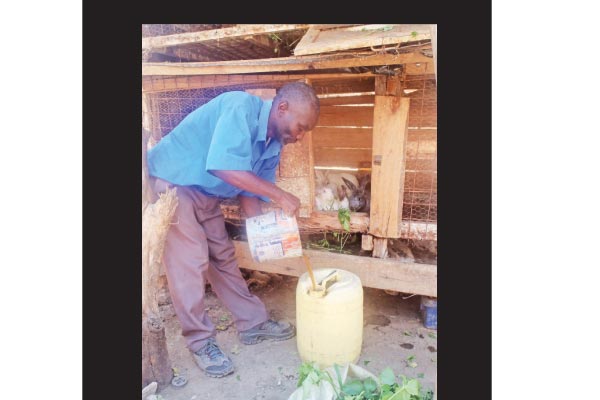
Peter Maina pours a brown liquid into a 20 litre container slowly to avoid spilling it.

It takes him about five minutes to fill the container with the liquid that looks like dirty water.

“Now I have 200 litres, I have five more 20 litre containers to fill,” says Maina with a sigh of relief.

Maina is a rabbit farmer in Kariobangi, Nairobi. However, he does not keep the rabbits for sale but he harvests their urine.

He went into rabbit farming so that he can sell them as they fetch good money.

But mid into the venture, he discovered that he can make more money from selling rabbit urine, which is used to make organic fertiliser.

The farmer owns over 60 rabbits comprising of California White and New Zealand breeds.

“Managing the rabbits is not labour intensive due to their calm nature and they rarely fall sick. I intend to have 100 rabbits so that I can boost my production. I will also sell the rabbits,” says the father of five, who invested Sh10,000 into the business, in January.

He has constructed the rabbit pen such that urine sips through the wire mesh, into the corrugated plastic sheet, to the gutters and finally into buckets.

Rabbit urine is highly corrosive, thus one must use materials that do not rust when constructing the pens.

In a month, he collects up to 300 litres of urine, which he carries on his pick-up truck to a depot on Ladhies Road for transportation to Eldoret, where the factory that processes the urine is located.

“I have delivered about 2,000 litres of urine to the processing plant and I am now waiting for my pay cheque,” says Maina, who bought the animals from Kinangop, Kiria-ini and Nanyuki.

The urine the farmer produces is used in the making of Rabbits Urine Extra, an organic liquid manure, which was unveiled recently.

The manure is manufactured from urine produced by farmers in Bomet, Eldoret, Nairobi and Kisii counties.

“Plans are underway to open two such factories at Dagoretti and Ruai in Nairobi in the course of this year,” says Robinson Runyenje, the developer of the fertiliser.

The fertiliser is produced by Kenya Com Rabbit Consortium Limited.

Runyenje, the chief executive at the consortium, says he conducted research and realised the organic fertiliser in the market was not made from rabbit urine.

“The fertiliser is rich in various elements including macro and micro nutrients that can be used as foliar feed and soil conditioner,” he says.

According to him, rabbit urine can end farmers’ reliance on NPK and CAN fertilisers whose prolonged use leave the soil unhealthy.

“As it is, our soils are facing an acidity crisis. Farmers are using a lot of money to reclaim their soils and make them useful,” says Runyenje.

To supply the company with rabbit urine, farmers have to register to be members.

“They are paid Sh100 per litre of urine supplied, alongside a bonus that will be given quarterly,” he says.

The idea is getting the farmer to sell directly without going through middlemen, thus enabling the farmer to earn more.

“Value addition is key to reaping better returns since it allows farmers to be in control of the price the product retails at,” says Runyenje.

He notes that by selling their urine, rabbit farmers reap twice.

“In a few weeks, the fertiliser will be available in agrovet shops and supermarkets in packages of 500ml, one, five and 20 litres,” says Runyenje, who got clearance from the government to sell the product.

To use the fertiliser, one mixes it with water in the ratio of 200ml of manure to 20 litres of water. This can spray an acre of land. The mixture is put in a pump and sprayed on the crops.

The spray should be done early in the morning and late in the evening as this is when the stomata are open. The leaves take in the manure directly while the rest is absorbed by the soil.

“Since it is a foliar feed, the spraying should be done at different stages of growth. For instance, in fruits, it should be done at sprouting, colouring and flowering stages,” says Runyenje.

With time, there will be no need to use fertiliser as the soil will be rich in essential nutrients absorbed from the rabbit urine.

It is advisable that the mixture is used the same day it is made since it has some potent elements that could be harmful. The beauty of it is that rabbit urine has no expiry date as long as it is kept covered after harvesting to preserve ammonia. Runyenje opted for rabbit urine rather than goat or cow due to the ease of harvesting.